You wake up negotiating with your back.
Before your feet hit the floor, you are testing the stiffness. You think about the drive to work, the chair at your desk, the laundry basket, the groceries, the dog pulling on the leash, the grandkids asking you to get down on the floor. None of these are dramatic tasks. That is what makes chronic back pain frustrating. It turns ordinary life into a string of small decisions and quiet avoidances.
For many people, the hardest part is not only the pain. It is the uncertainty. You rest and feel stiff. You push through and flare up. One person says stretch more. Another says stop bending. A scan may show age-related changes that sound alarming but do not explain why you hurt today.
You are not imagining it, and you are not stuck with guesswork as your only option. Chronic low back pain affected 619 million people in 2020, and in the United States nearly 39% of adults reported back pain in 2019 according to the World Health Organization. It is common. It is disruptive. It is also treatable.
The goal is not to chase a perfect back. The goal is to help you move with less fear, build capacity, and return to the parts of life that matter to you. That is how to relieve chronic back pain in a way that lasts.
The Reality of Living with Chronic Back Pain
Chronic back pain changes behavior before it changes a calendar.
A parent stops lifting a child into the car seat and starts asking for help. A runner keeps the shoes by the door but stops using them. Someone who used to work in the yard all weekend now breaks after ten minutes and worries all afternoon about paying for it later. Over time, pain narrows life.
That narrowing is not weakness. It is a normal response to repeated pain. If bending has hurt for months, your body and brain both start to treat bending like a threat. You brace before you move. You move less. Then strength, confidence, and tolerance drop. The cycle feeds itself.
What patients usually tell us
Individuals with persistent back pain do not say, “My spine feels unstable.” They say:
- I cannot sit very long anymore.
- I am fine until I do one wrong thing.
- I used to be active, but now I am afraid to make it worse.
- I have tried stretches, rest, and random videos, but nothing sticks.
Those details matter. Chronic pain is not solved by one trick, one stretch, or one passive treatment alone. It improves when the treatment matches the driver of your pain and when the plan is sustainable to keep going after the flare settles.
A better target than temporary relief
Short-term relief matters. When pain spikes, you want something that calms it down. But relief alone is not the finish line.
Long-term recovery means you can sit through dinner, lift what you need to lift, sleep better, travel, exercise, and trust your body again. That requires more than symptom control. It requires understanding why your back hurts, then building a plan that fits your body, your habits, and your life.
The most useful question is not “How do I stop this forever by tonight?” It is “What is driving my pain, and what can I do consistently that makes me stronger and less reactive over time?”
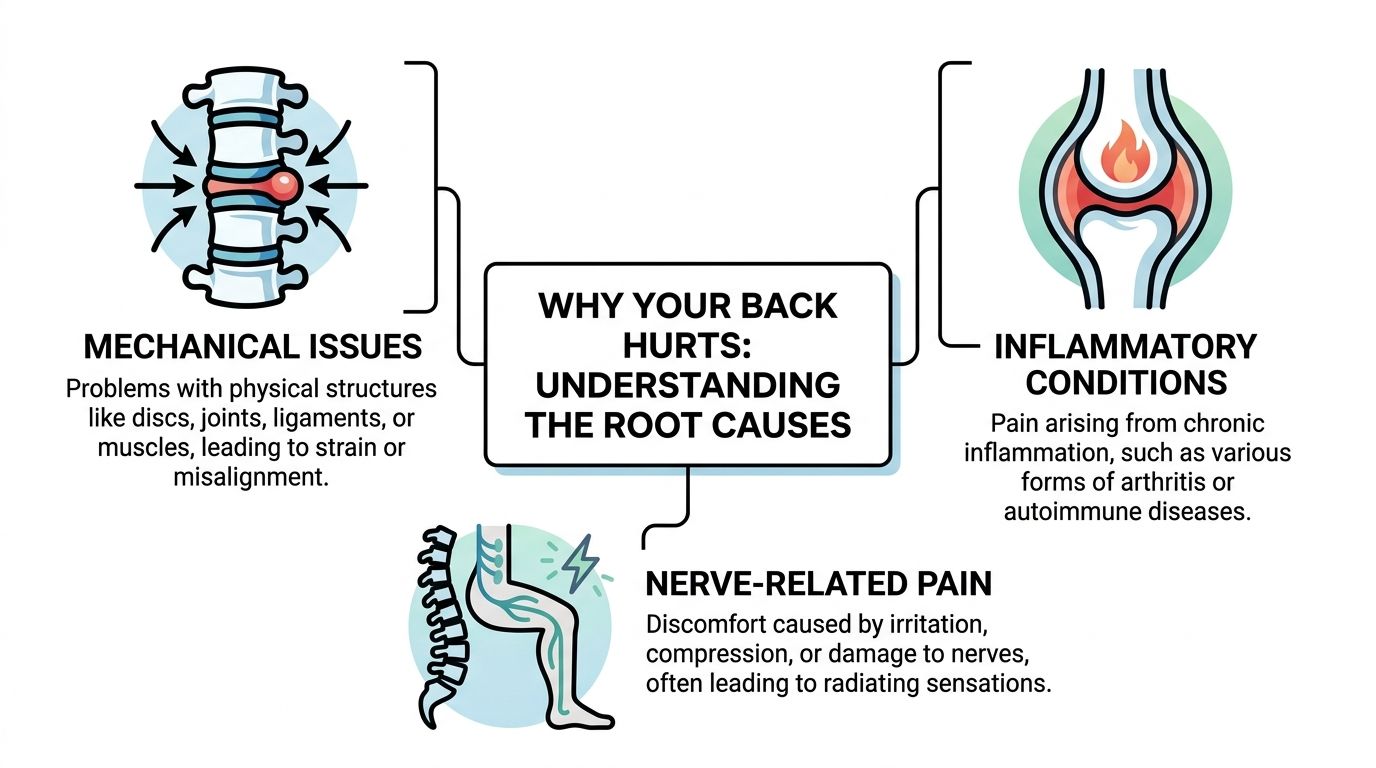
Why Your Back Hurts Understanding the Root Causes
Back pain is one label for several different problems.
When people say “my back is out,” they are trying to describe a complicated experience with simple language. In practice, chronic back pain falls into a few broad categories. Those buckets overlap, but separating them helps you understand why one person improves with strengthening, another needs medical workup, and another needs to calm an overprotective pain system.
Mechanical pain
Mechanical pain comes from how the back moves, loads, and tolerates force.
This is the category many initially consider. Muscles get irritated. Joints become stiff. Discs, connective tissue, and surrounding structures react to repeated strain, prolonged positions, or sudden increases in activity. Mechanical pain changes with posture, movement, lifting, twisting, or time spent in one position.
A few clues point in this direction:
- Pain with certain movements: Bending, standing, sitting, twisting, or getting out of the car changes symptoms.
- Morning stiffness or end-of-day soreness: The back feels different depending on how it has been used.
- Local tenderness or guarding: Muscles tighten to protect the area.
Mechanical pain responds well to the right dose of movement. Not any movement. The right movement. Some people need repeated extension. Others need hip mobility, trunk stability, or better load distribution. Individualized physical therapy is essential here. Generic exercise can help, but matched exercise is more efficient.
Inflammatory pain
Inflammatory pain is different. The tissues are irritated by a broader inflammatory process, not only by mechanics.
This pattern may show up as pronounced morning stiffness, pain that does not behave as expected with activity, or symptoms that seem out of proportion to the task. Inflammatory conditions can include forms of arthritis and autoimmune issues. A careful history is important here, because exercise still helps many people, but the plan may need to work alongside medical management.
If pain feels constant, unexplained, or paired with other systemic symptoms, a medical evaluation is important. Physical therapists screen for that. Good care does not force every back problem into an exercise-only box.
Neuroplastic pain
Some chronic pain is driven less by tissue injury and more by a pain system that has become too protective.
That does not mean the pain is fake. It means the alarm system is more sensitive than the actual level of tissue threat. This is often called neuroplastic pain. The nervous system learns pain. It can also unlearn it.
One of the clearest examples comes from Pain Reprocessing Therapy. A 2023 study found that 66% of chronic back pain patients who received PRT were pain-free or nearly pain-free after one year, compared with 20% in the placebo group, according to the University of Colorado Anschutz Medical Campus summary of the clinical trial.
That result matters because it reinforces a key point. Some long-lasting back pain improves when people change how they interpret and respond to pain signals, not only when they “fix” a structure.
Nerve-related symptoms need a closer look
Sometimes back pain stays local. Sometimes it travels.
Pain, tingling, numbness, or burning into the buttock or leg can suggest nerve irritation. If you are dealing with symptoms that move beyond the back, this guide on what radiating pain means can help you understand what clinicians look for and why the pattern matters.
What this means for recovery
A simple way to visualize this is:
| Pain driver | What it often feels like | What usually helps |
|---|---|---|
| Mechanical | Position- or movement-sensitive pain | Targeted exercise, mobility work, load management |
| Inflammatory | Stiff, persistent, less predictable pain | Medical screening, activity modification, coordinated care |
| Neuroplastic | Persistent pain with high sensitivity or fear response | Education, graded exposure, cognitive strategies, movement |
Individuals are not purely one type. They may have a mechanical trigger, a sensitive nervous system, and habits that keep the cycle going. That is why a blended plan works better than chasing one explanation.
Immediate Steps for Managing a Pain Flare-Up
A flare-up can make you feel like all progress is gone.
It is not gone. A flare is a spike in irritability, not proof that you caused major damage. Treat it like an inflammatory or sensitivity surge that needs calming, not panic.

First, lower the threat level
Your first job is to reduce guarding.
That means slowing down, changing position, and avoiding the “I need to test it” habit. Repeatedly bending, twisting, or poking at a painful area keeps the system stirred up.
Start with this sequence:
- Change positions often: Do not freeze in one posture for hours.
- Use calm, easy breathing: Long exhales can reduce bracing.
- Pick one or two gentle movements: The goal is to decrease threat, not force a stretch.
Good options include short walks, pelvic tilts, lying on your back with knees supported, or easy repeated motions that feel familiar and nonthreatening.
Heat versus ice
This is a frequent question, and both can help.
Use heat when your back feels stiff, guarded, or spasm-prone. Heat helps muscles relax and makes movement easier. Ice can be useful when the area feels hot, sharply irritated, or freshly aggravated after a specific strain.
If you are unsure which to try, choose the one that makes movement easier afterward. Relief during application is nice. Relief that lets you stand up and move better is better. This breakdown of heat vs cold compress can help you decide based on what your flare feels like.
Keep moving, but reduce the dose
Complete bed rest is one of the least helpful responses to back pain.
When you stop moving, the back gets stiffer, muscles decondition, and the nervous system can become even more protective. The better strategy is relative rest. You lower the load without shutting life down.
Try this:
- Short walks: Even a few minutes around the house or outside can settle the system.
- Frequent resets: Stand up if sitting is painful. Sit briefly if standing is painful.
- Smaller tasks: Split cleaning, cooking, or errands into pieces rather than pushing through all at once.
During a flare, think “motion without provocation.” You want enough movement to keep the back from locking down, but not so much that symptoms snowball for the rest of the day.
Use activity pacing instead of boom-and-bust
A common pattern is to rest until the pain dips, feel better, then do too much.
That boom-and-bust cycle keeps many people stuck. Activity pacing works better. If you know one chore triggers your back after a certain point, stop before that point, reset, then return later if needed.
Examples:
- Laundry: Fold one basket, then walk for a minute instead of folding three straight through.
- Yard work: Work in short blocks and switch tasks before symptoms climb.
- Desk work: Alternate sitting, standing, and brief movement breaks.
Medication can be a bridge, not the plan
Over-the-counter medication can be appropriate for some people, depending on their health history and clinician guidance. The key is to view it as a temporary aid that helps you move, sleep, or function during a rough patch.
Medication seldom rebuilds capacity. It can create the window in which you do the things that rebuild capacity.
Movement-based self-management matters here. A study of therapeutic virtual yoga for chronic low back pain found that participants reduced analgesic medication use by more than 21 percentage points compared with a control group, according to JAMA Network Open. That does not mean yoga is the answer for everyone. It does show that guided movement can reduce reliance on symptom-only strategies.
What not to do during a flare
Some habits make flare-ups last longer:
- Chasing aggressive stretches: Pulling hard on an irritated back can backfire.
- Repeatedly testing pain: “Let me see if it still hurts” often keeps it irritated.
- Avoiding all movement: This increases stiffness and fear.
- Adding five new treatments at once: You cannot tell what helps, and your body gets mixed signals.
The goal in the first day or two is simple. Calm the flare. Keep the body moving. Create enough comfort to return to a more structured plan.
Build a Resilient Back with a Graded Exercise Program
Exercise is the long game.
Not random exercise. Not punishment exercise. Not “no pain, no gain.” The most effective programs rebuild your tolerance step by step. That process is called graded exposure or graded exercise. You start below the level that spikes symptoms, then progress as your body and confidence improve.

Why graded exposure works
People with chronic back pain frequently have two problems at once.
The first is reduced physical capacity. The trunk, hips, and legs are not tolerating load well. The second is reduced trust. Even safe movements feel risky.
Graded exercise addresses both. You show the body that movement is tolerable, then useful, then normal again. Evidence supports that approach. Research reviewed in the BACPAC consortium affirmed that staying active is a primary treatment for chronic low back pain, and a large cohort study found that daily walking, even at a leisurely pace, significantly lowers the risk of chronic low back pain, as summarized in this review on chronic low back pain interventions.
Start with your baseline, not your ideal
Your baseline is the amount of activity you can do with manageable symptoms during and after.
That is where many people go wrong. They start from what they used to do, not from what they can currently recover from. A better baseline may be a five-minute walk, two sets of a simple stabilization drill, or gentle mobility work once a day.
Use a simple traffic-light check:
| Response | What it means | What to do |
|---|---|---|
| Green | Mild discomfort that settles quickly | Continue or progress slowly |
| Yellow | Symptoms rise but return to baseline later | Hold the level and monitor |
| Red | Pain escalates sharply or lingers significantly | Scale back and reassess |
Walking is often the first anchor habit
Walking is accessible, repeatable, and easy to dose.
If structured exercise feels overwhelming, begin here. Walk at a comfortable pace. The goal is consistency, not intensity. If one continuous walk is too much, break it into shorter bouts. The body still gets the message.
Good walking rules:
- Choose comfort over speed
- Keep your stride natural
- Stop before the back becomes aggravated
- Repeat often so the body recognizes it as routine
Core stability progression
Many people hear “strengthen your core” and do hard planks. That is too crude.
Core stability for back pain is about controlled load transfer. Your trunk learns to support movement without excessive bracing.
Beginner stage
Start with low-threat patterns.
- Abdominal brace with breathing: Lie on your back with knees bent. Gently tighten the lower abdomen as if preparing for a cough, but keep breathing.
- Pelvic tilt: Rock the pelvis to find comfortable spinal motion.
- Heel slide: Hold a light abdominal brace while sliding one heel out and back.
Focus on smooth breathing and low effort. If you are shaking or holding your breath, the drill is too hard.
Intermediate stage
Add limb movement while the trunk stays quiet.
- Dead bug variation: Lie on your back, brace lightly, and lift one leg at a time. Progress to opposite arm and leg movement.
- Bridge: Lift the hips while keeping the ribcage and pelvis controlled.
- Bird-dog with short reach: On hands and knees, extend one leg or one arm, then progress to opposite arm and leg.
Quality matters more than range. Small movement with good control beats large movement with twisting or breath-holding.
Advanced stage
Now the body tolerates more functional demand.
- Full bird-dog with pause
- Side plank variation
- Loaded carry
- Split-stance anti-rotation work
These movements prepare you for life, not just the exercise mat. Carrying groceries, lifting a child, and moving through the day all require controlled force through the trunk and hips.
If an exercise leaves you sore in a predictable, manageable way, that can be normal. If it creates a strong pain spike that changes the rest of your day, it was too much, too soon, or the wrong fit.
Mobility progression
Some backs need more support. Others need more movement. Many need both.
Mobility work should improve access to motion, not yank on sensitive tissue.
Gentle spinal mobility
Good early choices include:
- Cat-cow: Move through a comfortable range instead of forcing end range.
- Knees side to side: Lying on your back, let the knees rock.
- Prone press-up or supported extension: Useful for some people whose symptoms improve with extension.
Hip-focused mobility
The hips share the workload with the low back. When they are stiff, the back does extra work.
Try:
- Figure-four stretch
- Half-kneeling hip flexor stretch
- Hamstring mobility with a strap, done with care
Do not chase a dramatic stretch sensation. You are looking for easier movement afterward.
Functional retraining matters most
Eventually, the exercises need to connect to your triggers.
If your pain appears when lifting laundry, then your plan should include hinge practice. If your back tightens during long car rides, you need postural variation, mobility breaks, and endurance training. If sitting at work is the issue, your body needs tolerance for sitting plus options to interrupt it.
That is what makes an exercise program durable. It does not stop at “three sets of ten.” It rebuilds your actual life.
A sample weekly pattern
This kind of structure works well for many people:
- Walking: Most days
- Mobility drills: Briefly, often
- Core stability work: A few focused sessions each week
- Functional practice: Integrated into daily tasks
The exact dosage should match your irritability, history, and goals. The principle stays the same. Build capacity gradually. Repeat enough to make progress. Do not wait for perfect pain-free days to begin.
Integrate Long-Term Strategies for Lasting Relief
A stronger back helps. A smarter daily setup keeps that strength from getting wasted.
Many people do well in therapy, then slide backward because the environment around them never changed. They still sit the same way for hours, lift in a rush, sleep poorly, and react to every ache like a warning siren. Lasting relief comes from connecting exercise to the rest of life.
Fix your work setup by reducing static load
Your body tolerates posture better than it tolerates staying frozen.
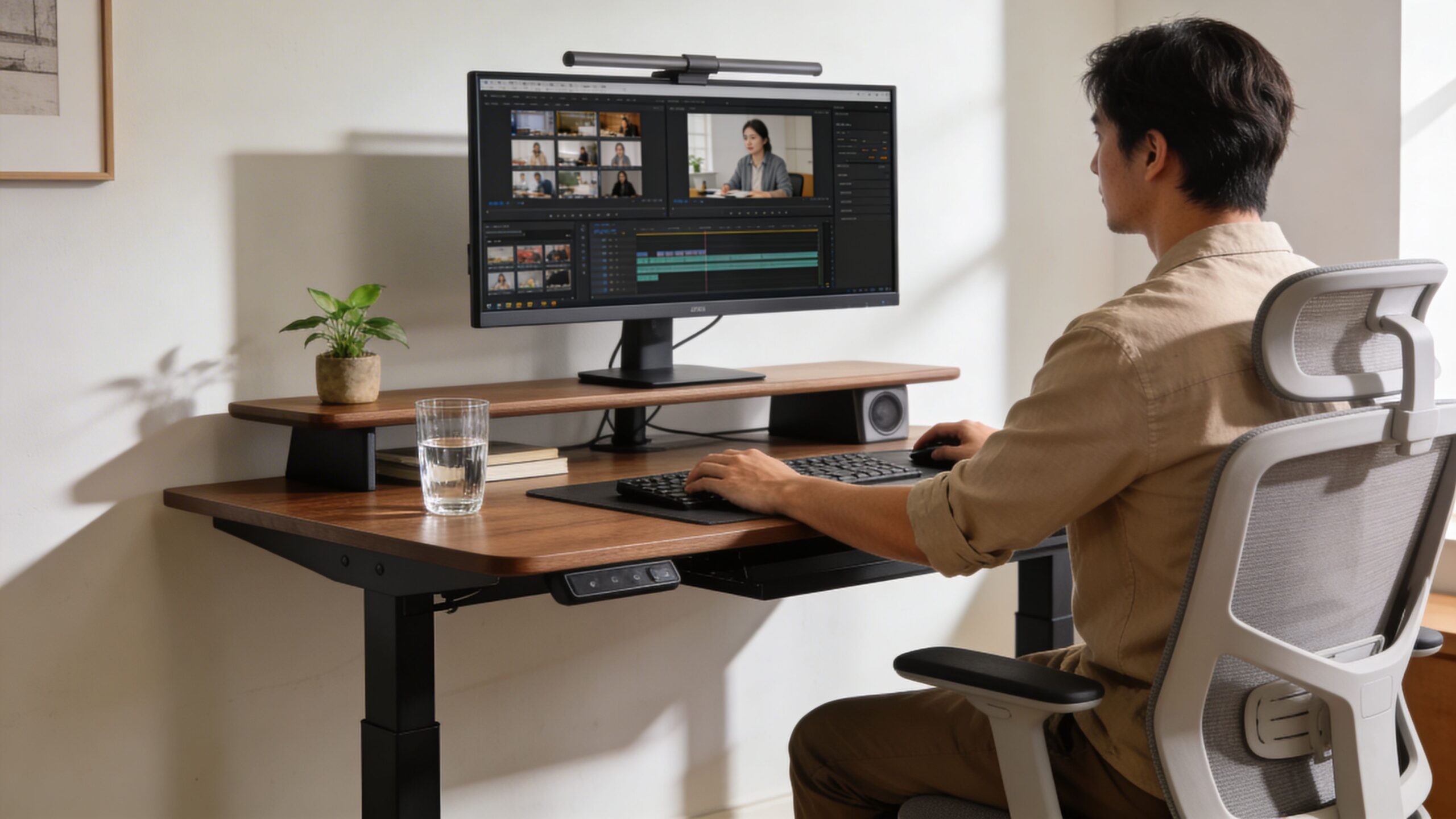
That means the perfect chair is less important than your ability to vary positions. Sit supported. Keep the screen at a comfortable height. Let your shoulders relax. Put your feet where they feel grounded. Then change something before your back starts complaining.
Useful workstation habits include:
- Alternate positions: Sit, stand, or shift.
- Bring the work closer: Reaching forward for the keyboard or laptop increases strain.
- Use movement breaks: Stand up, walk, or extend between tasks.
A standing desk can help some people, but standing all day is not the answer either. The winning strategy is variation.
Lift with options, not fear
People are told to “always lift with your legs” as if there is one safe pattern and every other pattern is dangerous.
Real life is messier. Good lifting means getting close to the object, creating tension through the trunk, using the hips and legs, and avoiding rushed, awkward effort. You do not need robotic posture. You need control and appropriate load.
Practice these ideas:
- Get close before lifting
- Exhale and brace
- Use both hips and knees when possible
- Turn your whole body instead of twisting under load
- Scale the weight or split the task when needed
The stronger and calmer your body becomes, the less fragile these movements feel.
Sleep changes pain tolerance
Poor sleep and chronic pain amplify each other.
When sleep is broken, the nervous system becomes more irritable. The next day, ordinary loads can feel bigger and recovery can feel slower. A useful sleep setup is one that lets your body relax without waking from discomfort.
Position matters. Side sleepers often like a pillow between the knees. Back sleepers may feel better with support under the knees. Mattress comfort matters too, especially if you wake up stiff or spend the night shifting. If you are sorting through options, this guide to the best mattress for back pain relief is a practical resource for thinking through support and comfort.
Calm the pain system, not just the tissues
If you have had pain for a long time, your nervous system may react to stress, poor sleep, overload, or unfamiliar movement. That is why two people can do the same task and have different pain responses.
A few strategies help lower that sensitivity:
- Mindful breathing: Slow, steady breathing reduces bracing.
- Body scanning: Notice tension in the jaw, shoulders, and abdomen.
- Cognitive reframing: Replace “I damaged something” with “I may have irritated a sensitive area.”
- Planned exposure: Return to feared movements instead of avoiding them.
This is not positive thinking for its own sake. It is behavior that changes the meaning of pain and reduces the spiral of fear, guarding, and deconditioning.
Lasting relief comes from stacking small wins. Better sleep, smarter pacing, regular walking, a calmer response to flare-ups, and a stronger trunk all support each other.
Build your post-PT self-management plan
Many people worry about what happens after formal treatment ends. That worry is reasonable. Structure helps.
Your maintenance plan does not need to be complicated. It does need to be clear.
A good long-term plan includes:
| Area | Keep doing | Watch for |
|---|---|---|
| Movement | Walking and a few key exercises | Skipping them for weeks at a time |
| Work habits | Position changes and movement breaks | Long static periods |
| Load management | Gradual build-up for chores and exercise | Sudden spikes in activity |
| Recovery | Sleep routine and flare-up plan | Repeated overreaction to mild pain |
The goal is independence, not dependence on treatment. You should know your early warning signs, your reset strategies, and the few habits that keep your back reliable.
How to Get Professional Help from a Physical Therapist
Self-care works well for many cases of back pain. It does not cover everything.
Some symptoms deserve immediate medical attention. Others call for a skilled physical therapy evaluation because the problem is no longer simple enough to solve by trial and error.
Know the red flags
Seek urgent medical care if back pain comes with:
- Loss of bowel or bladder control
- Rapidly worsening weakness
- Numbness in the groin or saddle region
- Severe symptoms after major trauma
- Fever, unexplained illness, or other concerning systemic changes with back pain
These symptoms do not mean something catastrophic, but they are not “wait and see” issues.
When PT is the right next step
If your pain has persisted, keeps returning, limits work or exercise, or creates fear around movement, a physical therapist can help sort out what is driving it.
A good evaluation should answer questions like:
- Is this pain mechanical, nerve-related, sensitivity-driven, or mixed?
- Which movements help, and which are loading the wrong thing right now?
- What can you do today?
- What is the plan for getting back to your real activities?
That clarity matters. Many people with chronic pain have tried isolated tools. They have not had a full movement assessment that ties symptoms to a progression plan.
What your first PT visit should feel like
A strong first visit is not a mystery ritual. It is a structured problem-solving session.
Expect the therapist to ask about symptom behavior, daily triggers, easing factors, sleep, work demands, activity history, and goals. Then they should examine movement, strength, mobility, tolerance, and symptom response. The point is not only to label the pain. It is to identify patterns you can act on.
Your plan may include:
- Targeted exercise: Chosen for your presentation, not copied from a generic sheet
- Manual therapy: Used when it helps pain or movement, not as a stand-alone fix
- Education: So you understand what is happening and why
- Progression: A path from early symptom control to full activity
If you are weighing provider types, this comparison of physical therapy vs chiropractor for back pain can clarify differences in approach and help you ask better questions.
Why multimodal care tends to work better
Chronic back pain has more than one driver. That is why a blended model outperforms a single-method approach.
Research involving over 10,000 patients found that combining individualized exercise with Cognitive Behavioral Therapy produced an 84% higher success rate for pain relief compared with standard exercise alone, according to this summary of the research in ScienceDaily.
That does not mean every patient needs formal CBT sessions. It does mean modern back pain care should address both body and behavior. Strength without confidence is incomplete. Education without loading is incomplete. Pain relief without a plan for recurrence is incomplete.
In outpatient practice, that may look like movement retraining, pacing strategies, graded exposure to feared activities, and practical coaching around work, sleep, and home exercise adherence. Highbar Physical Therapy offers outpatient rehabilitation for back pain through individualized evaluation, exercise-based care, hands-on treatment when appropriate, and telehealth or in-person follow-up based on patient needs.
Questions worth asking your therapist
You should leave an evaluation with more than exercises. You should leave with reasoning.
Ask:
- What do you think is the main driver of my pain?
- What are the top two or three things I should do this week?
- What should I stop doing for now?
- How will we know I am improving?
- What is the plan for keeping this from coming back?
Those questions force the treatment plan to become practical.
A note on recovery environment at home
One detail that matters more than people expect is sleep setup. If your symptoms are worst overnight or first thing in the morning, your therapist may ask about pillow support, sleep position, and mattress comfort. For people researching replacement options, this guide on finding a mattress for back pain relief can be a useful starting point for comparing support features.
Professional help should make your path simpler. You should understand your pain better, move with less fear, and know what actions move you forward.
Frequently Asked Questions About Chronic Back Pain
Can chronic back pain really go away
Sometimes yes. Sometimes it improves to the point that it no longer controls your decisions.
The more useful target is restored function with manageable symptoms, plus the ability to handle normal life without constant fear. Many people do not need a “perfect” back to feel good and live.
What is the single best exercise for chronic back pain
There is no single best exercise for everyone.
The best exercise is the one that matches your presentation, is tolerated well enough to repeat, and helps you build toward real-life activities. For one person that may be walking. For another it may be a directional movement, trunk stabilization drill, or hip mobility exercise.
Do I need an MRI before starting physical therapy
Not always.
Many people start physical therapy without imaging, especially when symptoms behave like a common musculoskeletal problem and there are no red flags. Imaging becomes more important when symptoms are severe, unusual, progressive, or suggest a condition that needs medical workup.
How long does PT take to help
That depends on how long the pain has been present, how sensitive the area is, and how well you can follow the plan.
Some people feel early relief when they stop aggravating the problem and begin the right movements. Longer-standing pain takes more time because you are rebuilding strength, tolerance, and confidence together.
If I had a flare-up, does that mean I am back to square one
No.
Flare-ups are common during recovery from chronic pain. They reflect irritation, overload, stress, poor sleep, or doing too much too soon. A flare is information. It helps refine your pacing, exercise dose, and recovery strategy.
If chronic back pain is limiting how you work, sleep, exercise, or enjoy daily life, Highbar Physical Therapy can help you make sense of it and build a plan that fits your goals. A physical therapist can evaluate what is driving your symptoms, guide you through the right progression, and help you move toward lasting relief instead of another short-term fix.