A lot of people describe iliopsoas pain the same way. It's a deep ache in the front of the hip or groin that's hard to point to with one finger. It may show up when you get out of the car, stand after a long meeting, lift your knee to put on pants, or try to run and feel a sharp pinch at the front of the hip.
That kind of pain is frustrating because it doesn't always behave like a simple pulled muscle. Sometimes it feels tight. Sometimes it feels weak. Sometimes stretching seems to help for a few minutes, then the pain comes right back. That's usually the moment patients start wondering whether the problem is the hip joint, the low back, or something deeper.
That Deep Nagging Pain in Your Hip
If your pain lives deep in the front of the hip, the iliopsoas deserves attention. This muscle group sits in a tricky spot, and when it gets irritated, the symptoms can feel vague, stubborn, and easy to misread.
One common pattern is this. You sit for a while, stand up, and feel a pulling or pinching sensation in the front of the hip. You walk a bit and it eases. Then later, stairs, fast walking, uphill work, running, or lifting the knee bring it back. If that sounds familiar, you may relate to this guide on painful hips after sitting.
Why this area gets misunderstood
Anterior hip pain often gets labeled as “tight hip flexors.” That label isn't always wrong, but it's often incomplete. The iliopsoas can be irritated because it's overloaded, weak for the demands you're placing on it, compensating for other movement problems, or reacting to irritation in nearby structures.
Practical rule: If stretching gives only brief relief and the pain returns with sitting, stairs, running, or lifting your knee, the problem usually isn't just short muscle length.
In the clinic, I often see patients who've spent weeks doing aggressive hip flexor stretches without lasting improvement. That usually happens because the tissue needs a better plan, not more force. The iliopsoas often responds better when you reduce aggravating load, restore control, and then rebuild strength.
What patients usually want to know
The general reader isn't asking for a perfect anatomy lecture. They want answers to a few practical questions:
- What is this muscle doing? It lifts the leg and helps control the trunk and hip.
- Why does it hurt? Usually from strain, repetitive irritation, or poor load tolerance.
- Will stretching fix it? Sometimes partly, but usually not by itself.
- What works? Accurate diagnosis, smart exercise progressions, and load management.
That's where the iliopsoas becomes much less mysterious.
Meet Your Iliopsoas The Body's Powerful Hip Flexor
The iliopsoas is the primary muscle group that lifts your thigh toward your body. If you feel pain at the front of the hip when you bring your knee up, step onto stairs, or start to walk after sitting, this muscle is often part of the picture.
Two muscles working as one
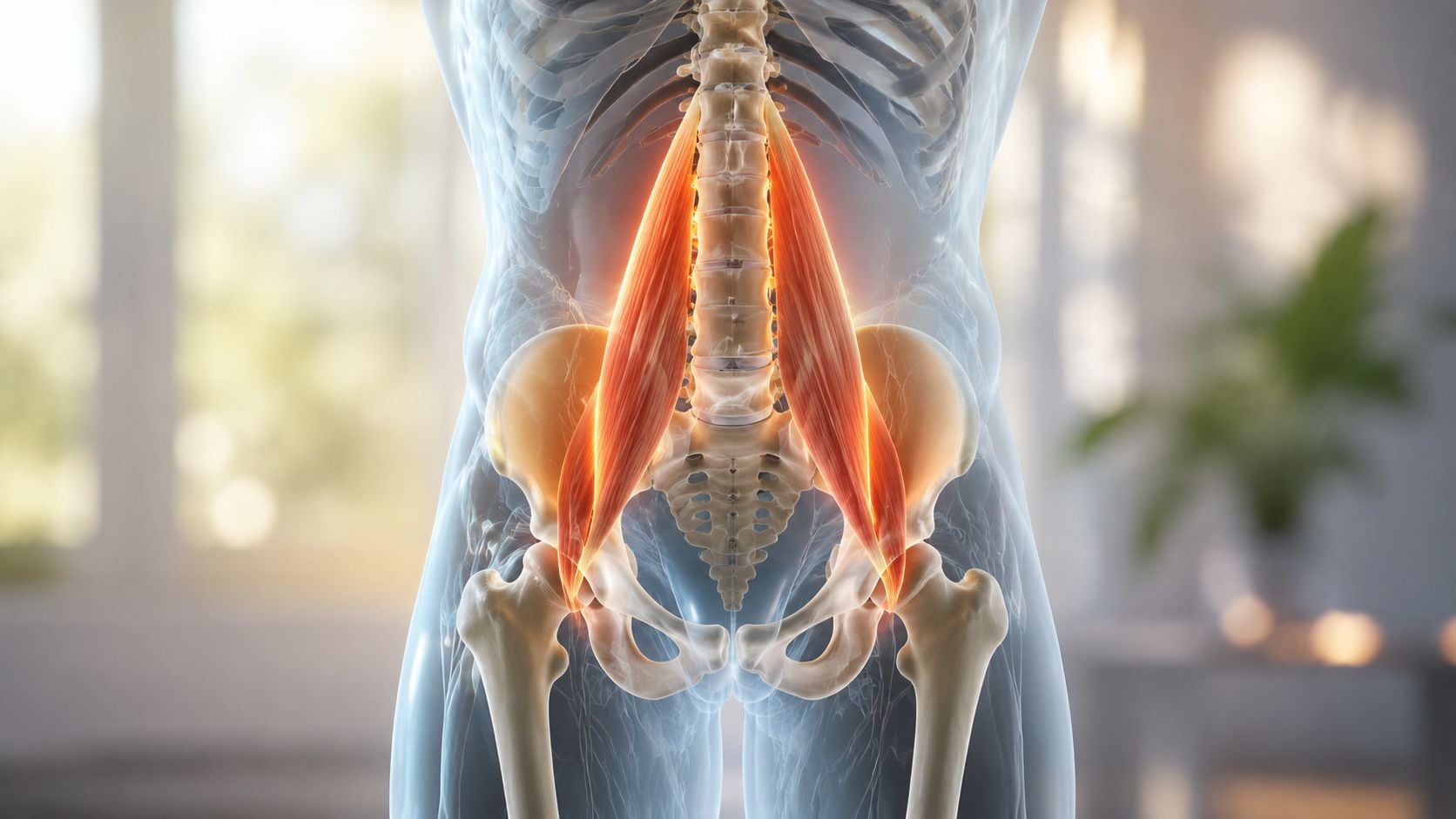
The iliopsoas is made of two muscles, the psoas major and the iliacus. The psoas major starts along the lower spine. The iliacus starts along the inside of the pelvis. They join together and attach to the upper femur, which gives them strong mechanical advantage for hip flexion.
A useful way to picture it is as a deep guy-wire that runs from the trunk and pelvis to the top of the thigh. When it shortens, it helps lift the leg. When the leg is fixed, it can also affect trunk position and pelvic control.
Anatomy in this area is not identical in every person. The nearby psoas minor is absent in many people, and the overall arrangement of the region can vary, as described in Kenhub's iliopsoas anatomy reference.
Why it matters so much in movement
This is not a small helper muscle. The iliopsoas does a large share of the work in hip flexion, which is why irritation here gets your attention fast.
You use it all day:
- Walking: It helps bring the leg forward during swing.
- Stair climbing: It works harder as the hip has to flex more.
- Running and kicking: It has to produce force quickly, over and over.
- Getting in and out of bed or a car: It helps lift and position the leg.
- Trunk control: Because the psoas attaches to the spine, it also influences how the trunk and pelvis work together.
The iliopsoas is deep, strong, and heavily loaded. When it becomes irritated, simple movements often stop feeling simple.
Why “hip flexor” is too simple
Patients often hear “hip flexor” and assume the answer is to stretch the front of the hip harder. That is often too simplistic. The iliopsoas connects the spine, pelvis, and femur, so symptoms here can show up with leg lifting, posture changes, walking changes, or even low back discomfort.
That matters in rehab. A painful iliopsoas is not always short. In many cases, it is sensitive, overloaded, or underprepared for the demands you are placing on it. Stretching may give temporary relief, but lasting improvement usually depends on better load management and progressive strengthening.
Why Your Iliopsoas Starts to Hurt
Iliopsoas pain usually shows up in one of two ways. The first is an acute injury, such as a strain after sprinting, kicking, or a forceful change of direction. The second is a more gradual overuse pattern, where the tendon or musculotendinous area gets irritated by repeated hip flexion without enough recovery or strength to tolerate the demand.
Acute strain versus repetitive irritation
A strain often feels sudden. People describe a sharp pull, pain during acceleration, or immediate discomfort after lifting the knee forcefully. That's more common in sports and fast movements.
Repetitive irritation tends to build over time. The front of the hip feels stiff after sitting, sore during activity, and sensitive with repeated lifting of the knee. Runners, field sport athletes, and people who spend long hours sitting can all fall into this pattern.
The key difference is mechanical tolerance. A strained iliopsoas has been overloaded quickly. An irritated iliopsoas tendon has usually been overloaded gradually.
What commonly drives symptoms
Several patterns show up again and again in practice:
- Repetitive hip flexion: Running, kicking, climbing, hurdling, and similar motions can irritate the area.
- Prolonged sitting: The hip stays flexed for long periods, which can make the front of the hip feel compressed and sensitive.
- Movement imbalance: Weak glutes, poor trunk control, and limited hip mobility can shift extra work onto the iliopsoas.
- Training errors: Sudden increases in pace, volume, hills, or kicking load often matter more than one single workout.
A painful iliopsoas is often less about “tightness” and more about a muscle-tendon unit that can't handle the loads being asked of it.
Age changes the picture
Documented iliopsoas injuries are uncommon, but they do happen. In one MRI study, the prevalence was 0.66% with a 95% CI of 0.44–0.89, and the injury pattern differed by age. In patients under 65, muscle strains and partial tendon tears related to athletic injury were most common. In patients 65 and older, complete tears were more frequent, including spontaneous cases, and all 8 complete tears in that study occurred in females, as reported in this PubMed MRI study on iliopsoas injuries.
That matters clinically. A younger runner with anterior hip pain and pain during acceleration raises one set of questions. An older adult with sudden front-of-hip pain and weakness after a simple movement raises another.
Could It Be Something Else?
Front-of-hip pain is one of the easiest regions to mislabel. The iliopsoas is a common source, but it isn't the only one. Pain from the hip joint, surrounding soft tissues, abdominal wall, or even the lumbar spine can land in a very similar area.
That's why a good assessment doesn't start with “What stretch should I do?” It starts with “What structure is driving the pain?”
Anterior hip pain comparison
| Condition | Typical Pain Location | Key Symptoms |
|---|---|---|
| Iliopsoas irritation | Deep front of hip or groin | Pain lifting the knee, discomfort after sitting, pain with stairs, running, marching, or resisted hip flexion |
| Hip labral involvement | Groin, deep joint pain | Clicking, catching, sharp pain with pivoting, pain with deep hip flexion |
| Femoroacetabular impingement | Front of hip or groin | Pinching in deep flexion, pain with squatting or sitting low, reduced hip motion |
| Adductor-related pain | Inner groin | Pain squeezing legs together, tenderness near groin attachment, sport-related groin pain |
| Sports hernia or athletic pubalgia | Lower abdomen or groin | Pain with cutting, sprinting, coughing, or core loading |
| Lumbar referred pain | Front of hip, groin, or thigh | May include back pain, stiffness, symptoms that change with spinal movement |
Clues that point more toward the iliopsoas
An iliopsoas problem often becomes more obvious when certain motions reproduce pain:
- Lifting the knee into the air
- Getting out of a car or bed
- Climbing stairs or hills
- Resisted hip flexion
- Transitioning from sitting to standing
Labral or impingement pain often has more of a joint-based feel. Patients may describe catching, pinching, or pain with deep bending. Referred pain from the low back may change more with spinal position than with hip loading.
Why self-diagnosis often goes wrong
Many conditions overlap. Someone can have an irritated iliopsoas and limited hip joint mobility. Another person may blame the hip flexor when the underlying cause is the lumbar spine. A third may have front-of-hip pain that only appears during cutting or sprinting because the problem shows up under speed, not during basic stretching.
That overlap is exactly why clinicians use multiple pieces of information together:
- History: what triggered it, when it hurts, what eases it
- Palpation and resisted testing: does the muscle-tendon unit reproduce symptoms
- Mobility testing: is the hip joint itself restricted or painful
- Functional testing: stairs, marching, squatting, gait, running, and trunk control
Front-of-hip pain is a region, not a diagnosis.
When patients understand that, they usually stop chasing random stretches and start looking for the source of the problem.
How to Check Your Iliopsoas at Home
You can't fully diagnose yourself at home, but you can gather useful information. Two simple screens can help you notice whether the iliopsoas seems limited, irritated, or weak. Stop if either test causes sharp pain.
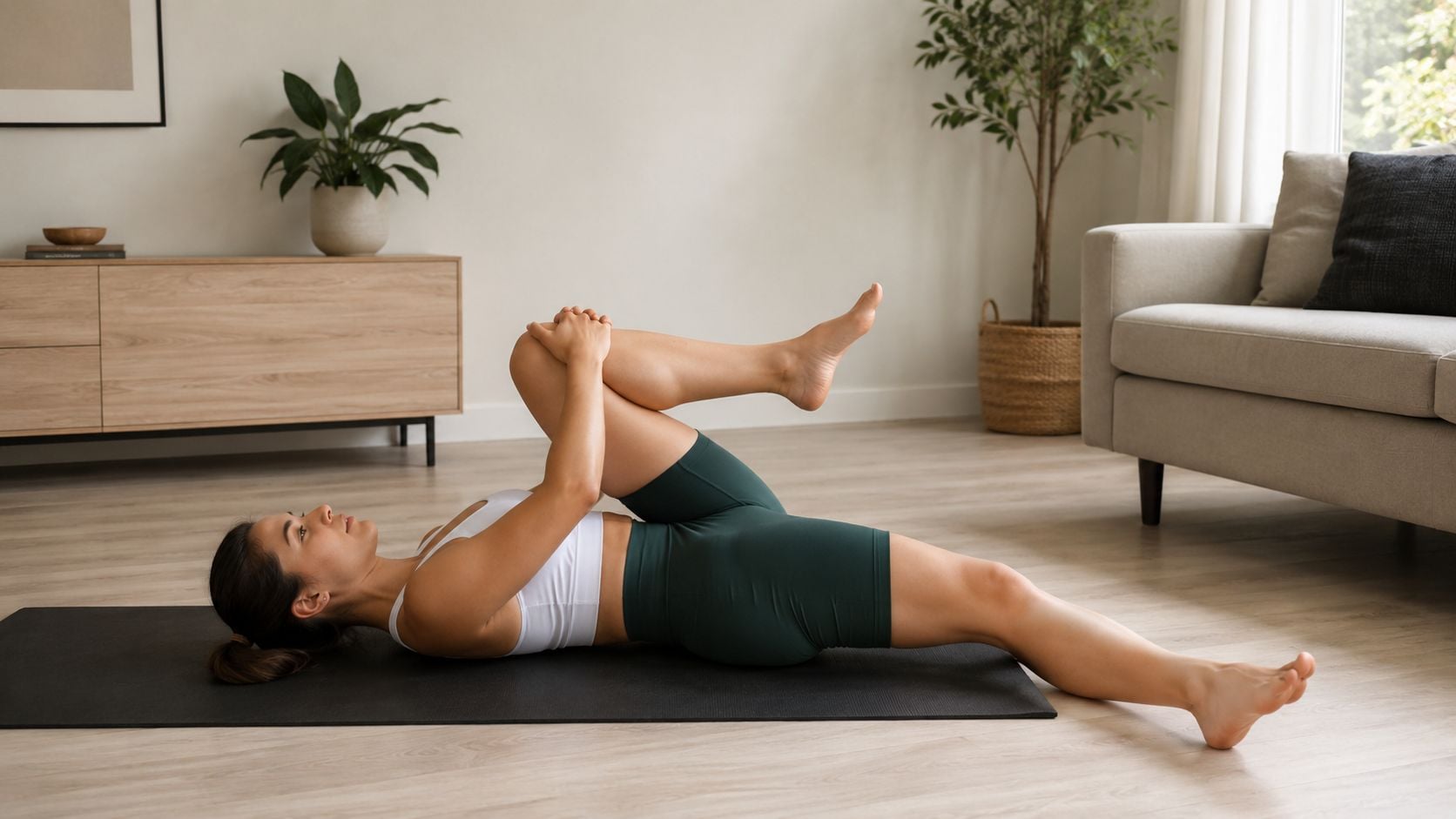
Try a modified Thomas-style check
Lie near the edge of a bed or firm couch. Pull one knee gently toward your chest and let the other leg relax downward off the edge.
Notice a few things:
- Does the hanging thigh stay high instead of dropping comfortably?
- Does the front of the hip feel tight or pinchy?
- Does the low back arch hard as you try to hold the position?
- Is one side clearly different from the other?
This doesn't prove you have an iliopsoas problem, but it can suggest that the front of the hip isn't moving well or doesn't tolerate extension comfortably.
Check active strength with a psoas march
Sit tall in a chair. Lift one knee a few inches, lower it slowly, and repeat. Then compare sides. You can also do this lying on your back with knees bent, lifting one foot at a time in a controlled march.
Pay attention to:
- Pain with lifting: especially deep at the front of the hip
- Weakness or shakiness: one side may feel harder to control
- Trunk compensation: leaning back or hiking the hip to get the leg up
- Endurance drop-off: symptoms rise after repeated reps
A sensitive iliopsoas often doesn't just hurt. It also loses smooth control.
What a PT adds beyond home testing
A physical therapist goes further than simple screens. We check resisted hip flexion in different positions, assess nearby joints and tissues, and watch how the hip behaves during real tasks. If you've seen hip tests online, this guide to the FABER test for hip assessment gives a good example of how clinicians use movement testing as one piece of a larger exam.
If a home check reproduces your familiar pain, that's useful information. If it doesn't, that also matters. The absence of pain in a simple test doesn't rule out a load-related problem.
That's especially true for athletes. Plenty of people feel fine on the floor, then hurt as soon as speed, impact, or repeated knee drive enters the picture.
A Modern Plan for Iliopsoas Rehabilitation
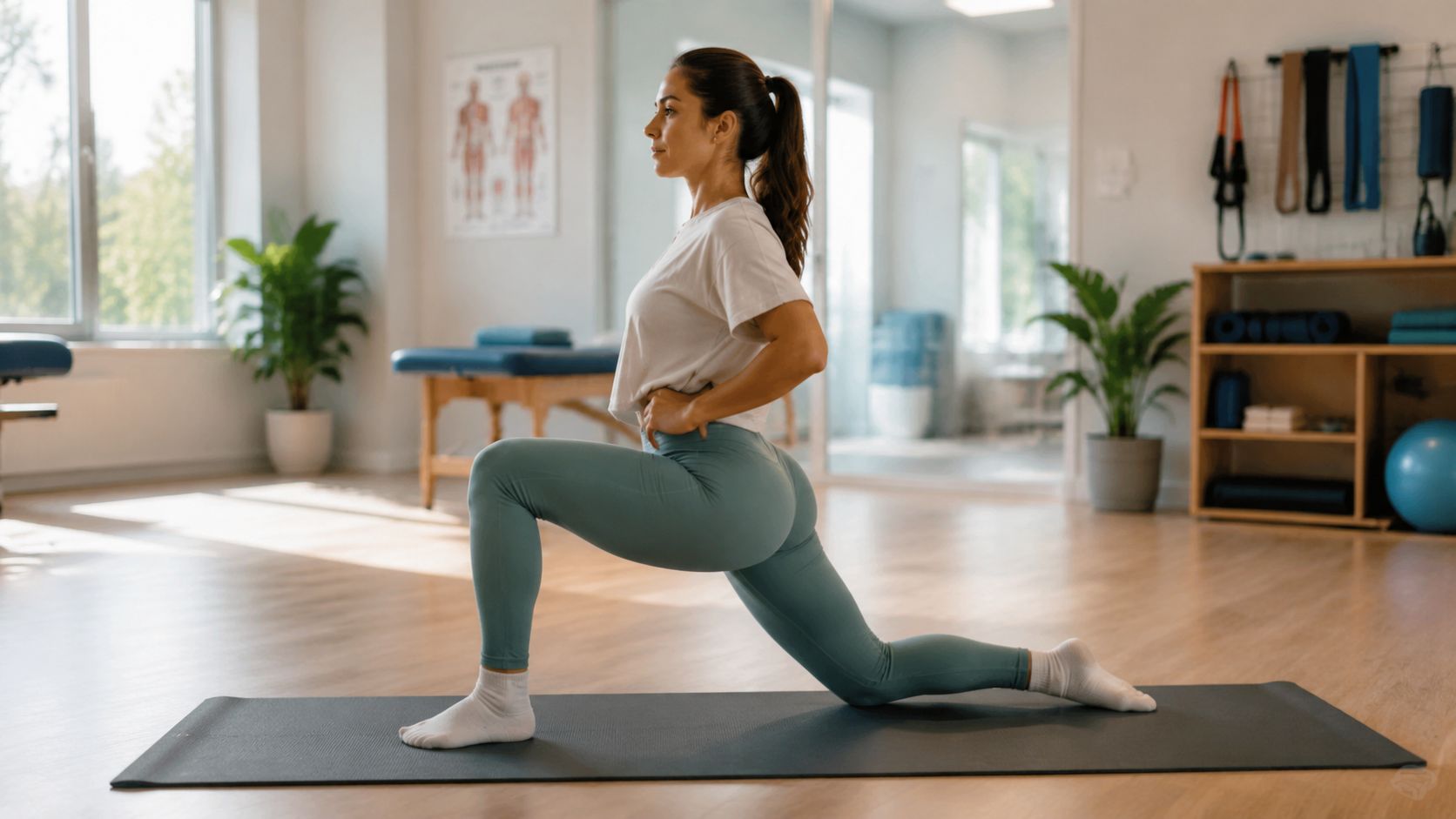
The old advice is simple. Stretch your hip flexors more. The problem is that this doesn't reliably solve iliopsoas pain, and in some cases it makes it worse. If the tendon or musculotendinous unit is already irritated, aggressive stretching can keep provoking the exact tissue you're trying to calm down.
Phase one calm it down
The first job is reducing irritation without letting the hip become deconditioned.
That usually means temporarily modifying the motions that spike symptoms. For one person, that's uphill running. For another, it's repeated high-knee drills, long sitting, or deep lunge stretching. You don't have to stop moving. You do need to stop poking the bear.
Useful early strategies often include:
- Relative rest: reduce the provoking activity, don't eliminate all movement
- Shorter sitting bouts: stand up and reset before the front of the hip stiffens
- Gentle mobility: easy hip motion that doesn't create pinching
- Pain-monitoring: mild discomfort may be acceptable, sharp worsening is not
If you're already doing a lot of stretching, this is also a good time to reconsider it. General flexibility work can help some people, but a blanket approach doesn't fit everyone. Many patients benefit more from understanding the difference between global tightness and true tissue irritability. This article on stretches for tight hip flexors is useful when you're trying to sort that out.
Phase two build strength where the problem lives
Once the area is less reactive, the focus shifts to capacity. This is a commonly overlooked step.
Targeted strengthening usually starts with isometrics and controlled hip flexion work, then progresses to more demanding patterns. The goal isn't just to contract the iliopsoas. It's to help it tolerate force without pain and to coordinate it with the trunk, pelvis, and glutes.
Examples often include:
- Supine march holds
- Seated resisted hip flexion
- Standing band marches
- Slow lowering work, which introduces eccentric control
- Trunk and pelvic control drills, especially when compensation is obvious
As noted in Physiopedia's iliopsoas tendinopathy overview, effective rehab focuses on correcting biomechanical deficits and progressive loading, not just static stretching, and return to play shouldn't happen until full, pain-free range of motion and strength are restored.
The question isn't “Can you stretch it?” The better question is “Can it handle the load of your day, your workout, or your sport?”
For clinicians, careful documentation matters during this phase because manual therapy and exercise often overlap in a plan of care. If you work in rehab operations, resources that explain how to prevent CPT 97140 claim denials can help clarify billing issues around skilled manual techniques.
Phase three reload for real life and sport
This phase brings back the exact demands that matter to you. If you're a runner, that means rebuilding stride-related load. If you play soccer, it means progressing kicking and acceleration. If your goal is normal daily life, it may be as simple as stairs, long walks, getting in and out of the car, and lifting the knee without pain.
This progression has to be specific. General strengthening alone won't fully prepare a person for sprint mechanics, repeated cutting, or high-volume stair climbing.
Common late-stage goals include:
- Pain-free marching and resisted hip flexion
- Control during single-leg tasks
- Tolerance for speed and repetition
- Return to full activity without symptom flare later that day
A clinic-based program can help if symptoms have lingered or if you're trying to return to higher-level activity. Highbar Physical Therapy is one option for outpatient evaluation and rehab when you need guided progression, movement analysis, and a plan that goes beyond generic hip flexor stretches.
When to See a Physical Therapist for Hip Pain
A mild front-of-hip ache that settles quickly may improve with simple load modification and exercise. But if the pain keeps returning, the smartest move is to stop guessing. Anterior hip pain is too easy to misread, and the right plan depends on knowing whether you're dealing with an iliopsoas issue, joint irritation, referred pain, or a mix of problems.
Signs it's time to get checked
Consider seeing a physical therapist if any of these apply:
- Pain has lasted more than two weeks and isn't clearly improving
- You feel a sharp pinch, catching, or clicking in the front of the hip
- Lifting your knee hurts during daily activities like dressing or stairs
- Sitting regularly aggravates the area
- Running, kicking, or training keeps triggering the same symptoms
- You've tried stretching and it isn't changing much
- You feel weakness, loss of control, or trouble returning to normal activity
What a good evaluation should answer
A proper exam should clarify more than “your hip flexors are tight.” It should identify which movements provoke symptoms, whether the iliopsoas is the driver, what surrounding impairments matter, and how to load the area without making it angrier.
That matters because rehab works best when it's precise. The right diagnosis helps you avoid wasting time on treatment that sounds logical but doesn't match the problem.
If front-of-hip pain is changing how you sit, walk, train, or sleep, it's worth getting a real answer.
The big takeaway is simple. The iliopsoas is a powerful, important muscle. When it hurts, the solution usually isn't more aggressive stretching. It's better assessment, smarter loading, and a progressive plan that restores strength and tolerance.
If you're dealing with persistent anterior hip pain and want a clear plan, Highbar Physical Therapy can help you figure out whether the iliopsoas is involved, identify what's driving the irritation, and build a rehab program that matches your daily life or sport.