You’ve probably felt it. You finish a stretch of computer work, stand up from the couch, or get out of the car, and one hip gives you that first sharp protest. Sometimes it’s a pinch in the front. Sometimes it’s a deep ache in the buttock or soreness on the outside of the hip. After a few steps, it may ease. Or it may stay cranky for the rest of the day.
That pattern is common, but it isn’t all the same problem.
As physical therapists, we see painful hips after sitting all the time. Sitting is often the trigger. It usually isn’t the full diagnosis. One person has stiff hip flexors and sleepy glutes. Another has an irritated tendon on the side of the hip. Someone else has joint-related stiffness that shows up most when they first rise from a chair. The right exercise depends on which one you’re dealing with.
That Familiar Ache When You Stand Up
A typical version goes like this. You’ve been seated for a while, focused on work and barely moving. Then you stand, take your first step, and your hip feels rusty, tight, or briefly unstable. You pause, straighten up, and wait for things to settle.
That moment matters because it gives useful clues.
If the pain is mostly in the front of the hip or groin, the tissues at the front of the joint often need a closer look. If it’s on the outside of the hip, the problem may involve the gluteal tendons or nearby irritated tissue. If it’s deep in the buttock and sometimes travels, the hip may not be the only structure involved.
Pain after sitting is a movement problem until proven otherwise. The body is telling you that it doesn’t like how it’s been loaded, positioned, or deconditioned.
This is also why generic advice can miss the mark. “Stretch your hips” helps some people and aggravates others. “Get a standing desk” sounds logical, but if you still stay in one position too long, the hip may keep complaining. And if joint stiffness is part of the picture, the plan needs to be different from what you’d use for a tendon problem.
If your symptoms overlap with age-related stiffness or joint irritation, this guide on how to stay active with hip arthritis gives useful movement ideas without pushing into the “no pain, no gain” mindset.
Why Your Hips Protest After Sitting
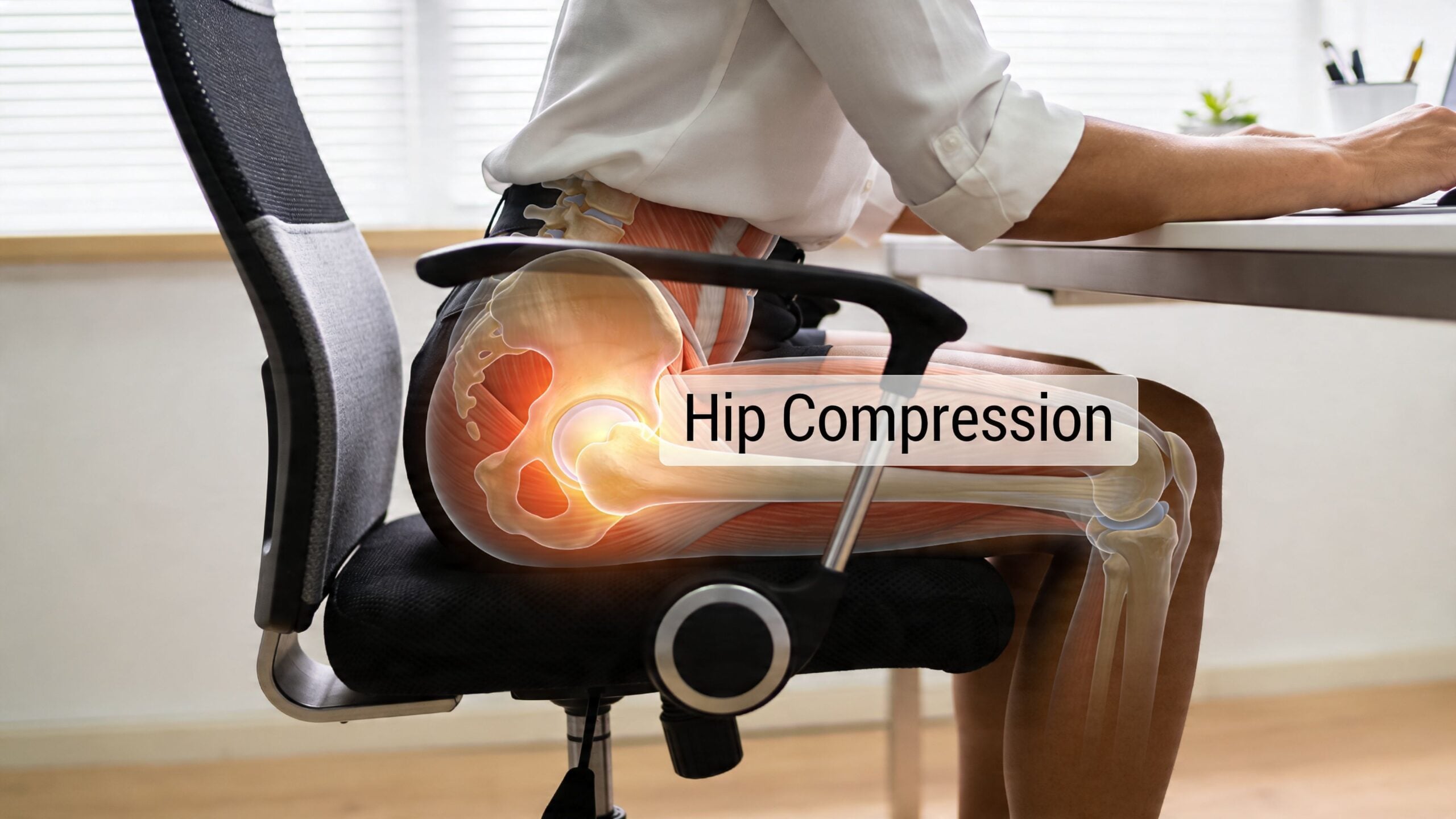
Sitting puts your hips in a very specific position for a very long time. That’s the issue.
Your hips spend hours bent. The muscles at the front of the hip stay shortened. The muscles that should help extend and stabilize the hip don’t do much at all. Over time, that creates a mismatch between mobility and strength.
The front gets tight and the back goes quiet
Think of your hip flexors as a spring held in a shortened position. They’re not necessarily “damaged,” but they stop tolerating length well. When you stand up, that spring has to open quickly. If it’s stiff, the front of the hip can feel pinchy or tense.
At the same time, your glutes act like watchdogs that fell asleep on the job. They should help drive hip extension and control your pelvis when you rise from a chair. After long periods of sitting, they often contribute less than they should.
Evidence summarized in physical therapy literature notes that prolonged sitting can intensify this imbalance after 40 to 50 hours weekly, with hip flexor stiffness increasing by up to 25% after 4 hours and hip extension strength weakening by 20% to 30% upon standing (Forte Orthopedics on hip pain from sitting).
Why standing up feels worse than sitting down
Individuals often don’t feel the problem while they’re still seated. They feel it during the transition.
That’s because standing requires three things at once:
- Hip extension: The front of the hip has to lengthen.
- Glute recruitment: The back of the hip has to produce force.
- Pelvic control: Your pelvis has to move from a flexed sitting posture into a more balanced standing position.
If your hip flexors are stiff and your glutes are underperforming, the front of the joint can take more stress. Some people describe this as a pinch. Others call it a jam, tug, or gripping sensation.
Practical rule: If standing up hurts but walking for a minute helps, stiffness and muscle imbalance are high on the list. If walking keeps making it worse, look harder at tendon or joint irritation.
Why stretching alone often doesn’t solve it
Stretching can help, but it’s only half the job.
If you lengthen the front of the hip without teaching the glutes and trunk to control the new range, your body often falls back into the same pattern. That’s why many people say, “I stretch every day, but it keeps coming back.” They improved mobility but not the movement strategy.
Relief usually comes faster when you pair mobility work with strengthening and movement breaks. The hip needs room to move, but it also needs the right muscles to take over when you stand, walk, and climb stairs.
Decoding Your Hip Pain Common Causes
Not all hip pain after sitting points to the same structure. Location matters. The type of pain matters. What happens after the first few steps matters.
A landmark UK study found that prolonged workplace sitting was a significant independent risk factor for hip pain, raising the odds by 82% compared with no prolonged sitting exposure (Annals of the Rheumatic Diseases study on workplace exposure and hip pain). That tells us sitting is a real contributor. It doesn’t tell us which tissue is irritated in your case.
Front of hip pain
If you feel pain in the front of the hip or groin, a hip flexor problem is one possibility. This often feels sharp, pulling, or pinching when you first stand and when you take a longer stride. It may also flare with uphill walking, lunges, or getting out of a low car seat.
Joint-related pain can also live in the same area. Hip osteoarthritis often causes a deeper stiffness rather than a quick muscular tug. People commonly describe needing a few steps to “get going.”
Side of hip pain
Pain on the outside of the hip often points toward the gluteal tendons. People may call this bursitis, but many cases behave more like tendon irritation than a simple inflamed bursa. This pain often worsens when lying on that side, climbing stairs, or standing on one leg to get dressed.
If you also get lateral thigh discomfort, it helps to distinguish tendon pain from irritation along the outer thigh. If that sounds familiar, our guide to iliotibial band syndrome at the hip can help you sort out what belongs to the IT band region and what doesn’t.
Deep buttock pain
A deep ache in the buttock can come from the piriformis region, the glutes, or pain referred from the low back. If you feel burning, tingling, or symptoms that travel down the leg, a nerve may be involved. If it feels more like a knot or pressure deep in the buttock after sitting on a hard chair, the hip rotators and nearby tissues may be the more likely source.
This is where posture and pressure matter. If you sit a lot for work, sitting doesn’t have to be a pain in the butt offers practical seating ideas that can reduce constant pressure on the buttock and side hip.
A few self-assessment cues
Use these as clues, not as a final diagnosis:
- Pain that improves after several steps: More consistent with stiffness, mild joint gelling, or tight hip flexors.
- Pain with lying on the painful side: More consistent with gluteal tendon irritation.
- Burning or radiating pain: Raises suspicion for nerve involvement.
- Sharp groin pinch with deep bending: More suggestive of front-of-hip compression or intra-articular irritation.
- Morning stiffness plus pain after rest: Often fits joint-related causes more than a pure muscle problem.
If your pain is easy to point to with one fingertip on the outside of the hip, think tendon or local soft tissue first. If it feels deep, hard to localize, or tied to back symptoms, widen the investigation.
Differentiating your hip pain symptoms
| Condition | Typical Pain Location | Pain Sensation | Key Differentiator |
|---|---|---|---|
| Hip flexor tendinopathy or tight hip flexors | Front of hip, groin | Pulling, pinching, tight | Worse when standing tall after sitting or taking a long stride |
| Gluteal tendinopathy | Outside of hip | Achy, tender, sometimes sharp | Worse with lying on that side, stairs, or single-leg standing |
| Hip osteoarthritis | Groin, front of hip, sometimes outer hip | Deep stiffness, ache | Often feels stiff after rest, then eases somewhat with gentle movement |
| Piriformis syndrome or sciatica | Deep buttock, may travel down leg | Burning, aching, radiating | May include tingling, numbness, or leg symptoms |
| Referred pain from low back or SI region | Buttock, side hip, groin | Diffuse ache | Hip movement alone doesn’t fully explain symptoms |
Immediate Relief Strategies for Aching Hips
If your hips hurt after sitting, the first goal isn’t to crush a workout. It’s to interrupt the pattern that keeps irritating the area.
That matters even more at home. Recent 2025 data reported that 58% of US remote workers had musculoskeletal pain tied to inadequate home setups like couches or kitchen chairs, and the same source notes that standing desks alone aren’t enough without regular movement breaks (Franciscan Health on hip pain and stiffness after sitting). The takeaway is simple. Position matters, but movement matters more.
Reset your sitting setup
You don’t need a perfect ergonomic lab. You do need a setup that stops feeding the problem.
- Choose a firmer seat: Deep, soft couches keep the hips flexed and the pelvis slumped.
- Bring the floor to your feet: If your feet dangle, use a footrest or sturdy stack of books.
- Raise low seats when needed: A folded towel or cushion can make standing easier and reduce front-of-hip compression.
- Keep work at elbow height: If your laptop is too low, your whole body folds forward.
Use movement snacks, not marathon breaks
Long breaks are great when you can take them. Often, however, they are not taken. Short breaks are more realistic and often more effective.
Try this cycle during work blocks:
- Stand up.
- Walk for a minute or two.
- Do one hip-opening stretch.
- Do one glute activation drill.
- Sit back down with your posture reset.
That whole sequence can take less time than checking your phone.
A standing desk helps only if you actually change position. Static standing can irritate the same body that static sitting irritates.
Pick the right kind of relief
A few same-day tools work well when matched to the right symptom:
- For muscle tightness: Gentle heat can help the front of the hip or buttock relax.
- For a sore, irritated outer hip: Cold may calm symptoms after activity.
- For uncertainty about which to use: This guide on heat vs cold compress breaks down when each option fits best.
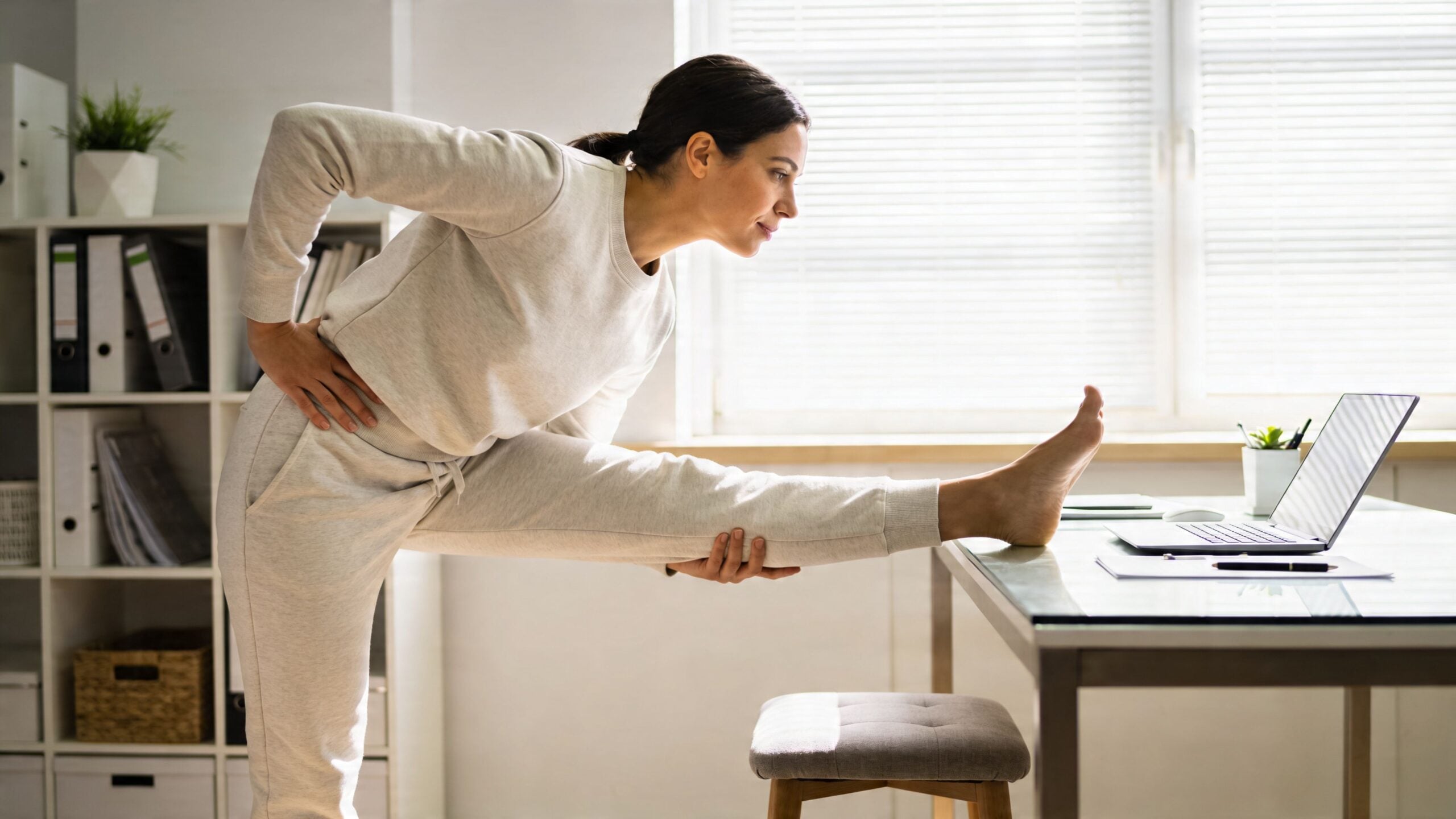
Desk-friendly stretches can also help if you keep them gentle. A seated figure-four stretch targets the buttock. A standing hip flexor stretch opens the front of the hip. If a stretch creates sharp pinching in the groin, stop and switch to a different approach. Painful hips after sitting usually respond better to frequent, moderate resets than to one aggressive stretching session at night.
A Progressive Exercise Guide to Build Resilient Hips
Quick relief is useful. Lasting change comes from giving the hip a better job to do.
That matters across the lifespan. In US adults over 60, 14.3% reported significant hip pain on most days over the prior 6 weeks, and severe hip pain was more common in inactive people, affecting 18.4% of those without leisure-time physical activity versus 12.6% of active individuals (NHANES III analysis on hip pain prevalence and inactivity). Exercise isn’t just conditioning. It changes how the hip tolerates daily life.

Mobility track
Start here if your main problem is stiffness when you first stand.
Half-kneeling hip flexor stretch
Set one knee on the floor and the other foot in front. Gently tuck your pelvis under, then shift forward until you feel the stretch in the front of the hip on the kneeling side. Don’t arch your low back.
- Dose: 2 to 3 rounds per side
- Hold: brief, comfortable holds
- Why it helps: It gives the front of the hip room to lengthen again
Figure-four stretch
Lie on your back or sit tall in a chair. Cross one ankle over the opposite knee. If tolerated, lean forward slightly in sitting or pull the uncrossed leg toward you in lying.
- Best for: Buttock tightness and deep posterior hip stiffness
- Skip it if: It causes sharp front-of-hip pinching
Progression option
If the basic hip flexor stretch becomes easy and symptom-free, move toward longer-lever variations. For more options, see these best stretches for tight hip flexors.
Strength track
Start here if the hip feels weak, unstable, or cranky when you rise from a chair.
Level 1 bridge
Lie on your back with knees bent and feet flat. Tighten your lower abdominals gently, squeeze your glutes, and lift your hips. Lower with control.
- Dose: 2 to 3 sets of comfortable repetitions
- Why it helps: Reintroduces hip extension without a lot of joint load
Level 2 sit-to-stand
Use a chair that doesn’t force you too low. Scoot toward the edge, lean your chest slightly forward, press through both feet, and stand. Sit back down slowly.
This is one of the best real-world exercises because it trains the exact movement that hurts.
- Cue: Push the floor away
- Watch for: Knees collapsing inward or shifting hard to one side
Level 3 single-leg bridge or split squat
These are later-stage options. They ask more from the glutes and pelvic stabilizers, so they fit once your pain is settling and your basic bridge and sit-to-stand are solid.
- Use them for: Rebuilding strength for stairs, hills, and sport
- Avoid them early if: Your hip is still sharp or highly irritable
Match the exercise to the symptom
This is the detective work that typically goes untaught.
- Front-of-hip tightness after sitting: Emphasize mobility first, then bridges and controlled sit-to-stands.
- Outer hip pain with stairs or lying on that side: Emphasize gradual glute strengthening and avoid aggressive side compression.
- Deep buttock symptoms from sitting pressure: Use position changes, gentle figure-four work, and progressive glute activation.
- Joint-like stiffness that eases once moving: Start with small-range movement, then build strength without forcing deep painful flexion.
What works: Gentle consistency, symptom-guided progressions, and exercises that improve how you stand, walk, and climb.
What usually doesn’t: One hard stretch, random online workouts, or pushing through sharp groin pain.
One practical option for people who need a personalized progression is Highbar Physical Therapy, which offers one-on-one outpatient PT and telehealth evaluations for movement assessment and individualized exercise planning.
Recognizing Red Flags When to See a Physical Therapist
Most cases of painful hips after sitting are mechanical and respond well to the right exercise, load management, and movement changes. Some symptoms need a professional evaluation sooner.
Pay attention if you have any of these:
- You can’t bear weight: If standing or walking feels unsafe, don’t try to exercise through it.
- Pain is sudden and severe: A rapid change without a clear explanation deserves more than home stretching.
- The hip locks, catches, or gives way: Occasional stiffness is one thing. Repeated mechanical blocking is another.
- You have numbness, tingling, or spreading weakness: That raises concern for nerve involvement.
- Pain wakes you at night or is present at rest: Especially if it isn’t changing with position.
- Symptoms are getting worse, not just lingering: Progressive loss of motion, strength, or function matters.
A physical therapist helps separate muscle tightness from tendon overload, joint stiffness, and referred pain from the back or pelvis. That distinction changes the plan. The wrong exercise can keep a problem simmering for months. The right one often feels different within days to weeks because it addresses the actual driver of the pain.
If you’ve tried generic stretching and it keeps coming back, that’s usually the point where an evaluation saves time.
Find Lasting Relief with Expert Guidance
Hip pain after sitting can feel simple on the surface. You sit, you stand, it hurts. In practice, it’s more nuanced. The symptom may come from shortened hip flexors, underactive glutes, irritated side-hip tendons, joint stiffness, or pain referred from somewhere nearby.
That’s why the best plan is usually not the most aggressive one. It’s the most accurate one.
A good physical therapy evaluation looks at where your pain is, what movement triggers it, how your strength and mobility interact, and which daily habits keep feeding the problem. Then the exercises make sense. You know why you’re doing them, what they should feel like, and when to progress.
That kind of guidance also helps with trade-offs. Some people need more mobility before strength work. Others need less stretching and more load tolerance. Some need seat changes and movement breaks more than they need another exercise sheet. When the plan matches the pattern, painful hips after sitting become much more manageable.
If your hip keeps barking every time you stand up, getting help early can prevent a short-term nuisance from turning into a persistent limitation.
If you want help figuring out what’s causing your hip pain and what to do next, Highbar Physical Therapy offers evaluations with licensed physical therapists who can assess your movement, build a personalized plan, and guide you in person or through telehealth.