Radiating pain is a tricky thing. It’s that sharp, shooting, or electric-shock feeling that seems to travel, moving from its source to a totally different spot. It isn't your typical muscle ache—it’s a clear signal that a nerve is irritated or compressed somewhere along its path.
This means the discomfort you feel zinging down your leg, for example, might actually be coming from a problem in your lower back.
Decoding What Radiating Pain Means

Have you ever felt a sudden, sharp pain shoot down your leg when you stand up? Or a strange tingling that travels all the way from your neck into your fingertips? If so, you’ve experienced radiating pain firsthand. It’s a distinct sensation that feels completely different from a localized ache, like a bruise that only hurts right where you press it.
Think of your nervous system as an incredibly complex electrical grid. Your nerves are the wires, carrying signals from your brain to every part of your body and back again. When a nerve gets pinched, inflamed, or compressed—often where it exits the spine—it sends a faulty signal down the entire length of that "wire."
Key Insight: The most important thing to understand about radiating pain is that the location of your pain is not always the location of the problem. The sensation you feel is an urgent message from your nervous system, pointing to an issue somewhere else entirely.
To help you better understand what you might be feeling, let's compare radiating pain directly with the more common localized pain.
Radiating Pain vs Localized Pain at a Glance
This table quickly breaks down the key differences to help you identify your symptoms more clearly.
| Symptom | Radiating Pain | Localized Pain |
|---|---|---|
| Sensation | Sharp, shooting, electric, burning, or tingling ("pins and needles"). | Dull, achy, sore, or throbbing. |
| Location | Travels along a specific path, often down an arm or leg. | Stays in one specific, well-defined area. |
| Source of Pain | The problem is often far from where you feel the pain (e.g., a back issue). | The problem is usually right where the pain is (e.g., a bruise). |
| Common Triggers | Certain movements or positions (like bending or sitting) that compress the nerve. | Direct pressure on the area, or use of a specific muscle/joint. |
| Associated Signs | May include numbness, weakness, or a loss of reflexes in the affected limb. | Swelling, redness, or tenderness to the touch at the site. |
Recognizing which category your pain falls into is a huge first step toward getting the right kind of help.
It’s Not Just a Feeling, It’s a Clue
This traveling discomfort is your body’s way of handing you a major clue about what’s really going on. Unlike a dull ache that stays put, these radiating symptoms help experts—like our physical therapists here at Highbar—trace the pain back to its true source. A simple example of this is when an earache causes a headache; the discomfort originates in one area but is felt in another.
Understanding this distinction is the first step toward finding real, lasting relief. Keep an eye out for these common characteristics:
- Sharp, shooting, or "electric shock" sensations.
- Numbness or a "pins and needles" feeling.
- A sense of weakness in the arm or leg.
- Pain that follows a very specific, defined path, like a stripe down the back of your leg.
By learning to recognize these signs, you can give your physical therapist the information they need to get to the bottom of it. This knowledge empowers you to move beyond temporary fixes and start addressing the underlying issue, so you can get back to living your life.
Uncovering the Root Causes of Radiating Pain
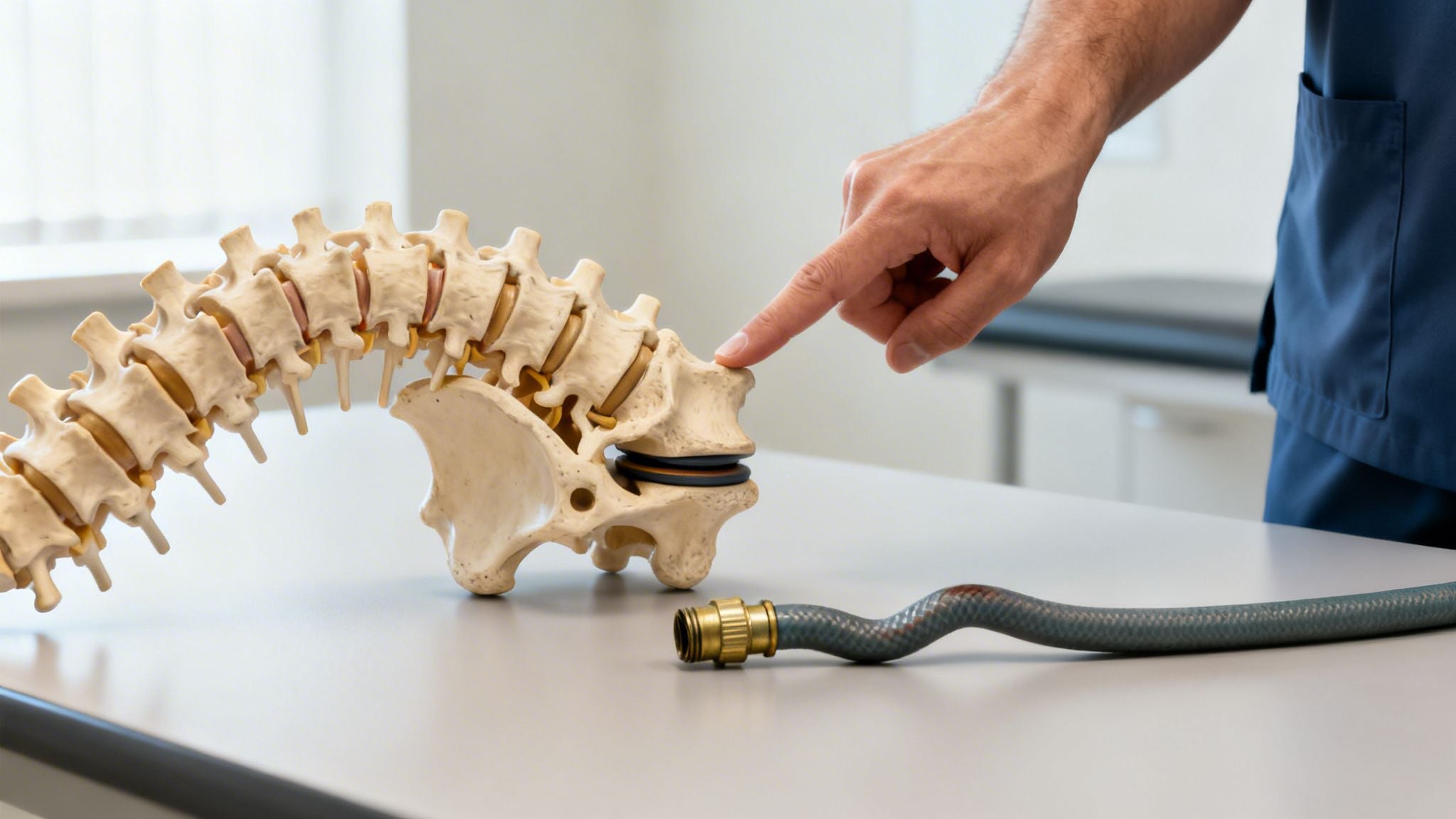
So, where does radiating pain actually come from? Almost always, it’s a signal that a nerve is being irritated, compressed, or inflamed somewhere along its journey—most often right where it leaves the spinal column. The sharp pain shooting down your arm or leg is just the final stop on that nerve’s pathway.
Think of it like a garden hose. If you’re watering your flowers and someone steps on the hose back at the spigot, the flow at the nozzle turns into a trickle. Your nervous system works in a similar way. When something puts pressure on a nerve in your spine, it disrupts the signal and creates symptoms—like pain, tingling, or weakness—much further down the line.
This is exactly why an experienced physical therapist won't just look at your leg when that’s where the pain is. We trace it back to the source, looking for that "kink in the hose." The real key to relief is figuring out what’s causing the compression in the first place.
Common Conditions That Cause Nerve Compression
Several common spinal issues are notorious for irritating nerves and causing that tell-tale radiating pain. At their core, each one creates a mechanical problem that crowds a sensitive nerve root.
Herniated Disc: Your spinal discs are like soft, gel-filled cushions between your vertebrae. If a disc’s tough outer layer tears, the gel-like center can bulge or leak out, pressing directly onto a nearby spinal nerve. This is a classic cause of sharp, shooting symptoms.
Spinal Stenosis: This condition is a narrowing of the spinal canal—the bony tunnel that protects your spinal cord and nerve roots. Often due to age-related changes like bone spurs, this narrowing slowly eats away at the space your nerves need, eventually leading to compression.
Sciatica: You've probably heard this term before. Sciatica isn’t a diagnosis itself, but rather a symptom that describes pain traveling along the sciatic nerve. It’s the longest nerve in your body, running from your lower back all the way down each leg, and it's most often irritated by a herniated disc or spinal stenosis in the lumbar spine.
Spondylolisthesis: This happens when one vertebra slips forward over the one beneath it. That slight misalignment can be just enough to pinch the nerve root exiting at that level, triggering pain that radiates away from the spine.
Understanding the mechanical nature of these problems is the first step toward fixing them. This isn't some mysterious pain; it's a structural issue that requires a targeted, physical solution.
Radiating low back pain is a significant signal that distinguishes nerve-related issues from simple muscle strains. Studies have shown the mean incidence of this pain is 9.4 per 1000 person-years, while its prevalence is 17.2 per 1000 person-years, highlighting how frequently it appears in clinical settings. You can learn more about these findings by exploring the full research on radiating low back pain.
At Highbar Physical Therapy, our expert clinicians are trained to identify these root causes through a thorough evaluation. By understanding the "why" behind your pain, we can create a precise, effective treatment plan that addresses the source, helping you get better and return to a fuller life.
Recognizing Key Symptoms and Important Red Flags

Knowing that radiating pain often starts in the spine is one thing, but being able to describe what you’re actually feeling is the next crucial step. At Highbar Physical Therapy, we believe that understanding your symptoms empowers you to be a better partner in your own recovery.
Radiating pain is rarely a simple ache. It has a distinct "nerve" quality that feels different from muscle soreness. People often use very specific words to describe it, and these descriptions are like clues that help a physical therapist trace the problem back to its source.
A common culprit is a herniated disc injury in the spine. When the soft center of a disc bulges out and presses on a nerve root, it triggers that unique and often unsettling cascade of symptoms down your arm or leg.
Common Signs of Radiating Pain
Everyone's experience is a little different, but nerve-related pain tends to show up in a few classic ways. See if any of these sensations sound familiar:
- Shooting or Electric Sensations: A sudden, sharp pain that feels like a jolt of electricity zapping down a limb. It’s quick, shocking, and impossible to ignore.
- Burning Pain: This isn't a warm, soothing feeling. It's a persistent, hot, or searing sensation that travels along a very specific path.
- Tingling or "Pins and Needles": You know that feeling when your foot "falls asleep"? It's like that—what we call paresthesia—but it doesn't go away when you move around.
- Numbness: A partial or even complete loss of feeling in certain patches of skin. You might notice it when you touch the area or when something brushes against it.
- Muscle Weakness: This can be unnerving. You might find it hard to lift your foot, notice your grip isn't as strong, or feel like your leg might "give out" without warning.
These symptoms aren't random. They often follow a very predictable map along the nerve's path. Pain traveling down the back of the leg, for instance, is the classic sign of sciatica, while pain shooting from the neck to the hand points toward a problem in your neck (cervical radiculopathy).
Identifying the pattern of your pain is like giving your physical therapist a roadmap. Knowing exactly where the sensations travel helps us pinpoint which specific nerve root is irritated, leading to a more accurate diagnosis and a more effective treatment plan.
When to Seek Immediate Medical Attention
Most radiating pain responds incredibly well to physical therapy. However, some symptoms are considered “red flags.” These are serious signs that could point to a condition needing immediate medical evaluation to prevent permanent damage.
Do not wait to see a professional if you experience any of the following along with your radiating pain:
- Loss of Bowel or Bladder Control: Any new difficulty starting or stopping urination, or unexpected leakage.
- Numbness in the "Saddle" Area: This is a loss of sensation in your groin, inner thighs, and buttock region—the areas that would touch a saddle if you were riding a horse.
- Sudden and Severe Weakness: An abrupt inability to move your foot or significant weakness that appears suddenly in both legs.
- Pain Following a Major Trauma: Any radiating pain that starts after a significant event like a car accident or a bad fall.
These symptoms could signal a condition called cauda equina syndrome, which is a true medical emergency. While it's rare, it’s vital to act fast. For all other types of radiating pain, the expert clinicians at Highbar are ready to help you find relief and get back to your life.
How Physical Therapists Pinpoint the Problem

When you're dealing with pain that travels, a physical therapist essentially becomes a detective. Our job is to look past the obvious symptom—the pain in your leg or arm—and uncover the real source of the problem. At Highbar Physical Therapy, our clinicians don’t just ask where it hurts; we use a thorough, hands-on evaluation to figure out why it hurts.
This process is the critical first step. We listen carefully as you describe your symptoms, but we learn even more by watching you move. The way you walk, bend, and even sit can reveal subtle changes in your movement patterns that often point directly to the underlying issue.
This in-depth assessment is what sets physical therapy apart. We are trained to connect the dots between your radiating symptoms and a specific mechanical problem, allowing us to build a precise and effective plan for your recovery.
The Comprehensive Movement Assessment
The diagnostic process starts with a series of systematic tests designed to carefully recreate—and ultimately relieve—your symptoms. This isn't about causing pain; it's about understanding its behavior so we can get rid of it.
A key part of this is the functional movement screening. We might ask you to:
- Walk a short distance to observe your gait.
- Bend forward, backward, and side-to-side to see how your spine moves.
- Sit and stand to evaluate how pressure on your lower back changes.
These simple movements tell a complex story about your body's mechanics. For instance, if bending forward consistently sends a sharp pain down your leg, that gives us a strong clue that a disc issue might be involved. This process is central to what we cover in our guide on what to expect at physical therapy for lower back pain.
Specialized Nerve and Strength Testing
After observing your general movements, we get more specific to confirm our suspicions and isolate the exact nerve involved. This is where the real detective work gets focused.
These tests include:
- Neurological Screening: We'll check your reflexes, sensation (your ability to feel light touch), and muscle strength. A weak reflex or a patch of numbness helps us map the pain directly to a specific nerve root in your spine.
- Nerve Tension Tests: These are special movements that gently place a stretch on the nerves. The Straight Leg Raise test, where you lie on your back while the therapist carefully lifts your leg, can show definitively if the sciatic nerve is irritated.
By combining these findings, a physical therapist can accurately pinpoint which nerve is compressed and what’s causing it. This precise diagnosis is the foundation for everything that follows—it ensures your treatment targets the root cause, not just the symptoms.
The global rise in low back pain, much of which involves radiating symptoms, shows just how widespread this kind of nerve-related agony is, especially for working adults. Between 1990 and 2021, low back pain cases among this group jumped by 52.66% to 452.8 million worldwide, leading to significant lost productivity. You can explore the full scope of these findings in research on global low back pain prevalence. This is why a precise diagnosis from a movement expert is so vital—it’s the fastest path to getting you better and back to living your life.
Proven Treatments to Stop Radiating Pain
Getting a clear diagnosis is a huge step, but the real work begins with a targeted treatment plan. At Highbar Physical Therapy, we don’t just chase symptoms. We focus on evidence-based treatments that get to the root of the mechanical problem causing your pain. Our goal isn't just to provide relief; it's to give you the understanding and tools to move freely again and live a fuller life.
Think of it like systematically taking pressure off an irritated nerve. It's not about masking the pain—it's about actively resolving the compression. By using specific movements and skilled, hands-on techniques, we can actually guide the pain out of your arm or leg and back toward the spine. That’s a key sign that healing is underway.
Centralizing Pain with Directional Preference
One of the most powerful tools in our arsenal for treating radiating pain is a concept called centralization. This is the process of making the pain retreat from its furthest point—like your foot or hand—and move progressively closer to your spine. The primary way we achieve this is by finding your directional preference.
This simply means we work with you to find one specific direction of movement—like bending backward or shifting your hips to one side—that consistently makes your symptoms better and brings them closer to the source. This technique, a core part of the McKenzie Method, is incredibly effective because it directly addresses the mechanical problem.
For instance, if a herniated disc is pressing on a nerve, there might be a specific extension movement that helps gently guide that disc material away from the nerve root. Finding that one, reliable, pain-relieving direction can be a complete game-changer for recovery.
Restoring Movement with Targeted Techniques
Beyond just finding that key movement, we use a combination of techniques to restore healthy nerve function and get you moving comfortably again. These methods all work together to reduce irritation, improve mobility, and calm the system down.
- Nerve Gliding (or 'Nerve Flossing'): Your nerves need to slide and glide smoothly through surrounding tissues as you move. When a nerve gets pinched or "stuck," these gentle, specific exercises help restore its natural mobility. It’s a lot like flossing to free up something caught between your teeth.
- Manual Therapy: This is where our hands-on expertise comes in. A therapist uses skilled pressure to mobilize tight joints, release constricted muscles, and manually take pressure off a compressed nerve root. This can provide immediate relief while improving spinal mechanics.
- Trigger Point Dry Needling: Sometimes, stubborn knots in the muscles around the spine are a big part of the problem, contributing to nerve irritation. As you can learn more about trigger point dry needling, this technique involves using a very thin needle to release these trigger points, which helps reduce muscle tension and pain.
The Goal of Treatment: Every technique is chosen with a clear purpose—to reduce mechanical stress on the nerve, improve blood flow for healing, and restore your ability to move without pain. You become an active partner in this process, equipped with the right strategies to accelerate your own recovery.
The impact of radiating pain is enormous. Low back pain, which is one of the most common causes, was the leading cause of disability globally, with 619 million cases in 2020. This shows just how critical effective, evidence-based care is for getting people back to their lives. For more details on these statistics, you can explore the full research on its societal impact.
It's Time to Address Your Radiating Pain
Understanding what's causing that shooting or traveling pain is a critical first step. But real relief comes from taking action. That radiating sensation is a clear signal—your body is telling you a nerve is irritated. The good news is that physical therapy is often the most direct and effective way to get to the root of the problem.
Don't wait for the discomfort to become your new normal. You have the power to take control of your health.
At Highbar Physical Therapy, we make it easy to get started. You have direct access to our expert clinicians, which means you don't need a physician referral to book an appointment. Our team is passionate about helping you move freely again, and we believe in empowering you with knowledge. Our guide on how to choose a physical therapist is a great resource for making an informed decision.
Book an appointment today and let our team build a plan that gets you back to living without limitations.
Frequently Asked Questions About Radiating Pain
When you’re dealing with radiating pain, it’s natural to have questions. Our physical therapists hear them every day, so we’ve gathered the most common ones to give you clear, expert answers.
We want you to have the right information so you can feel confident taking the next step toward a life without this disruptive pain.
How Long Does It Take for Radiating Pain to Go Away?
This is the number one question we get, and the honest answer is: it depends. Every person’s recovery journey is unique, but most of our patients start feeling real, noticeable relief within a few weeks of consistent physical therapy.
The single most important factor is often how quickly you get started. Our main goal at Highbar Physical Therapy is to show you measurable progress early in your treatment. We do this by zeroing in on the mechanical root of the problem, instead of just chasing the symptoms.
Is It Better to Rest or Stay Active?
While a short period of rest might calm a nerve that’s acutely flared up, too much inactivity almost always makes radiating pain worse. Your nerves need healthy movement and good blood flow to heal properly.
The best strategy is what we call “relative rest.” This means you stop doing the specific things that make your pain worse, but you continue with gentle, targeted movements that actually help it feel better. A physical therapist is an expert at prescribing the right "dose" of activity—showing you the exact movements that promote healing without making the nerve angrier.
Key Takeaway: Total bed rest is rarely the right answer for radiating pain. The right kind of movement is often the best medicine, and a physical therapist is the ideal guide to prescribe it.
Can Physical Therapy Prevent This Pain from Returning?
Absolutely. In fact, we believe that preventing the pain from coming back is just as important as fixing it in the first place. It’s a core part of our philosophy.
Once we’ve calmed down your immediate radiating pain, our focus shifts to long-term solutions. We work with you to build core strength, fine-tune your posture and body mechanics, and teach you how to protect your spine during everyday life—whether you're lifting groceries or sitting at a desk. This is what truly great physical therapy is all about. We don’t just want to solve your current problem; we want to give you the tools and knowledge to keep it from ever happening again.
Do I Need an MRI Before Starting Physical Therapy?
In the vast majority of cases, the answer is no. A licensed physical therapist is highly trained to perform a thorough clinical evaluation to accurately pinpoint the source of radiating pain. An MRI often isn't necessary to get started.
Starting with conservative care like physical therapy is the recommended, evidence-based first step. Your therapist will conduct a detailed examination, and if any "red flag" symptoms pop up, they will immediately refer you to the right physician for further investigation.
Don't let radiating pain dictate how you live your life. At Highbar Physical Therapy, our expert team is ready to help you feel better, move without fear, and get back to doing what you love.
Take the first step toward getting your life back. You can learn more about our approach at https://highbarhealth.com and book your appointment today.