You bend to grab a laundry basket, twist to load the dishwasher, or stand up after a long meeting and feel that familiar tug across your lower back. For a lot of people, that moment feels random. It usually isn’t. Your back muscles have been working the whole time, often unnoticed and without credit, until one part of the system stops sharing the load well.
Most patients don’t think about their back muscles until they hurt. That makes sense. You don’t feel the deep stabilizers doing their job when you’re walking, reaching, breathing, or sitting upright. You notice them when the system gets overloaded, stiff, guarded, or painfully reactive.
Why Your Back Muscles Are the Unsung Heroes of Daily Life
Back muscles do far more than “help you stand up straight.” They keep your spine organized while your arms move, your rib cage expands, and your body shifts weight from one leg to the other. They act like a live support system that’s constantly adjusting to gravity, motion, and load.
That’s why back pain is so common. According to the CDC, 39% of U.S. adults reported back pain in the past three months, and prevalence increased significantly with age in the National Health Interview Survey summary. In daily practice, that tracks with what patients describe. The pain often shows up during ordinary tasks, not dramatic injuries.
Everyday movement depends on them
A healthy back muscle system helps you:
- Transfer force efficiently when you pick up a child, a bag of groceries, or a suitcase
- Control motion so you can bend forward without collapsing into the joints
- Hold posture with less effort when you sit, stand, walk, or reach overhead
- Stabilize while breathing because the rib cage, spine, and trunk muscles work together
When these muscles are coordinated, movement feels smooth. When they aren’t, your body usually finds a workaround. That workaround may keep you functioning for a while, but it often shifts excess demand into the wrong tissues.
Practical rule: Back pain doesn’t always mean your back is weak. It often means the right muscles aren’t contributing at the right time.
Why this matters for quality of life
Patients sometimes assume back muscles are mainly a gym topic. They’re not. They’re a function topic. Your ability to garden, sleep comfortably, carry things, exercise, travel, and work at a desk all depends on how well your back muscles manage motion and load.
The key point is simple. Your back isn’t one big muscle. It’s a layered system with large movers, smaller stabilizers, and deep muscles that guide spinal control segment by segment. If you understand that ecosystem, back pain starts to make more sense. So does recovery.
Anatomy of the Back A Tour from Superficial to Deep
The back is built in layers. That’s the easiest way to understand it. Consider a house. The outer parts help you interact with the world. The inner structure keeps the building stable. If you only look at the siding, you miss the frame.
The back’s musculature includes around 40 pairs of muscles organized into three main layers: superficial, intermediate, and deep intrinsic layers, all connected through the thoracolumbar fascia, as described in the WHO low back pain overview.
The outer layer handles bigger visible movement
The superficial muscles are the larger, more familiar ones. These are involved in shoulder girdle and upper limb motion. They help with pulling, reaching, and controlling the shoulder blade.
When patients point to the broad muscular area across the upper or mid-back, they’re usually talking about this outer layer.
The middle layer supports breathing
The intermediate layer is smaller in scope but still important. These muscles help the thoracic cage move. That means they contribute to breathing mechanics, especially around the rib-spine relationship.
People with back stiffness sometimes notice they also feel tight with deep breaths or rotational movement through the rib cage. That’s not a coincidence.
The deepest layer is the true spinal support system
The intrinsic back muscles are the closest to the spine. These are the muscles PTs care about a lot when someone has recurring pain, poor segmental control, or symptoms that return every time they “throw their back out.”
They’re less about big showy movement and more about control, timing, balance, and posture.
| Layer | Key Muscles | Primary Function |
|---|---|---|
| Superficial | Trapezius, latissimus dorsi, rhomboids, levator scapulae | Shoulder and upper limb movement |
| Intermediate | Serratus posterior muscles | Thoracic cage motion and breathing support |
| Deep intrinsic | Erector spinae, multifidus, semispinalis, rotatores | Spinal stability, posture, proprioception, segmental control |
A blueprint patients can actually use
Here’s the practical takeaway from that anatomy. If your upper back gets sore after carrying, rowing, or lifting overhead, the larger superficial muscles may be overworking. If your back “goes out” during a simple bend or after prolonged sitting, the issue often involves the deeper stabilizing layer not organizing the spine well enough.
The deeper the muscle, the less likely you are to isolate it by accident.
That’s why generic advice can miss the mark. Telling every patient to “strengthen your back” is like telling someone to “fix your house” without checking whether the issue is the roof, wiring, or foundation.
How Your Back Muscles Work in Harmony
Your back muscles don’t take turns neatly. They overlap, trade jobs, and adjust in real time. A better comparison is an orchestra. The large muscles create power and range. The smaller deep muscles keep timing, tension, and control from falling apart.
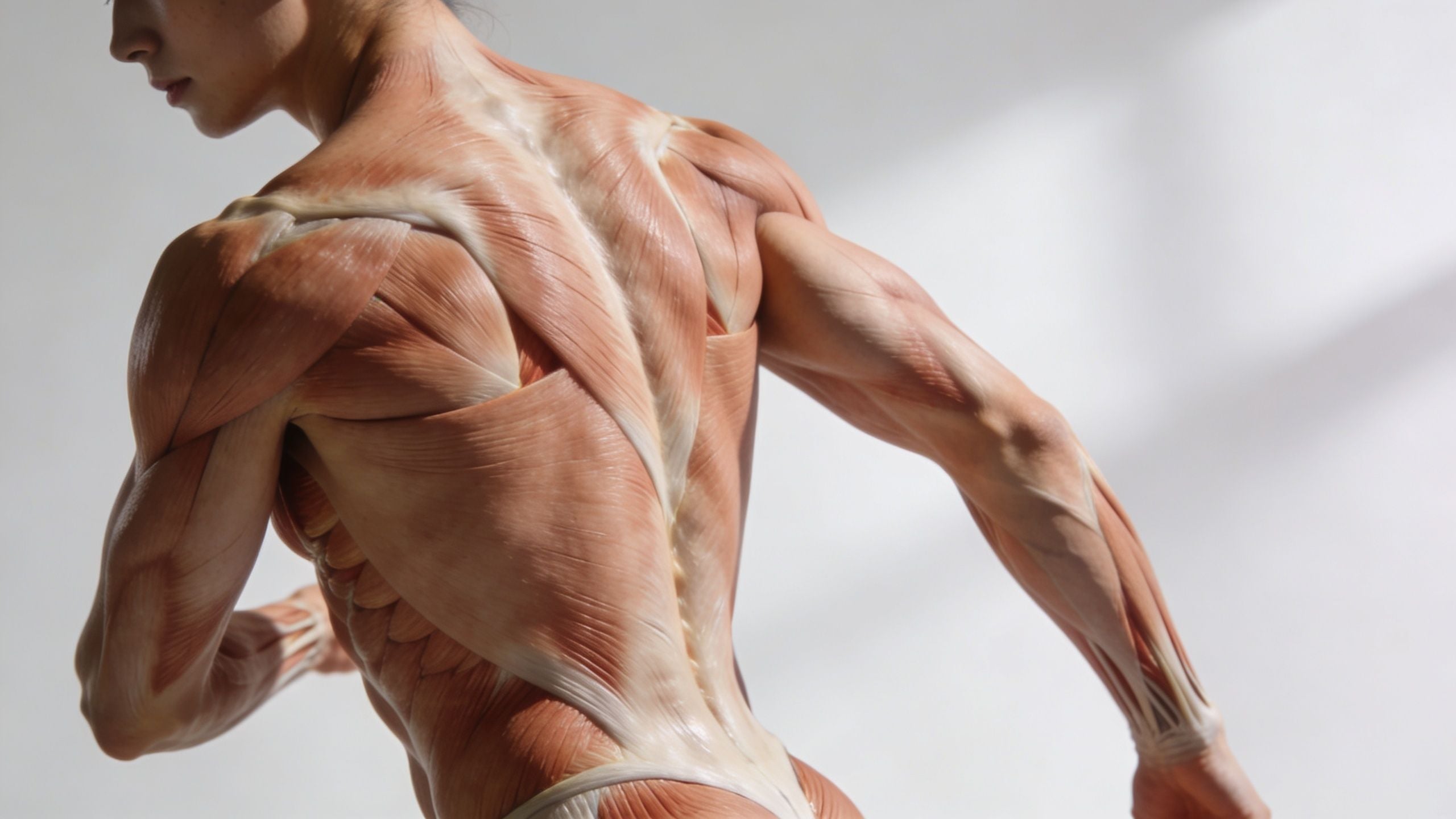
Movers and stabilizers do different jobs
The broad outer muscles create visible action. They help extend the trunk, rotate the torso, and coordinate shoulder movement with the spine. They’re built to generate force.
The deeper muscles work more like guy wires on a mast. They don’t need to create dramatic motion to matter. Their job is to keep each spinal segment from drifting, hinging, or shearing more than it should while the rest of the body moves.
When those small stabilizers are doing their job, larger muscles can work efficiently. When they’re late, inhibited, or fatigued, the bigger muscles often stiffen up and try to take over. That compensation may feel like “tightness,” but tightness is often a sign of overprotection, not a sign that more stretching alone will solve the problem.
Your back also acts like a sensor system
Deep back muscles help with proprioception, which is your body’s sense of position and movement. They give the nervous system constant information about where the spine is in space.
That matters during ordinary tasks:
- Bending forward without folding into one painful segment
- Rolling in bed without a sudden catch
- Walking uphill while controlling trunk sway
- Reaching overhead without arching through the low back
A patient may say, “My back feels unstable,” even when imaging looks unimpressive. That feeling can be very real. Stability isn’t just about bone shape. It’s about whether the muscular system is giving the spine good control.
Strong back muscles matter, but coordinated back muscles matter more.
Why one weak link changes the whole pattern
The body hates wasted movement. If one layer isn’t contributing well, another layer picks up the slack. That’s how people end up with pain far from the original problem. A deep lumbar control issue can show up as upper back tension. Limited rib movement can increase low back strain. Hip stiffness can make the spine move too much.
This is why two people can describe “the same back pain” and need completely different rehab plans.
The Root Causes of Back Muscle Pain and Stiffness
Most back muscle pain isn’t mysterious. It usually comes from a mismatch between what the tissues were asked to do and what they were prepared to tolerate. Sometimes that mismatch is sudden. Sometimes it builds gradually through repetition, posture, previous injury, or lack of recovery.

Over 80% of adults will experience low back pain at some point, and most cases are mechanical in nature, meaning they relate to tissues like muscles, ligaments, and joints rather than a more serious disease process. That framing appears in the CDC-backed material summarized earlier, and it’s one of the most important facts for patients to understand.
The sudden overload problem
This is the classic strain pattern. You lift, twist, catch something awkwardly, or do a task your body hasn’t practiced in a while. The muscles don’t fail because they’re bad. They fail because demand arrived faster than control.
Common examples include:
- Weekend overload after a mostly sedentary week
- Fast twisting under load while moving furniture or sports equipment
- Reaching from a poor position instead of stepping closer
- Fatigue-based form breakdown near the end of a workout or long workday
The slow-build pattern
Chronic irritation often comes from repetition, sustained posture, or underused movement options. Sitting itself isn’t evil, but sitting for long stretches with very little variation can reduce contribution from the deep stabilizers and increase load on tissues that are trying to hold you upright by brute force.
If you spend much of the day at a computer, it’s worth cleaning up the basics of workstation setup and movement breaks. This guide on improving posture while sitting at a desk is a practical place to start.
Inhibition and imbalance are the missing piece
Many people face a common challenge. After pain, injury, or prolonged guarding, some deep muscles stop contributing well. The body then leans on larger, more superficial muscles. Those muscles get overworked, irritable, and stiff.
That’s why these pairings are so common:
| What you feel | What may be happening underneath |
|---|---|
| Tight low back after sitting | Deep stabilizers under-contributing, larger extensor muscles holding tension |
| Recurrent “throwing out” episodes | Segmental control problem rather than simple inflexibility |
| Mid-back ache during desk work | Shoulder girdle and thoracic muscles doing too much postural holding |
| Pain with simple bending | Poor load-sharing through hips, trunk, and deep spinal stabilizers |
Painful back muscles are often working hard. They’re just working in the wrong role.
Common Conditions Related to Back Muscle Issues
Patients hear many labels for back pain. Some are useful. Some are vague. What matters most is understanding what each term usually means and what it doesn’t mean.
Muscle strain
A muscle strain is an injury to muscle fibers or the muscle-tendon unit. It often happens with lifting, twisting, acceleration, or unexpected load. Symptoms usually include localized pain, tenderness, and pain with certain movements or muscle contraction.
A strain doesn’t automatically mean severe damage. In many cases, it means the tissue was overloaded and became reactive.
Muscle spasm
A muscle spasm is a protective contraction. Patients describe it as gripping, seizing, or locking. It can feel dramatic, but the spasm itself is usually the body’s attempt to limit motion it perceives as threatening.
Spasm is a response, not a full diagnosis. The next question is why the muscle is protecting in the first place.
Myofascial trigger points
These are sensitive, irritable spots in muscle that can produce local tenderness and sometimes referred pain. They’re common in overworked postural muscles and in areas that have been bracing for too long.
Patients often say, “There’s one knot I can press on.” That can be a useful description, but the knot is rarely the whole story. Trigger points often reflect a larger movement problem.
Guarding and movement fear
Not every painful back presents as a formal tissue injury. Sometimes the main issue is guarding, where the nervous system limits motion and increases muscular tension. The person feels stiff, vulnerable, and unstable, even with simple tasks.
This is common after an acute pain flare, after a previous injury, or after repeated episodes that taught the body to expect trouble from bending and twisting.
Deep stabilizer dysfunction
This is the category that often gets missed. A person may have relatively normal general strength but poor activation or timing of deep spinal muscles such as the multifidus or rotatores. The result is inefficient control, recurring flare-ups, and a sense that the back never feels fully dependable.
Two people can have the same MRI finding and very different muscle problems.
When the issue may be something else
Back pain can also come from structures outside the muscles, including discs, joints, nerves, or non-musculoskeletal causes. That’s why pattern recognition matters. Muscle-related pain often changes with posture, load, and movement. Pain that doesn’t behave mechanically, or that comes with major neurologic or systemic symptoms, needs medical evaluation.
A useful rule in clinic is this:
- If pain is linked to movement, muscle and mechanical factors are high on the list
- If pain is constant and unrelated to position, broaden the differential
- If symptoms include major weakness, saddle numbness, or bowel or bladder changes, seek urgent medical care
The label matters less than the plan. A diagnosis should help guide treatment, not just name the pain.
Rebuilding Your Back A PT's Approach to Rehabilitation
Good back rehab doesn’t start with random exercises. It starts with a better question: which part of the system isn’t doing its job well enough? Until that’s clear, people often bounce between stretching what feels tight and strengthening what’s already overworking.

Why generic back strengthening often falls short
Many exercise programs help people feel active, but not all of them improve spinal control. Big lifts, extension work, and general core exercises can be useful later. They’re not always the right starting point when the problem is a deep stabilizer that isn’t activating or timing well.
That distinction matters for the multifidus, one of the key deep back muscles. According to the NCBI overview of intrinsic back muscles, the deep multifidus muscle’s cross-sectional area and force production are critical for lumbar stability, and motor control exercises can restore its function by improving segmental control and load-sharing across the spine.
That’s why a patient can be strong in the gym and still have a back that feels unreliable.
What targeted rehab usually includes
A modern PT plan tends to blend several elements rather than relying on one tool.
Calming down irritability first
If the back is highly guarded, you may need symptom reduction before meaningful retraining. That can include movement modification, graded exposure, breathing work, and hands-on treatment. If you’re not familiar with that side of care, this overview of manual therapy in physical therapy explains where it fits.Motor control before heavy load Physical therapy becomes more precise at this stage. The goal is to help the right deep muscles engage without the larger global muscles dominating the pattern. These drills often look simple. They’re supposed to. If a patient can’t control a spinal segment in a low-load position, adding load usually just reinforces compensation.
Progressive strengthening after control returns
Once the spine is organizing better, bigger exercises make more sense. Hinges, carries, rows, anti-rotation patterns, split-stance work, and functional lifting are often more valuable than isolated “back exercises” alone.Transfer to real life
The final phase is applying that control to work, sport, parenting, commuting, yard work, or training. Rehab fails when gains stay on the treatment table.
What works and what usually doesn’t
Here’s the trade-off I discuss often with patients.
| Approach | What it can do | Where it falls short |
|---|---|---|
| Stretching only | May reduce tension briefly | Doesn’t rebuild timing or stability |
| Rest only | May calm an acute flare | Often leaves the same movement problem in place |
| General strengthening only | Builds capacity | May miss deep segmental control deficits |
| Targeted PT progression | Addresses pain, control, and resilience together | Requires patience and individualization |
If one small deep muscle is underperforming, doing more of the wrong exercise harder won’t fix the pattern.
Why personalization matters so much
Two patients with similar pain locations may need completely different plans. One needs thoracic mobility and shoulder unloading. Another needs lumbar motor control. A third needs hip strength and confidence returning to bending. The exam should sort that out.
In practice, that may involve movement testing, palpation, symptom response to specific positions, and sometimes tools such as real-time ultrasound in settings that use it. Clinics also rely on good documentation and patient communication to track how symptoms behave over time. Operational tools can support that process too. For teams interested in workflow and intake systems, Recepta.ai for PT clinics is one example of a resource built around practice operations.
If you’re looking for a care option, Highbar Physical Therapy provides outpatient PT for back pain and related movement issues, with treatment built around individualized assessment and progression.
Your Next Steps for a Stronger Pain-Free Back
The most unhelpful belief about back pain is that you should just wait for it to “settle down” and hope it doesn’t come back. That approach sometimes works for a mild flare. It doesn’t work well for a back that repeatedly stiffens, spasms, or feels unreliable during ordinary life.
Your back muscles are a system. Large movers, respiratory helpers, and deep stabilizers all have to share the job. If one layer overworks while another checks out, pain often follows. That’s why the right plan is rarely just more stretching, more rest, or more random core work.
A simple way to move forward
Start with three actions:
Notice your triggers
Pay attention to whether symptoms show up with sitting, bending, lifting, reaching, walking, or training. Patterns matter.Build consistency before intensity
A few well-chosen exercises done regularly beat occasional hard workouts that flare your back.Adjust your environment
Recovery isn’t only exercise. Sleep setup matters too. If nighttime pain or morning stiffness is a recurring issue, reviewing Gorins' quality mattresses for back pain can help you think through mattress features that may better support your spine.
For people who want a safe starting point at home, these back pain relief exercises at home can help you begin moving without guessing.
You don’t need to become an anatomy expert. You do need a plan that matches the problem. If your back pain keeps returning, gets triggered by simple tasks, or leaves you avoiding movement, a physical therapist can identify which muscles are overworking, which ones are underperforming, and how to rebuild the system step by step.
If you want a personalized assessment and a clear plan for recovery, Highbar Physical Therapy can help you find a licensed physical therapist who evaluates movement, identifies the underlying drivers of back pain, and builds an evidence-based program to help you move with more confidence.