August is National Golf Month, and here in New England, this is the heart of the season. Whether you picked up clubs for the first time this summer, play a weekly league round, or compete with a single-digit handicap, one thing is true for every golfer: your body is your most important piece of equipment.
Golf is also one of the best lifelong sports you can play. Walking 18 holes covers four to five miles and roughly 10,000 steps, and research has linked regular golf to better cardiovascular health, stronger balance in older adults, and improved mental well-being.
“Golf is one of the few sports you can keep playing well into your 80s and stay competitive,” says Dr. Conor Bray PT, DPT, OCS, TPI. “It is a great outlet for consistent exercise, provides a social network, and keeps your mind sharp. Take care of your body so you can keep playing the game you love well into the later part of your life and enjoy it.”
That is the goal of this guide: to help you do exactly that. Here is what every golfer should know.
Why do golfers get injured in a low-impact sport?
Do not let the pace of the game fool you. The golf swing is one of the most demanding rotational movements in sports, accelerating a club to 80 to 100+ miles per hour in about a quarter of a second.
“Golf is a very dynamic movement, combining rotational movements of the spine, hips, and shoulders, resulting in six to eight times your body weight being placed on the spine,” explains Dr. Nick Fontanella PT, DPT. “Limitations in strength, stability, and mobility increase a player’s risk for injury, as the body is not fully equipped to handle the stresses required for an adequate golf swing.”
The most common golf injuries are:
- Lower back pain, the most frequently reported golf injury, caused by repetitive rotational stress on the spine
- Golfer’s elbow (medial epicondylitis), pain on the inside of the elbow from repetitive forearm loading
- Shoulder injuries, including rotator cuff strain and impingement
- Wrist, hip, and knee pain from the twisting forces of the swing
Here is the important part: most golf injuries do not come from a single moment on the course.
“Golf looks low impact, but you’re generating serious rotational force with every swing. Then combine your practice swings and shots, and you are doing that hundreds of times a round,” says Dr. Brian Hay PT, DPT, OCS. “Most of the injuries I see aren’t from one bad swing. They’re from a body that wasn’t prepared to repeat good ones. Focusing on your mobility and strength off the course is what keeps players on it.”
A stiff mid-back makes the lower back rotate more than it should. Weak glutes make the knees absorb force they were never meant to. Understanding this chain is the key to preventing pain and to playing better.
What does the research say about warming up?
More than you might expect. A systematic review of golf warm-up studies found that most golfers either skip the warm-up entirely or keep it too short to matter. The same research points to two findings worth changing your routine over:
1. Dynamic beats static before you play. Movement-based warm-ups (arm circles, trunk rotations, lunges, practice swings building in speed) consistently improved clubhead speed, driving distance, and shot quality in studies. Holding long static stretches immediately before playing actually decreased driving distance and swing speed in several trials. Save the long holds for after your round.
2. Hitting a few balls is not a warm-up. Studies found that a club-only warm-up did not produce the same benefits as a short dynamic routine followed by practice swings.
“Spending just five to ten minutes on a dynamic warm-up is a small investment compared to the four or more hours you’ll spend on the golf course,” says Dr. Aidan Crone PT, DPT, CSCS. “Those few minutes can help you move more efficiently, improve your swing, and reduce the risk of injury, making it one of the easiest ways to protect both your game and your body.”
Or as Mike Semancik PT, DPT, OCS, TPI-M2 puts it: “The golf swing is a fast, forceful movement, which is exactly why so many amateur golfers struggle with consistency, distance, and nagging aches throughout a round. If your body can’t move the way it’s supposed to, a repeatable and reliable swing becomes nearly impossible. Golf is a sport. Treat it like one and warm up like an athlete.”
A simple pre-round routine to try
Before your next round, spend five minutes on:
- Arm circles and shoulder swings (30 seconds each direction). Stand tall and sweep your arms in large, controlled circles, gradually increasing the size. This brings blood flow to the rotator cuff and prepares the shoulders for the speed of the swing.
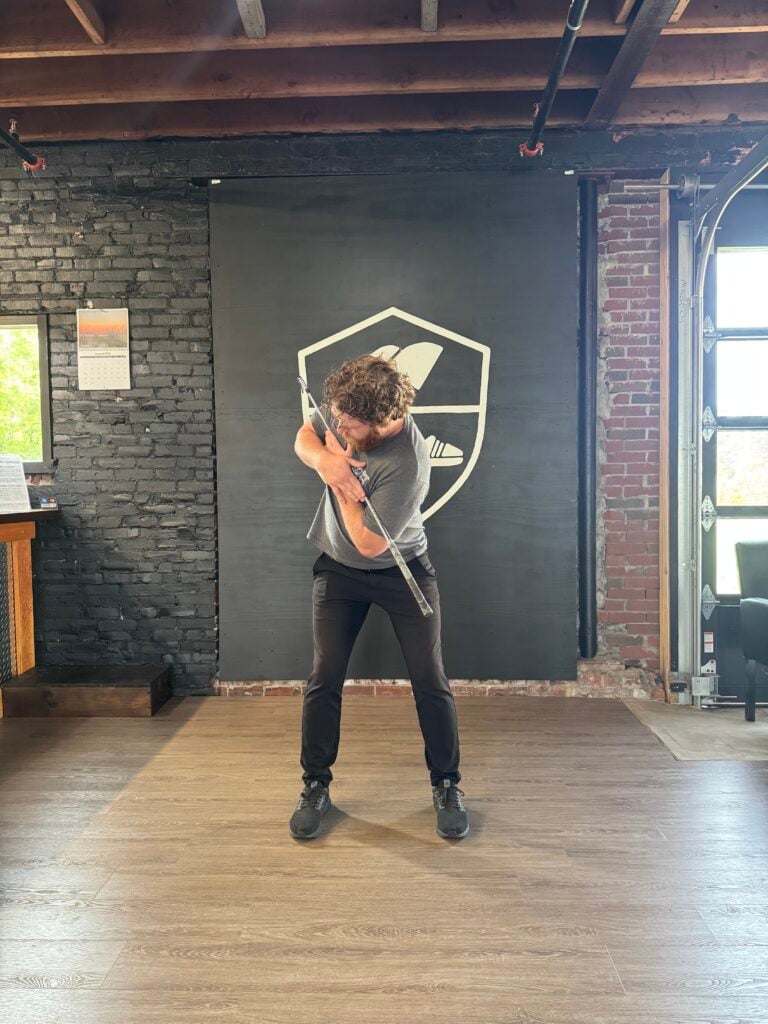
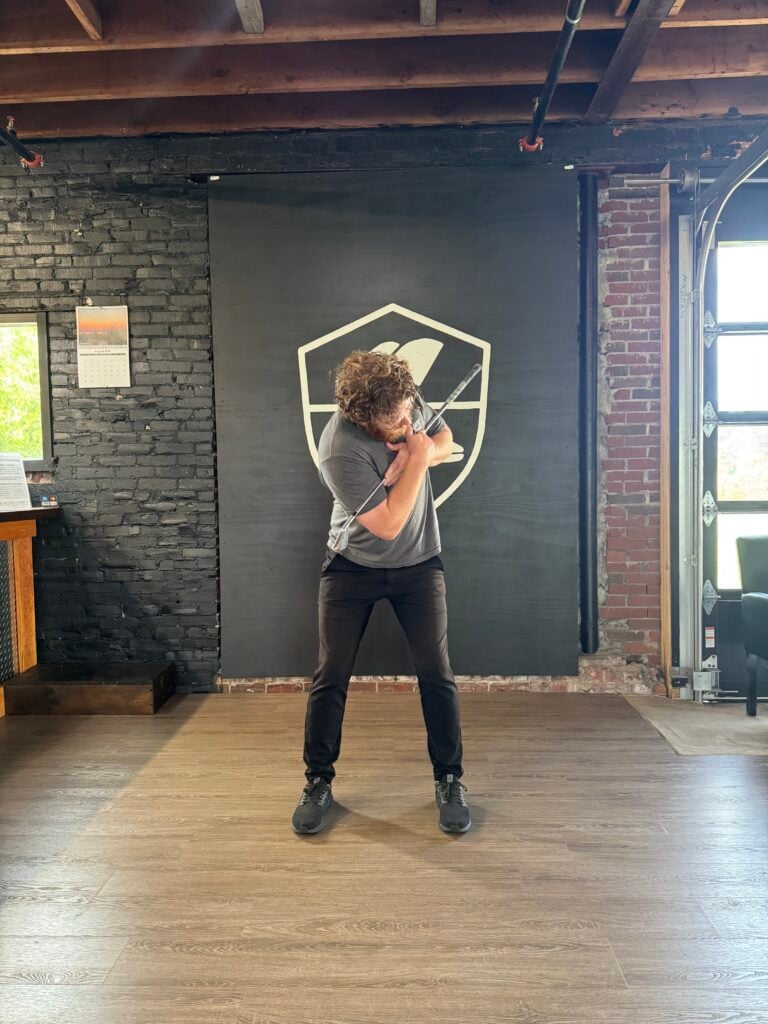
- Standing trunk rotations (10 each side). Place a club across your shoulders or hold it in front of you, keep your hips quiet, and rotate your upper body left and right in a smooth rhythm. This wakes up the mid-back, the segment responsible for most of your backswing turn.
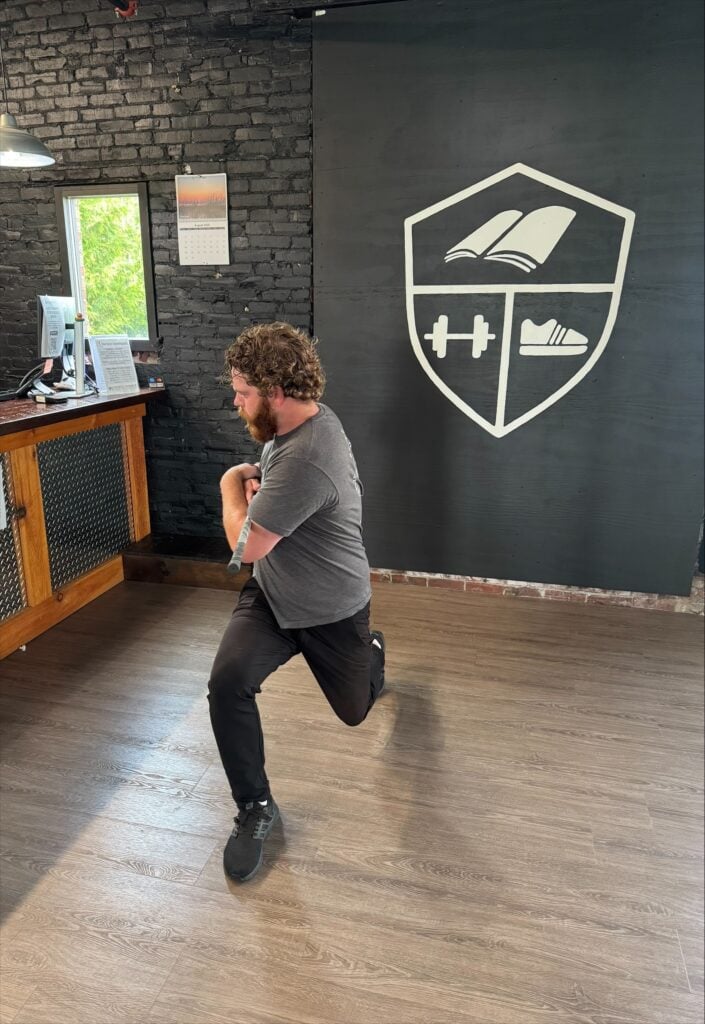
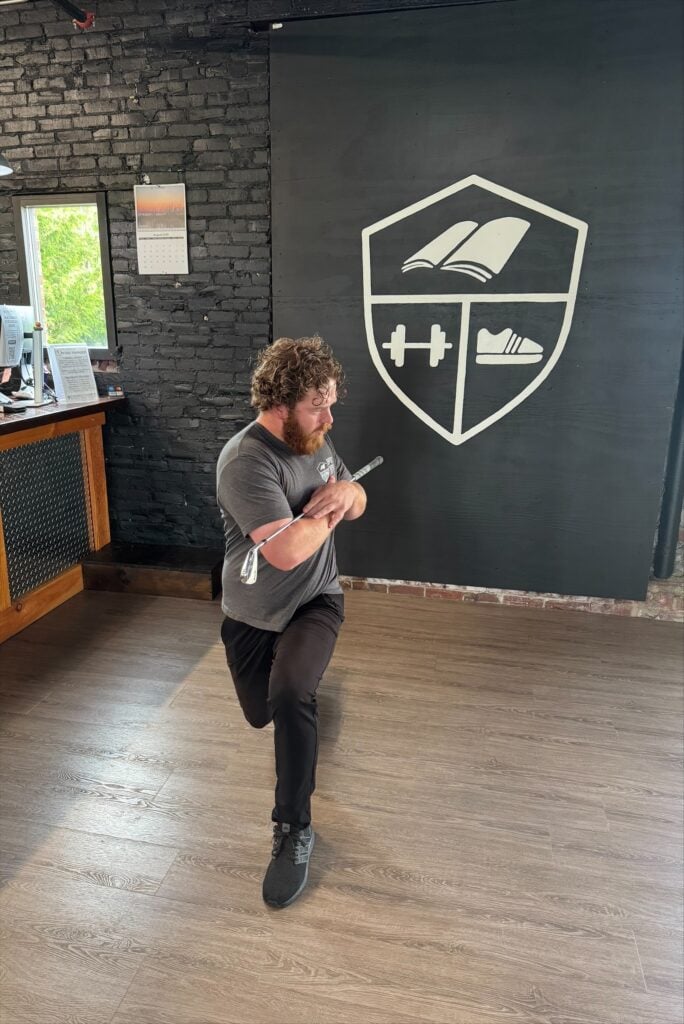
- Walking lunges with rotation (10 total). Step forward into a lunge, and at the bottom, rotate your torso over your front leg while holding a club against your chest. This activates the glutes and hips while linking lower-body stability to upper-body rotation, exactly the pattern the swing demands.
- Leg swings (10 each leg, each direction). Holding something for balance, swing one leg front-to-back, then side-to-side. Loose, mobile hips are the foundation of an efficient weight shift.
- Practice swings, starting at half speed and building to full speed over 8 to 10 swings. Never make your first full-speed swing of the day count for score.
Exercises that protect the areas golf stresses most
Building these into your week, not just your tee time, is what changes your risk long term. As Dr. Fontanella reminds his patients, “A strength and mobility program is crucial in reducing risk for injury while also improving power, resulting in healthier rounds, increased yardage off the tee, lower scores, and taking more money off your friends.”
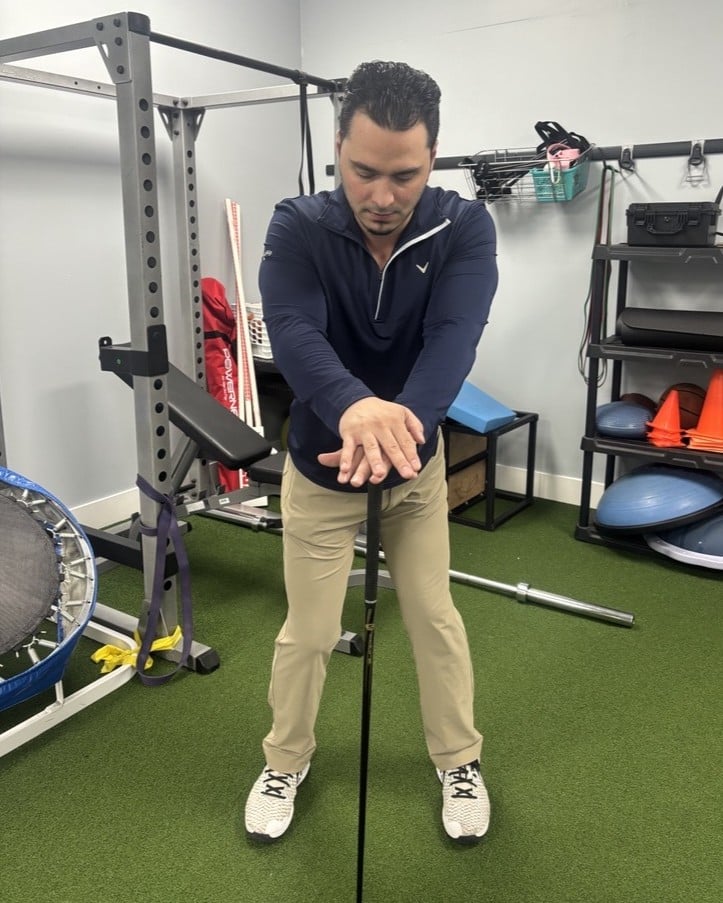
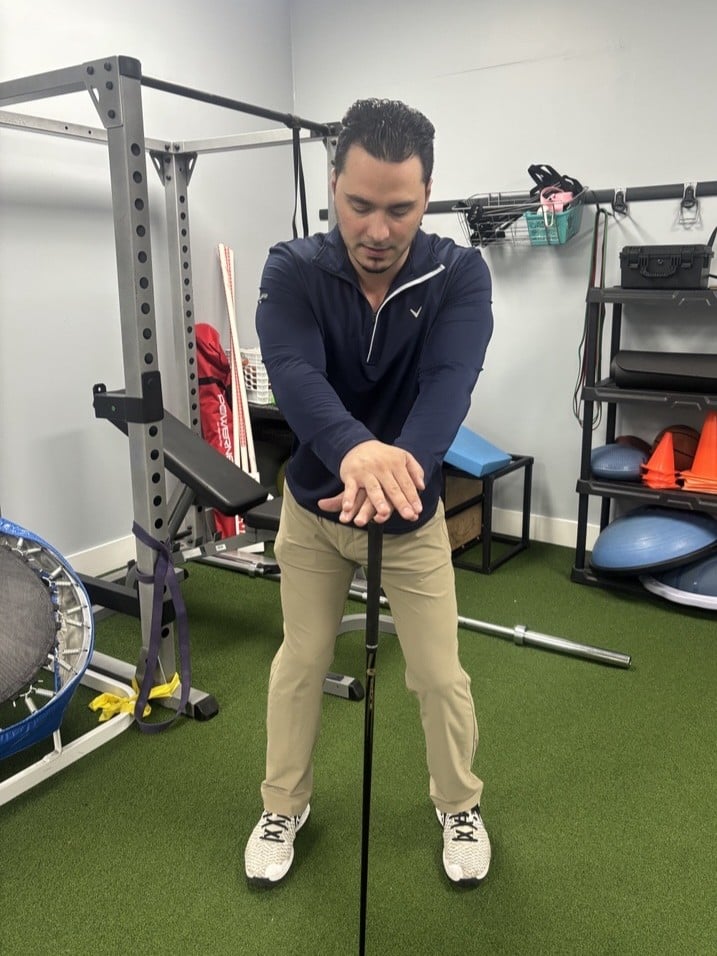
Pelvic rotations in golf posture (for lower-body and upper-body separation). From Dr. Alexander Perdikis PT, DPT, TPI: “Start in a five iron posture and hold onto the club in front of you comfortably. From here, rotate your pelvis to the left without moving your shoulders or your head, then rotate your pelvis to the right in the same manner. This works on improving your lumbo-pelvic mobility as well as your ability to disassociate your upper body and lower body during the golf swing.” Perform 15 twists in each direction. That separation between hips and shoulders is where stored power in the swing comes from, and losing it is one of the most common causes of both swing faults and back pain.
Glute bridges (for power and spine protection). Lie on your back, knees bent, feet flat on the floor hip-width apart. Drive through your heels and lift your hips until your body forms a straight line from knees to shoulders, squeezing your glutes at the top. Hold two seconds, lower slowly. 12 to 15 reps. Strong glutes are the engine of the swing and the guardians of the lumbar spine.
Wrist extensor holds (for elbow protection). Hold a light dumbbell or a hammer, palm down, forearm supported on a table with your hand hanging off the edge. Slowly lower your wrist toward the floor, then raise it back up, taking three seconds in each direction. 10 to 12 reps per side. Gradual forearm loading is one of the best defenses against golfer’s elbow.
Optimize your golf game with this series
Dr. Nicholas Grillo PT, DPT, OCS, put together this five-exercise series that targets the exact demands of the swing: hinging, rotating, shifting weight, and controlling your finish.
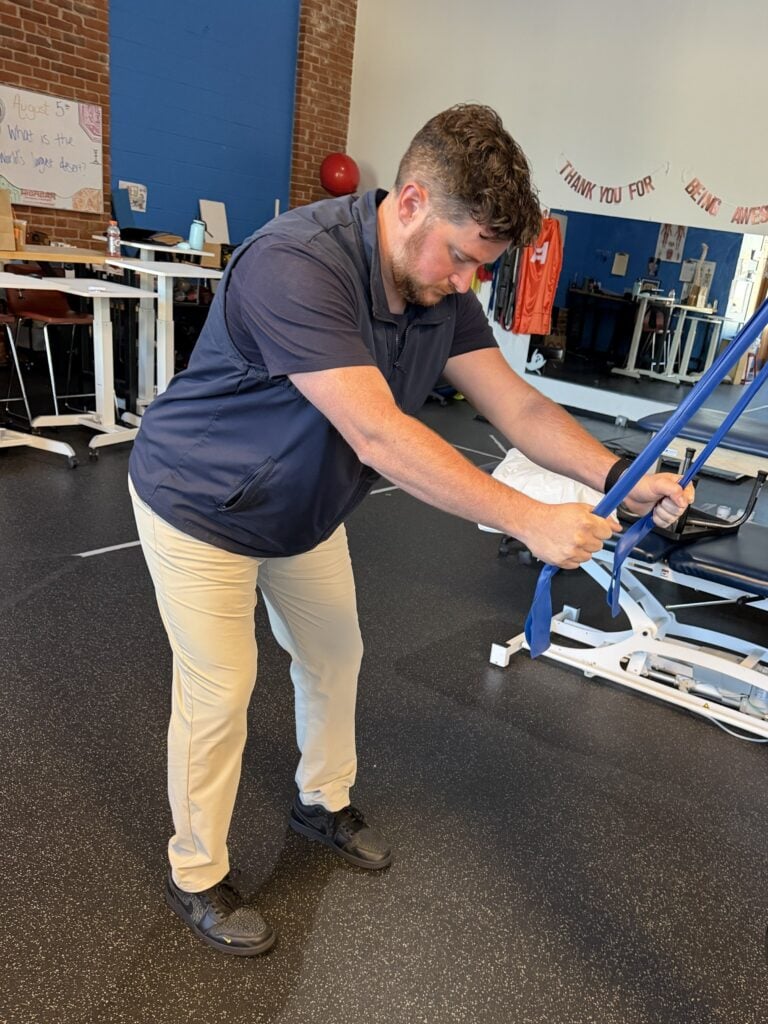
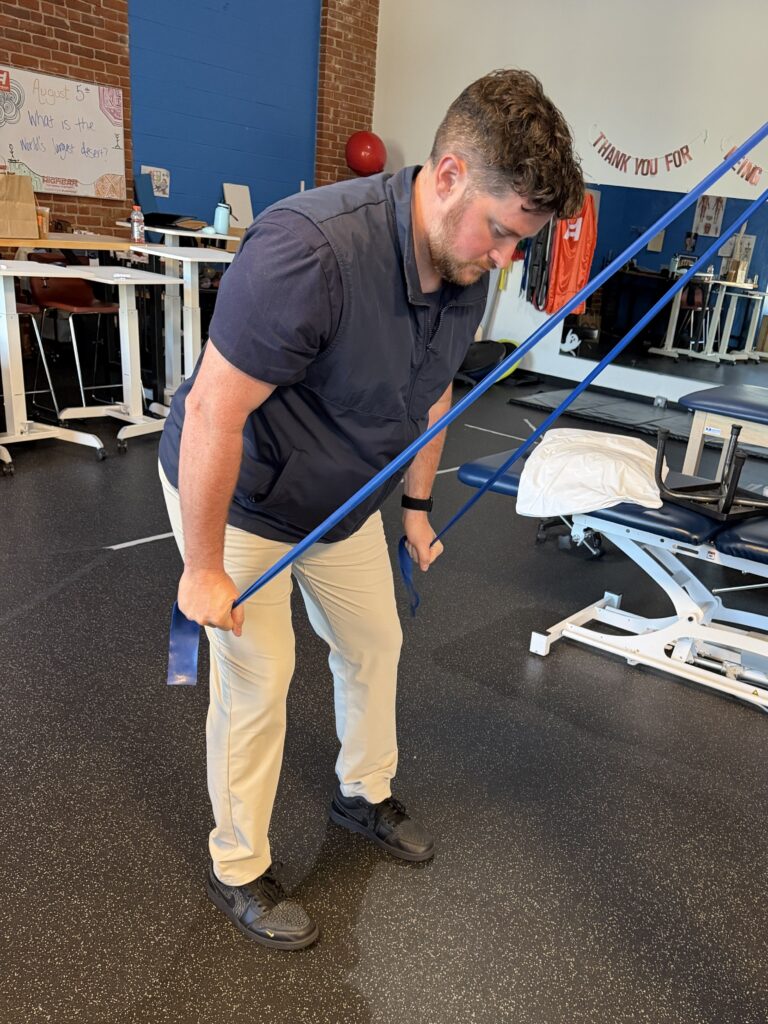
1. Hinged band pull-downs. Anchor a resistance band above shoulder height. Hinge forward at the hips into your golf stance, keeping your back flat, and pull the band down and across your body. This mimics the swing stance while challenging lumbo-pelvic stability, training your core to stay solid while your arms produce force. 2 sets of 15.
2. Thread the needle. Start on hands and knees. Reach one arm underneath your body as far as you can, rotating your mid-back and letting your shoulder drop toward the floor, then return and reach toward the ceiling. Hold the bottom position for 10 seconds. 3 per side. In Dr. Grillo’s words, this is one “we all should do.” It restores the thoracic rotation every backswing depends on.
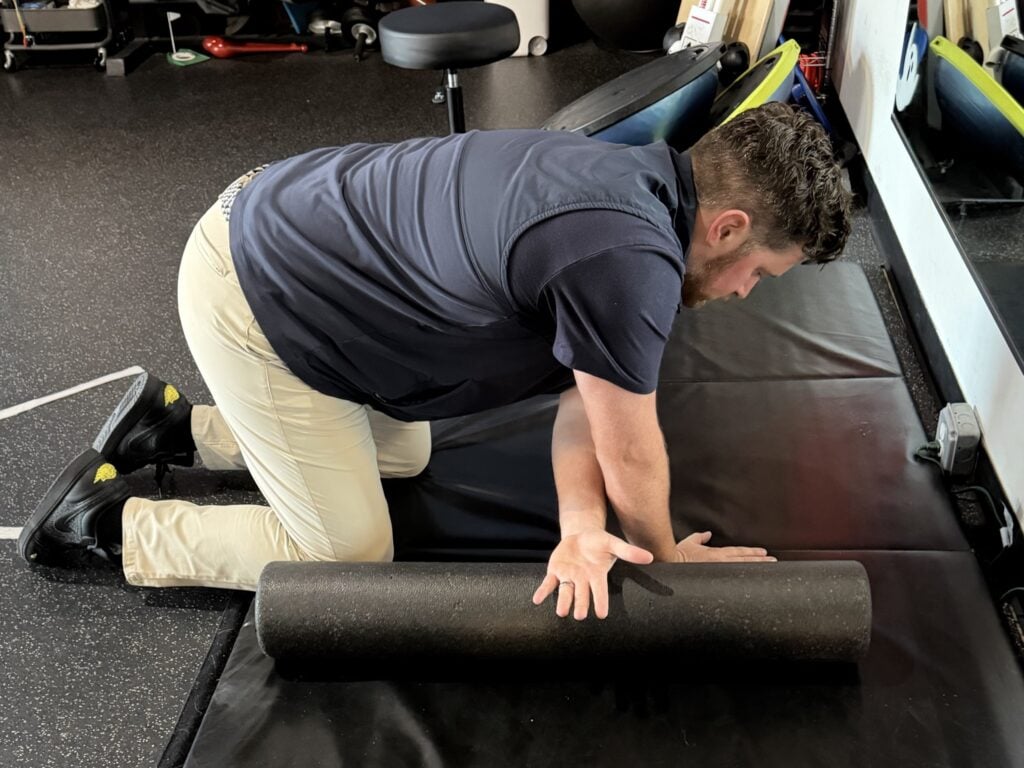
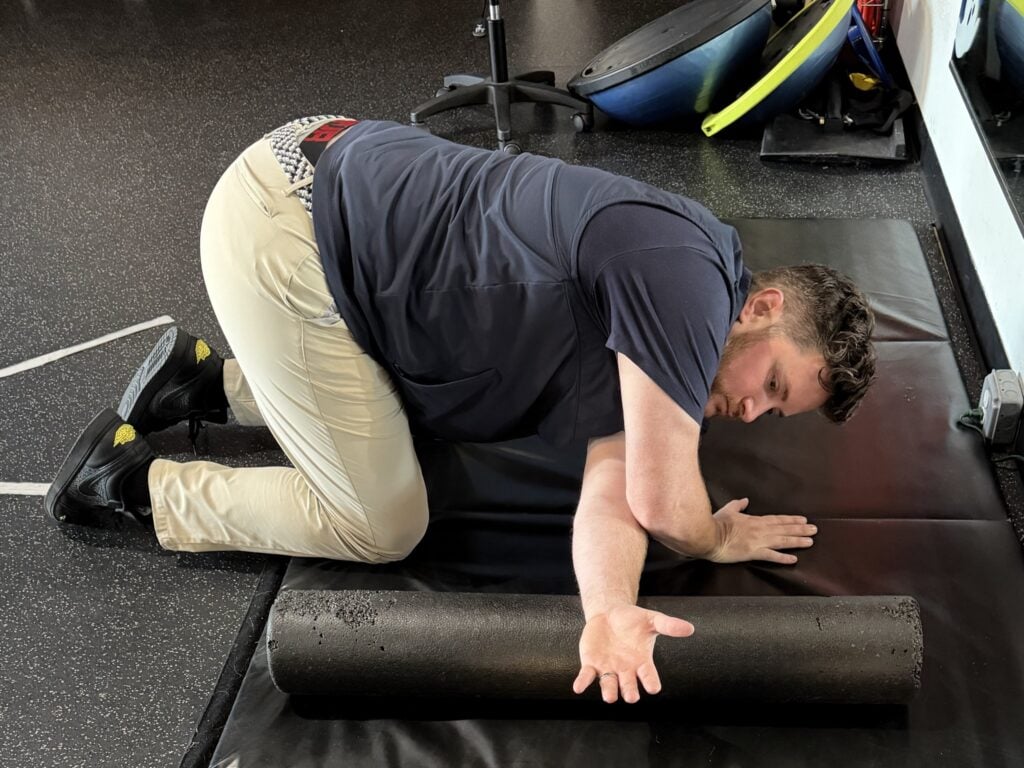
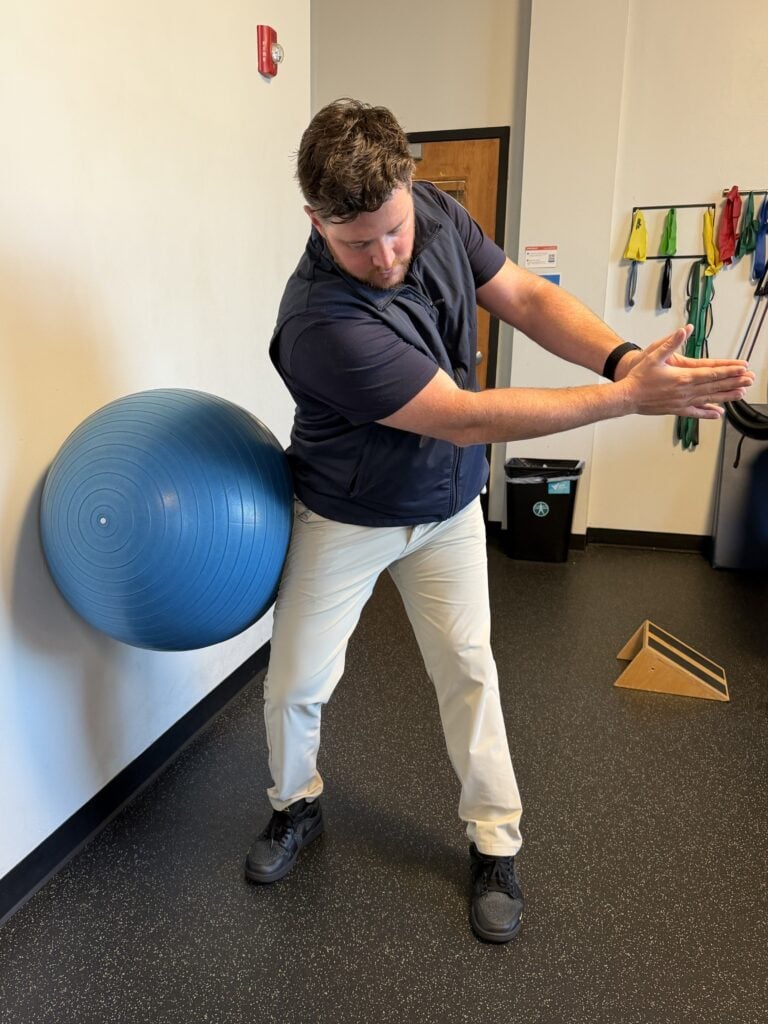
3. Hip against the ball through follow-through. Place a stability ball between your lead hip and a wall. Take your address position, then rotate through a slow-motion swing into your follow-through while keeping pressure on the ball. This trains proper weight shift into the lead side and prevents the hanging-back pattern that robs power and stresses the spine. It also optimizes rotation through impact.
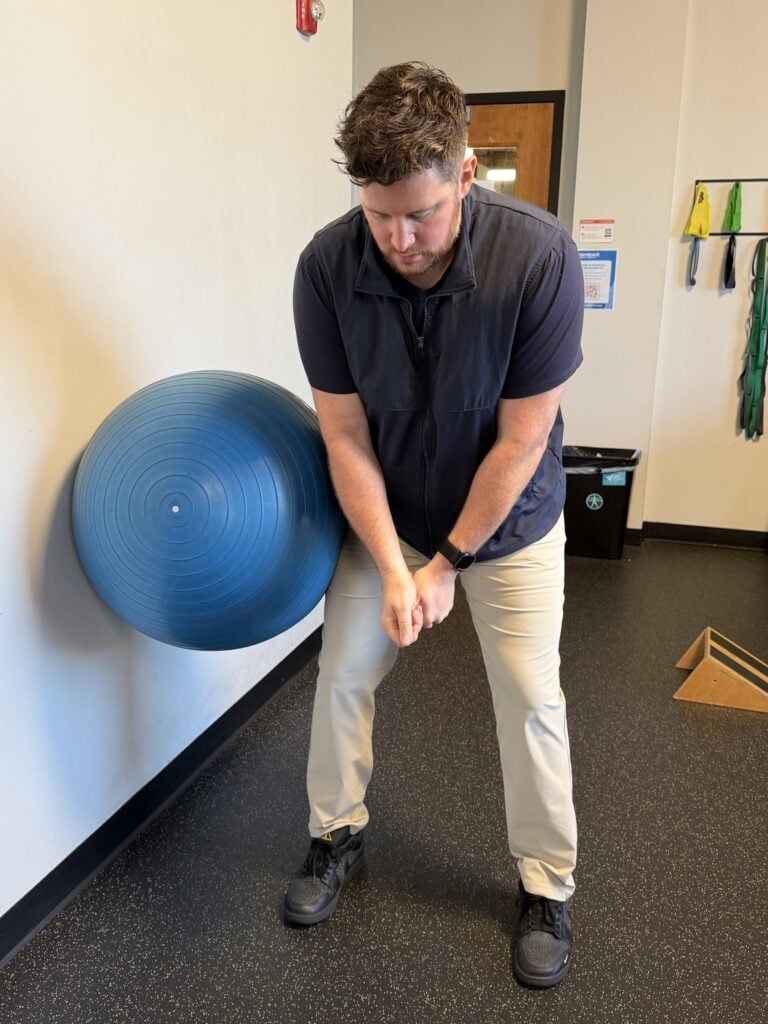
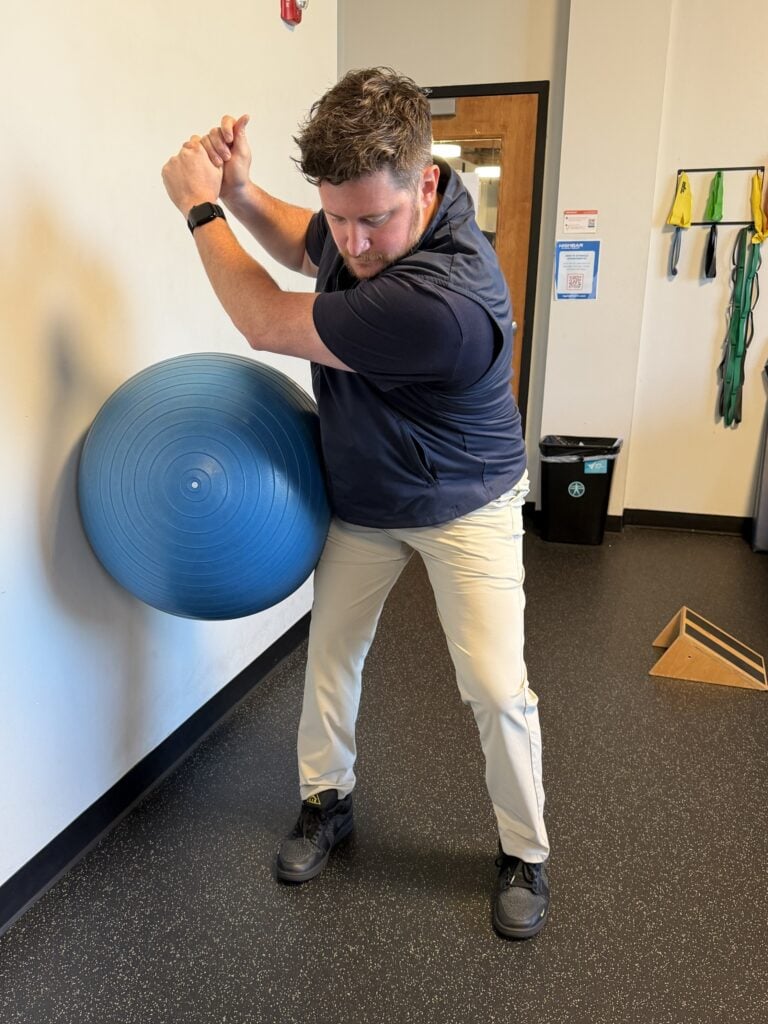
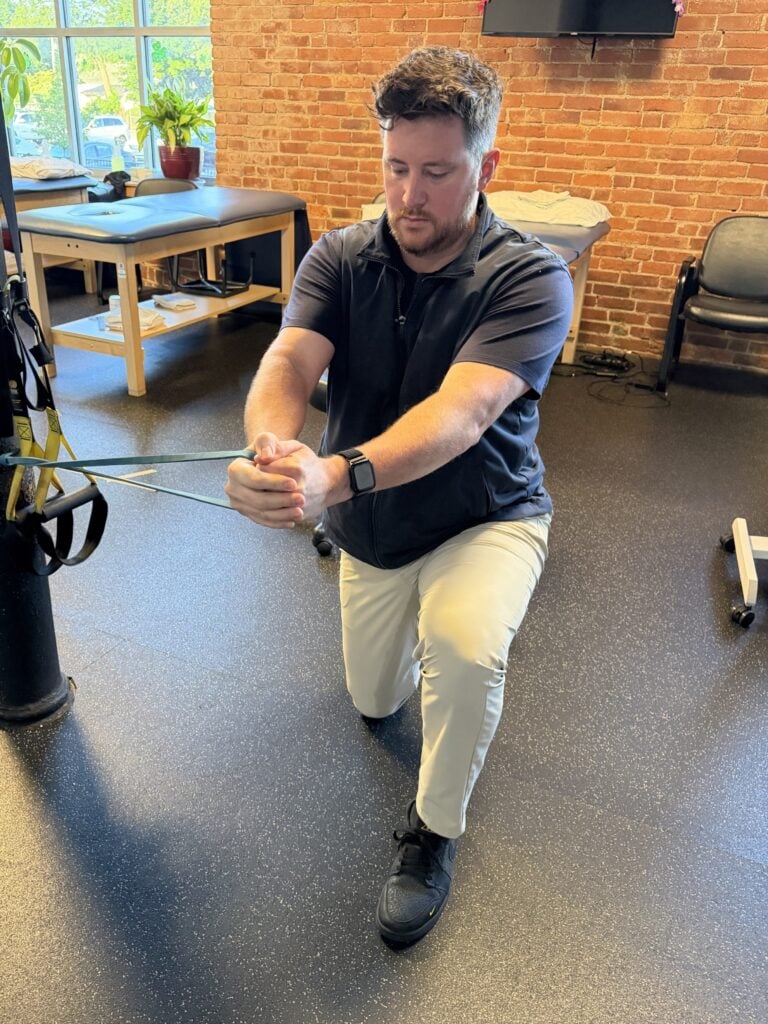
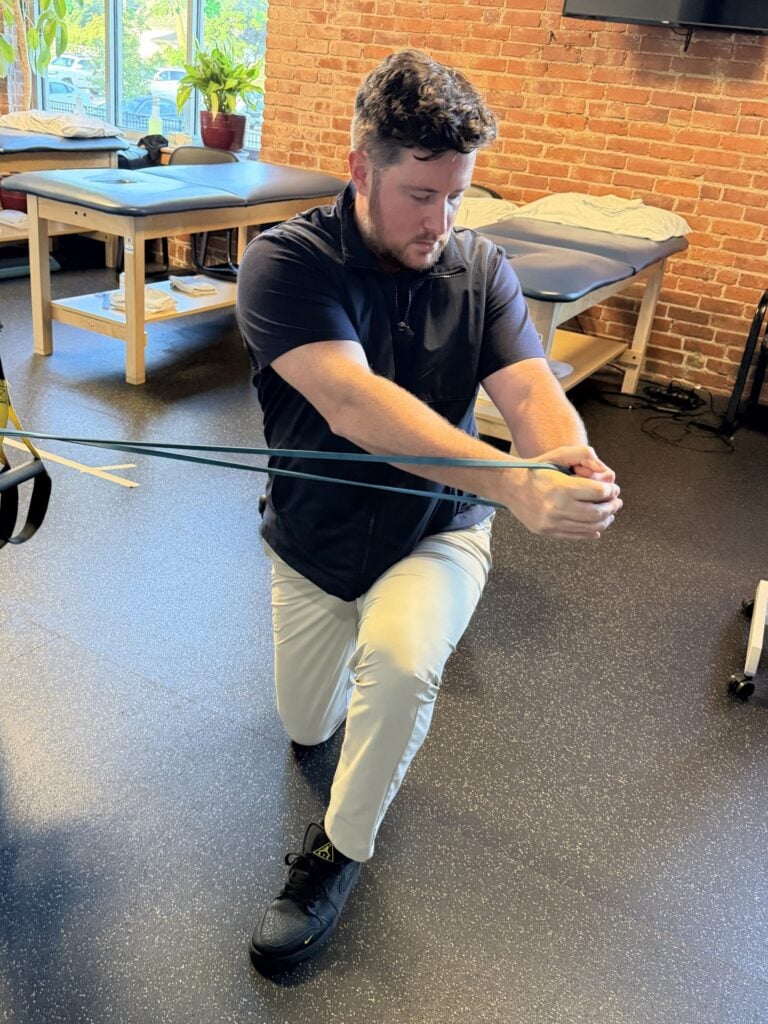
4. High kneeling wood chop. From a tall kneeling or half kneeling position, anchor a band low to one side. Grip with both hands and pull diagonally up and across your body, rotating your trunk while your hips stay square. This loads the end range of the swing, strengthening and supporting the back through the follow-through, the moment when many golfers get hurt.
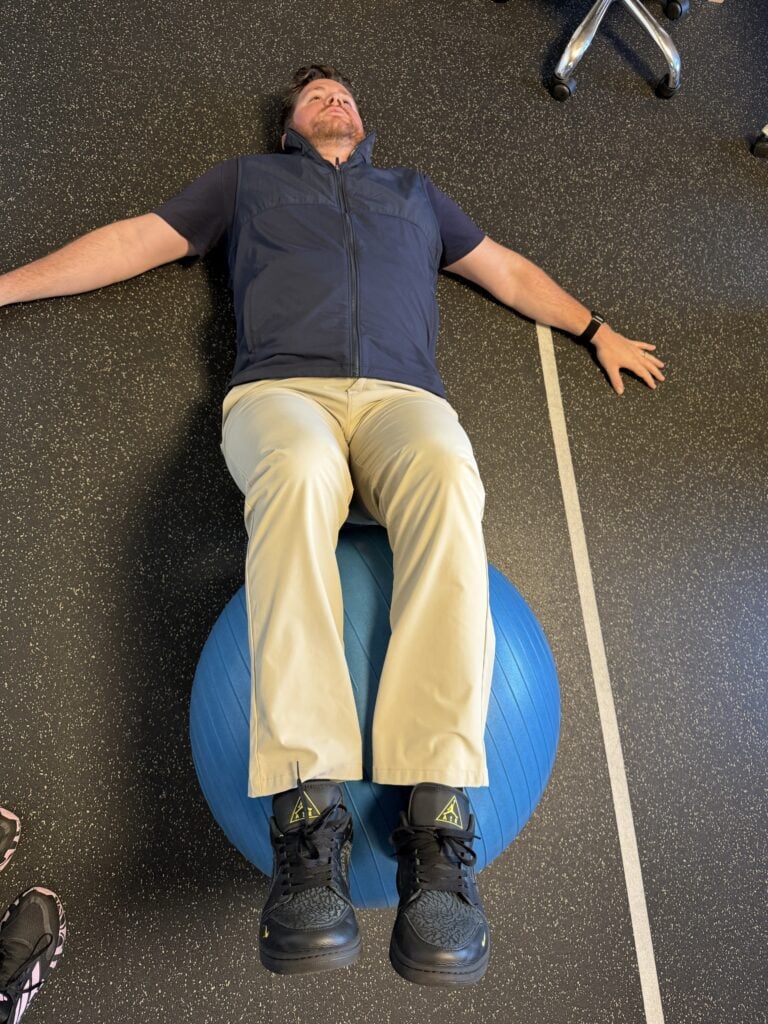
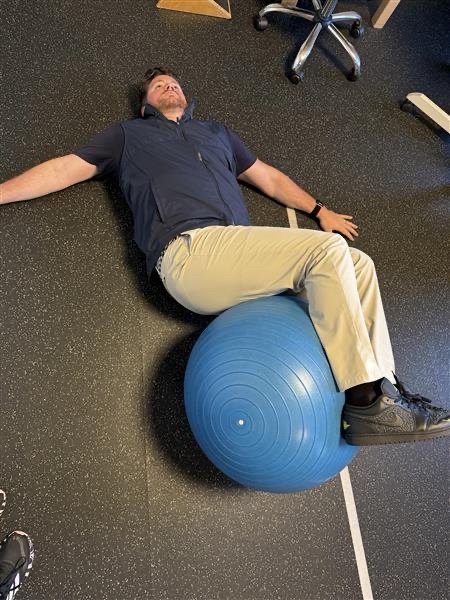
5. Supine lower trunk rotations with a ball. Lie on your back with your knees bent and a ball between your knees. Keeping your shoulders on the floor, slowly rock your knees side to side, moving only as far as you can control. This builds both mobility and control in the lower trunk, the ability to rotate and to stop rotating, which matters just as much.
Every swing is unique. Yours should work for your body.
There is no single perfect golf swing, and that is good news.
“The kinematic sequence of the golf swing is an incredibly nuanced, complex cycle of movements in the human body,” says Dr. Perdikis. “Throughout the swing cycle, every joint must work in synchrony to swing efficiently and, most importantly, safely. The beautiful thing about golf is that every golfer’s swing is unique based on their own physical ability. However, everyone can have an efficient, accurate, and powerful swing when their body-swing connection is clicking.”
That body-swing connection is where physical therapy meets golf, and it is the foundation of a credential several of our clinicians hold.
What does it mean that our clinicians are TPI certified?
The Titleist Performance Institute (TPI) is the world’s leading organization dedicated to studying how the human body functions in relation to the golf swing. Drawing on the largest database of golf biomechanics ever assembled, from tour professionals to everyday players, TPI trains healthcare and fitness professionals to understand the body-swing connection: how your physical capabilities shape the way you swing a club.
When a physical therapist earns TPI Medical certification, they gain a specific skill set on top of their doctorate-level training in movement and rehabilitation:
- A golf-specific movement screen. A structured series of tests measuring the mobility, stability, and strength of the exact body regions the swing depends on: hips, mid-back, shoulders, and core.
- The ability to link body to swing. Limited hip rotation often shows up as swaying or sliding. A stiff mid-back forces the lower back to over-rotate. A TPI certified clinician can trace a swing fault, or a pain pattern, back to its physical root cause.
- A plan built for your swing. TPI’s core philosophy is that there is no one perfect way to swing a club, but there is one most efficient way for your body. Treatment and training are designed around your screen results, not a generic template.
The practical difference for you: instead of guessing why your back aches on the back nine or why lessons alone are not fixing your slice, a TPI certified clinician can test, measure, and address the physical limitation driving it. At Highbar, clinicians including Dr. Bray hold TPI certifications, and this screening is available to golfers of every level, from first season to competitive.
Know the difference between soreness and a warning sign
Some muscle fatigue after 18 holes is normal. These are not:
- Pain that is sharp during the swing, especially in the back or elbow
- Soreness that lasts more than 48 hours or shows up at the start of every round
- Numbness or tingling into the arm or leg
- Pain that changes how you swing
Overuse injuries respond well to early treatment. Left alone, they become chronic and much harder to resolve. If any of these sound familiar, get evaluated. In Rhode Island and Massachusetts, you have direct access to physical therapy, which means you can book an appointment without a physician referral.
Frequently asked questions
What is the best warm-up before golf? Five to ten minutes of dynamic movement (trunk rotations, lunges, arm circles), followed by practice swings that build gradually to full speed. Skip long static stretches until after the round.
Why does my lower back hurt after golf? Usually a combination of repetitive rotation and limited mobility in the hips or mid-back, which forces the lower back to do work it is not built for. It is common, and it is treatable.
Do I need a referral to see a physical therapist? No. Rhode Island and Massachusetts both allow direct access, so you can schedule directly with us.
Is golf good exercise for older adults? Yes. Walking the course, carrying or pushing a bag, and the balance demands of the swing all support cardiovascular health, strength, and stability well into later life.
Keep playing the game you love
Golf is a sport for a lifetime, and your body is what makes that possible. If pain is affecting your game, or you want to move and swing better before the fall season, our team, including our TPI certified clinicians, is here to help.
Find a Highbar Physical Therapy location near you and schedule your visit today.