A scar can close well on the surface and still feel wrong underneath. You might notice a pulling sensation when you reach overhead after shoulder surgery, stiffness around an ankle scar when you walk, or a tender band of tissue that seems to catch every time you try to move normally. That disconnect is frustrating. The incision looks healed, but the area still doesn't move like your body used to.
That’s where ultrasound for scar tissue often enters the conversation. In physical therapy, ultrasound isn’t a magic fix and it isn’t useful for every scar. It’s a treatment tool that can help therapists influence tissue behavior, especially when a scar is stiff, painful, adherent, or limiting motion. Used well, it can make tissue more responsive to hands-on treatment and exercise. Used poorly, it becomes a passive treatment that doesn’t change function.
Patients usually want a simple answer: will ultrasound break up scar tissue? Referring providers often want a more clinical one: when does it make sense, what does it do, and how do you know it’s helping? The honest answer to both questions is the same. Ultrasound can be helpful, but its value comes from how it’s integrated into a larger rehab plan.
A strong plan doesn’t stop at the machine. It pairs the right ultrasound settings with scar mobility work, joint motion, progressive loading, and movement retraining. That matters because a scar isn’t just a skin issue. It can affect tendon glide, muscle performance, tolerance to stretching, and the way someone returns to lifting, running, reaching, or working.
Clinical reality: The scar itself may be the complaint patients point to, but the real treatment target is often restored movement.
Introduction
People usually ask about ultrasound when a scar starts interfering with everyday life. A knee incision feels thick and tight when going down stairs. A C-section scar stays tender months later. A repaired tendon glides poorly, and the surrounding tissue feels stuck. In those moments, individuals aren’t looking for technology. They’re looking for a way to move normally again.
Therapeutic ultrasound can play a role in that process. It uses sound waves to deliver mechanical energy into tissue, and in the right clinical context that can help address stiffness, sensitivity, and restricted mobility around a scar. The key point is that ultrasound is a tool, not the treatment plan.
Why scars behave differently
Scar tissue forms because your body needs a patch. That patch is necessary, but it isn’t identical to the original tissue. It may be less organized, less elastic, and more likely to bind to nearby structures. In a low-demand area, that may not matter much. Around a joint, tendon, or surgical site, it often does.
That’s why two people with similar incisions can have very different recoveries. One regains motion quickly. The other develops tightness, pain, or a persistent sense that the area won’t loosen up.
Where ultrasound fits
In practice, ultrasound tends to work best when it supports a specific goal:
- Improve tissue mobility so stretching and manual treatment are more effective
- Reduce scar-related pain that limits exercise progression
- Address early healing needs when the clinical picture supports controlled tissue stimulation
- Prepare collagen-rich tissue for movement retraining
That last point matters most. If tissue becomes more pliable but the patient never learns to load and move through that new range, the benefit usually doesn’t last.
For patients, that means expectations should be realistic. For physicians, it means the decision to use ultrasound should be tied to a clear functional deficit, not just the presence of a scar.
What Scar Tissue Is and Why It Causes Problems
Scar tissue isn’t automatically bad. It’s part of healing. The problem starts when the repaired tissue becomes disorganized, overly thick, hypersensitive, or stuck to neighboring layers that should glide independently.
One simple way to think about it is fabric repair. Healthy tissue acts like neatly aligned fibers in a well-made sweater. Scar tissue can resemble a patch where the threads are denser and less organized. The patch holds things together, but it may not stretch or move the same way.
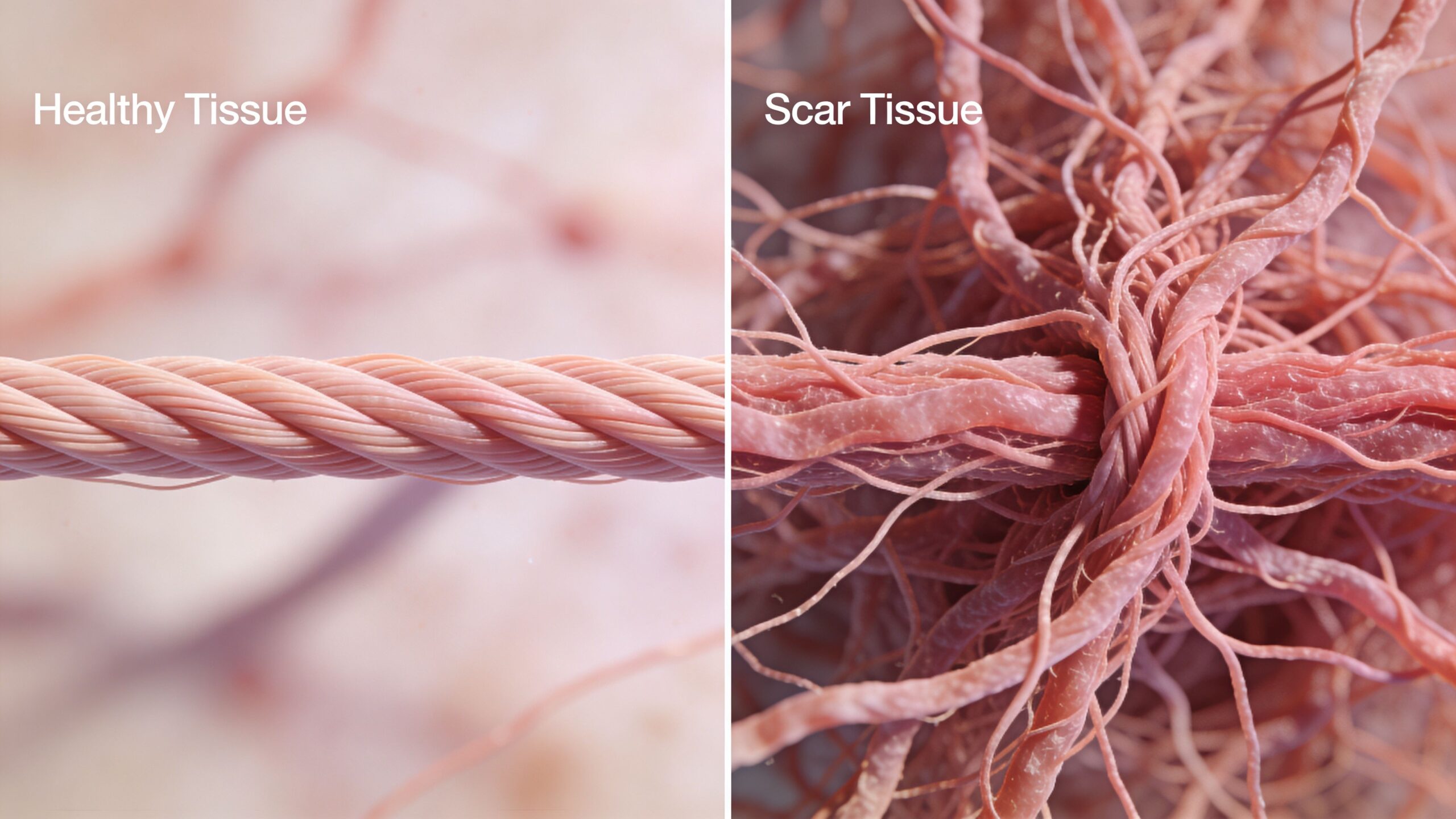
A normal scar versus a problematic one
A normal scar usually becomes flatter, less tender, and more mobile over time. It may never feel exactly like uninjured tissue, but it stops dominating movement.
A problematic scar tends to show up in more functional ways:
- It pulls with motion and creates a sharp or stretching sensation at end range
- It adheres to deeper tissue so skin, fascia, tendon, or muscle no longer glide well
- It stays thick or raised and remains irritable with pressure or activity
- It contributes to compensation because the person starts moving around it
That last point is easy to miss. A shoulder scar can change how someone reaches. A foot or ankle scar can alter gait. A post-surgical abdominal scar can affect trunk rotation, breathing mechanics, or tolerance to exercise.
Why adhesions matter
The term adhesion usually refers to tissue layers that have become abnormally stuck together. In physical therapy, that matters because movement depends on glide. Tendons need to slide. Fascia needs to move. Skin needs to tolerate stretch over the structures beneath it.
When that glide is limited, people report familiar symptoms:
- Tightness that doesn’t improve with simple stretching
- Pain with motion in a very specific line or band
- Stiffness after inactivity, especially in the morning or after sitting
- Weakness or guarded movement because the area feels restricted
If you’re early in recovery, scar management also overlaps with prevention. At this stage, good incision care, early movement when appropriate, and guided rehab matter. If that’s your stage, preventing scar tissue after surgery is often easier than trying to reverse a more established restriction later.
A scar becomes clinically important when it changes how tissue moves, not simply when it’s visible.
Not all fibrosis responds the same way
Superficial scars, deeper post-surgical fibrosis, and tendon-related scar tissue don’t behave identically. A raised skin scar may need a different strategy than dense tissue around a repaired tendon. That’s one reason generic advice falls short. Treatment depends on depth, irritability, healing stage, and what movement is limited.
This is also why some scars benefit from ultrasound and others don’t. If the tissue issue is mechanical and tied to poor mobility, ultrasound may help set up the next part of treatment. If the underlying driver is weakness, poor motor control, or an overly protective movement pattern, the machine alone won’t solve it.
How Therapeutic Ultrasound Works on Scar Tissue
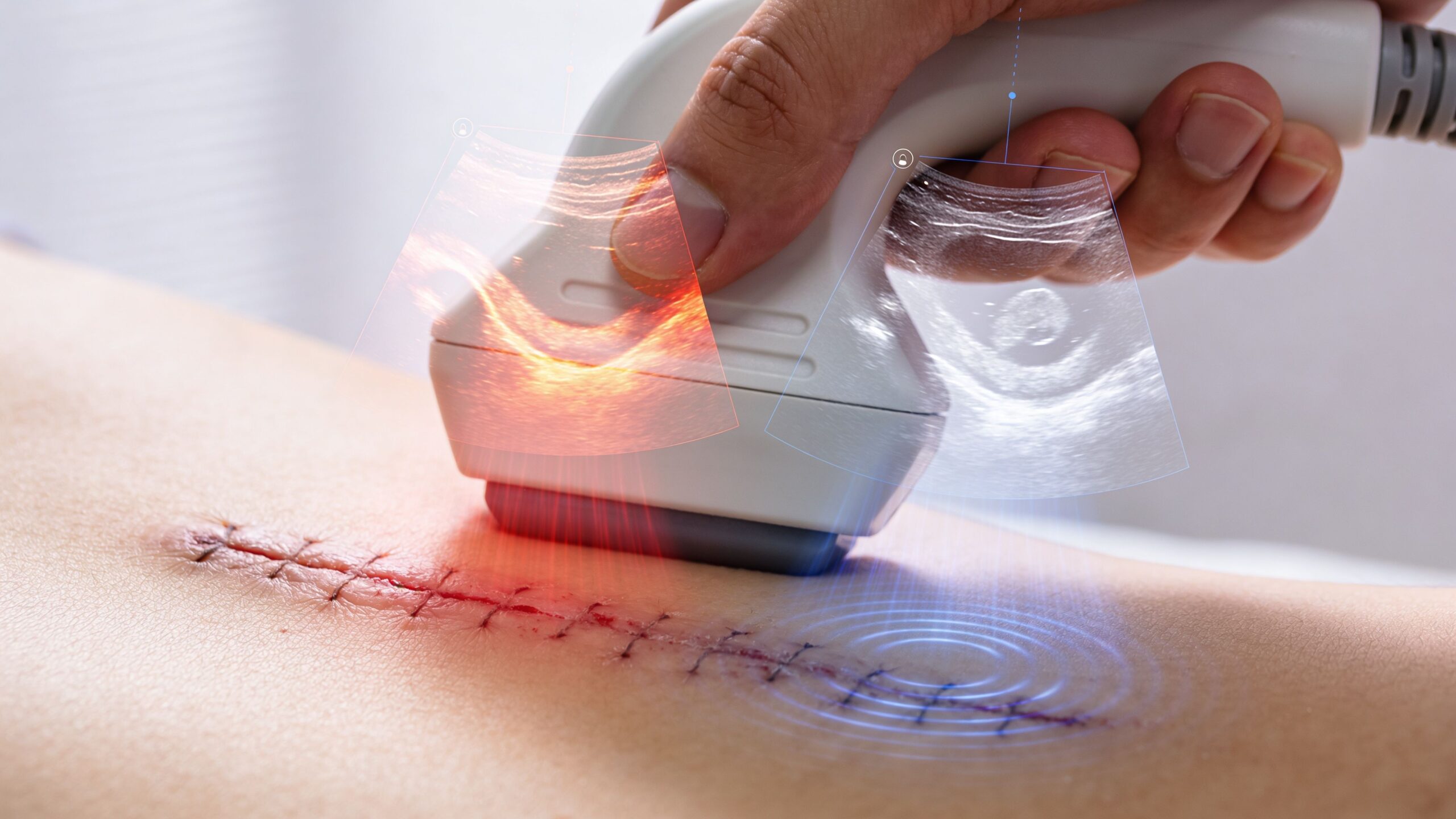
Therapeutic ultrasound works through thermal and non-thermal effects. Both matter, but not in the same way and not at the same point in healing. When patients say ultrasound feels like a “deep treatment,” that’s a fair description. It can act a bit like a controlled micro-massage inside collagen-rich tissue.
The thermal effect
With continuous ultrasound, the tissue absorbs energy and warms. Scar tissue, tendons, and fascia tend to absorb ultrasound well because they’re collagen-rich. That warming effect can make tissue more extensible, which is useful before stretching, mobilization, or movement drills.
A practical analogy is warming stiff clay. Cold clay resists shaping. Warm clay yields more easily. Tissue isn’t clay, but the idea is similar. If the scar and surrounding structures are less stiff, a therapist can often get more out of the next intervention.
Thermal ultrasound is often chosen when the clinical target is chronic stiffness. The point isn’t just to heat tissue. The point is to create a short window where movement work is more effective.
The non-thermal effect
Pulsed ultrasound emphasizes mechanical effects rather than sustained heating. This includes cavitation and microstreaming, which are ways ultrasound influences fluid movement and cell behavior at a microscopic level. Patients don’t need the physics lecture, but the clinical takeaway is useful: non-thermal ultrasound may support healing activity and tissue organization when timed appropriately.
Verified clinical guidance notes that therapeutic ultrasound targets scar tissue through both mechanisms, and low-intensity pulsed ultrasound at 0.125 to 3 W/cm² can stimulate fibroblast activity during healing, while high-intensity focused ultrasound over 5 W/cm² can ablate hypertrophic scars. The same source notes that in the proliferative phase, applying 1 to 1.5 W/cm² ultrasound 3 times per week can accelerate wound contraction when used within 72 hours post-injury, leading to smaller, more organized scars, as described in this clinical review of ultrasound therapy for scar tissue and fibrosis.
Why frequency matters
Ultrasound settings aren’t arbitrary. 1 MHz is commonly used for deeper targets. 3 MHz is used for more superficial tissue. If the scar issue is mostly dermal or just beneath the skin, the therapist may choose a more superficial approach. If the restriction sits deeper around tendon or fascia, the settings may shift.
That’s one reason home assumptions like “more intensity is better” are wrong. Better treatment depends on the tissue depth, healing stage, and clinical goal.
Here’s how therapists typically understand it:
- Need superficial treatment: higher frequency may be more appropriate
- Need deeper tissue effect: lower frequency may be selected
- Need more heating: continuous mode may fit the goal
- Need more healing-oriented mechanical input: pulsed mode may make more sense
What ultrasound does not do
Ultrasound doesn’t melt scar tissue. It doesn’t erase an old scar in a single visit. It also doesn’t replace loading, mobility work, or progressive return to activity.
That matters because some of the language patients hear outside rehab can blur the line between therapeutic ultrasound and aesthetic or procedural uses of focused ultrasound. If you’re curious about the cosmetic side of focused ultrasound, Ultherapy Treatment is a useful example of how ultrasound energy is used very differently in skin-tightening care than in outpatient rehabilitation.
Practical rule: In PT, ultrasound should create a better setup for movement. If it isn’t changing what happens next in the session, it may not be the right tool.
Where it fits best clinically
Ultrasound for scar tissue tends to make the most sense when a scar is limiting tissue mobility, painful with motion, or preventing effective manual work and exercise. I’m less interested in whether a scar is present and more interested in whether it’s stopping progress.
That distinction separates useful care from passive care. The machine matters less than the plan around it.
The Evidence for Using Ultrasound on Scars
The evidence for ultrasound on scars is promising in some settings and underwhelming in others. That’s not a contradiction. It reflects a treatment that depends heavily on timing, dosage, tissue type, and what else is happening in rehab.
One of the strongest evidence-based points is early wound support. When applied within 72 hours post-injury, low-intensity therapeutic ultrasound can accelerate wound healing and reduce scar size. A systematic review of 5 studies confirmed low-dose ultrasound, including 0.5 W/cm², pulsed 20% duty cycle, 1 MHz for 5 minutes, as an effective adjunct. Trials cited in that review reported 20 to 30% shorter healing time and less hypertrophic scarring, according to Physio-pedia’s review of ultrasound in wound healing.
What that evidence supports
The key word is adjunct. Ultrasound can support healing. It doesn’t replace standard wound care, progressive mobility, or therapeutic exercise.
For clinicians, this lines up with how the modality performs in practice. It’s often most useful when it helps tissue tolerate the rest of treatment better. If a scar softens enough for effective stretching, tendon gliding, or loading, that matters. If a patient feels a little warmth but function doesn’t change, it usually doesn’t.
Where the evidence is more mixed
Some soft tissue conditions don’t respond meaningfully to ultrasound alone. That’s an important guardrail because the modality can be overused because it’s available. The best interpretation of the literature isn’t “ultrasound works” or “ultrasound doesn’t work.” It’s more specific.
A better summary is this:
- Early healing support has a clearer rationale
- Scar mobility work may benefit when ultrasound prepares tissue for follow-up treatment
- Stand-alone passive care is much less convincing
- Functional outcomes depend on what the patient does after the modality
If the scar improves on the table but the patient still can’t squat, reach, run, or lift, the plan isn’t finished.
Why PT integration matters
Outpatient physical therapy earns its value in this context. Scar management is rarely about the scar alone. An athlete after tendon repair may need ultrasound, yes, but also graded loading and movement retraining. A patient after joint replacement may need tissue mobility work, but also strength, gait training, and confidence with daily activity.
That’s also why two providers can use the same machine and get very different results. The difference often isn’t the device. It’s the clinical reasoning. Ultrasound has a role, but it’s most defensible when used to support a larger, active recovery plan.
What a Physical Therapy Session with Ultrasound Involves
Most ultrasound sessions are uneventful, and that’s a good thing. The treatment is brief, comfortable, and usually folded into a much larger appointment built around movement.
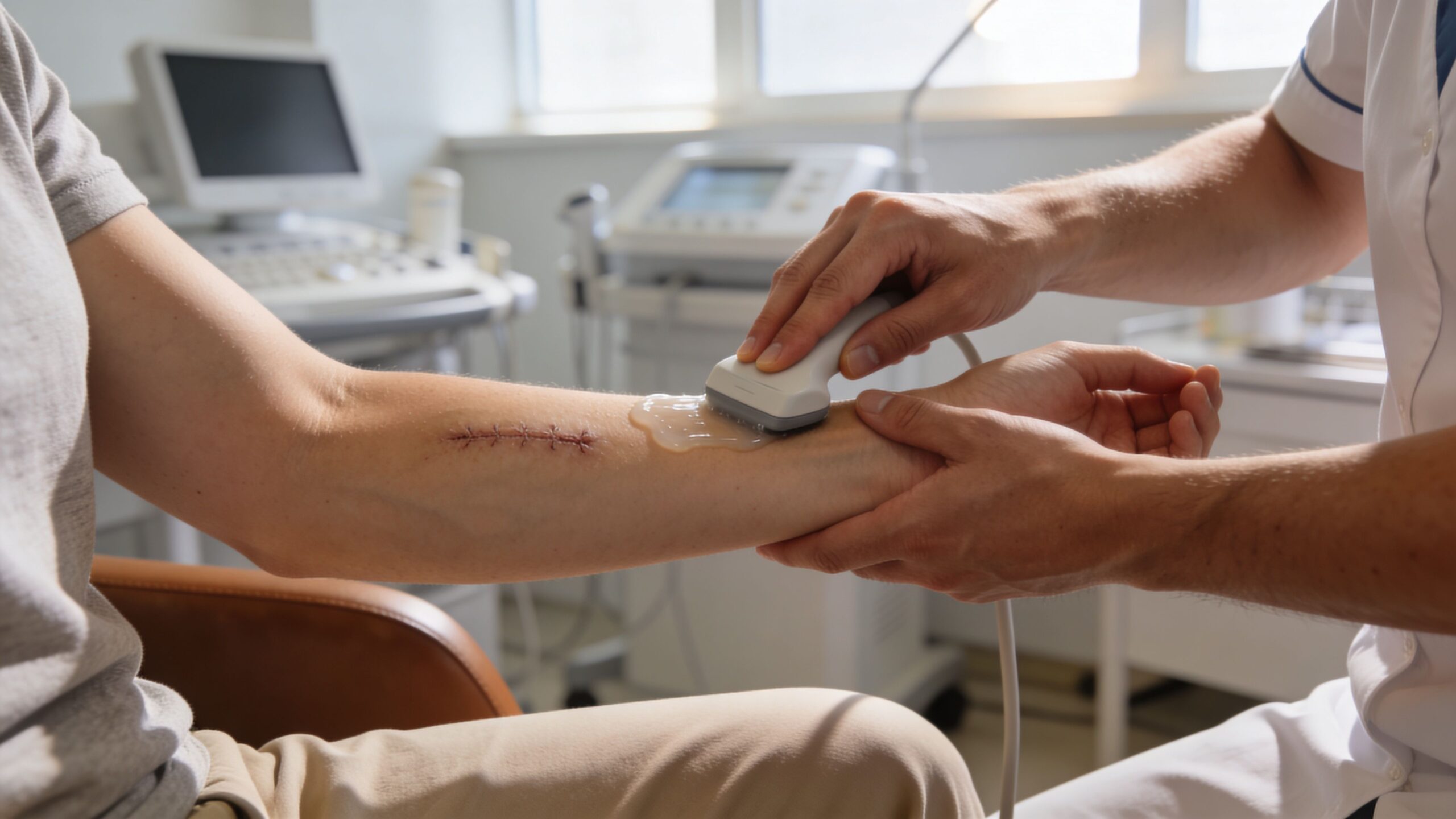
What the patient experiences
The therapist starts by looking at the scar and the movement problem attached to it. That comes first. If the scar isn’t the structure limiting function, ultrasound may not be used at all.
If it is appropriate, the process is simple:
- Skin check and positioning. The area is exposed and positioned so the tissue can be treated comfortably.
- Gel application. The gel improves transmission of the sound waves.
- Probe movement. The therapist moves the sound head slowly over the treatment zone, usually in small circular or overlapping motions.
- Immediate follow-up. The patient moves, stretches, or performs exercise while the tissue is more responsive.
Treatment typically involves very little sensation. Some feel mild warmth. Others feel almost nothing.
How long it lasts
Ultrasound is usually a short portion of the visit, not the whole visit. A typical protocol may involve 5-minute sessions performed 3 times per week, combined with standard wound care or manual therapy, and over-reliance on ultrasound without movement retraining can increase the risk of re-injury. The same source also notes that ultrasound alone doesn’t always outperform sham treatment, which reinforces the therapist’s role in guiding tissue remodeling through exercise, as discussed in this review on integrating ultrasound technology into rehab.
That’s the most important practical point in the room. The machine may take a few minutes. The rehab work takes the rest.
What happens after the ultrasound
The useful session begins to distinguish itself from the forgettable one. After ultrasound, a therapist might move directly into:
- Scar mobility work to improve glide between tissue layers
- Joint mobility techniques if nearby stiffness is part of the problem
- Targeted stretching to use the temporary gain in tissue extensibility
- Strengthening or tendon loading so the improved motion becomes functional
When indicated, that hands-on portion may include techniques covered in manual therapy in physical therapy, especially when the goal is to restore tissue glide and joint motion around the scarred area.
A good ultrasound session ends with movement, not with the patient just getting off the table.
What providers should expect
For referring clinicians, a useful PT note should tie ultrasound to a clear impairment. That might be a scar restricting dorsiflexion after Achilles repair, a thick incision limiting patellar mobility, or adherence around a tendon repair that interferes with glide. If the modality is being used without that kind of specificity, it’s worth asking why.
Expected Outcomes and How Progress Is Measured
The expected outcome from ultrasound for scar tissue isn’t that the scar vanishes. The better expectation is more functional: less pulling, improved mobility, better tolerance to loading, and a scar that interferes less with movement.
Some changes are subjective. Patients may say the tissue feels looser, less sharp, or less tender. Those reports matter, but they aren’t enough on their own. Good rehab also tracks objective change.
What therapists monitor clinically
In day-to-day practice, progress is usually measured through function:
- Range of motion improves with less end-range restriction
- Movement quality looks smoother and less guarded
- Strength work becomes easier to tolerate
- Task performance improves in activities like reaching, stairs, squatting, walking, or sport-specific drills
The scar itself is also assessed directly. Is it moving better? Is it less sensitive? Does it feel flatter, softer, or less adherent?
What imaging can add
High-frequency ultrasound gives clinicians a more objective way to monitor scar remodeling. A systematic review found that B-mode ultrasound can detect scar-thickness changes as small as 0.6 mm intra-rater, which helps clinicians distinguish real change from measurement noise, according to this review of high-frequency ultrasound for scar assessment.
That matters because subjective scar scales can miss subtle tissue change. Ultrasound imaging can evaluate thickness and echogenicity, which gives a clearer picture of whether the tissue is remodeling.
Why objective tracking matters
For patients, objective tracking builds confidence. They’re not just being told that the scar “seems better.” There’s a measurable way to follow change over time.
For clinicians and referring providers, it improves decision-making. If tissue thickness is changing and function is improving, the current plan may be working. If imaging and movement both plateau, the plan may need to shift.
One practical example in outpatient care is using diagnostic imaging alongside treatment to benchmark response. Highbar Physical Therapy offers therapeutic ultrasound as one modality within a broader rehab plan, where the tissue response is judged by changes in function first and imaging findings second.
Comparing Ultrasound with Other Scar Treatments
Scar treatment usually works best as a combination approach. Ultrasound has a specific lane. It reaches deeper tissue non-invasively and pairs well with active rehab. Other treatments may be better for surface texture, raised scars, or skin-focused cosmetic concerns.
Comparison of Common Scar Tissue Treatments
| Treatment | Mechanism | Best For | Invasiveness | Professional Required? |
|---|---|---|---|---|
| Therapeutic ultrasound | Thermal and non-thermal energy to influence tissue extensibility and healing response | Scar-related stiffness, adhesions, deeper soft tissue restrictions | Non-invasive | Yes |
| Manual scar mobilization | Direct mechanical mobilization of skin and underlying tissue | Adherent scars, glide restrictions, sensitivity work | Non-invasive | Often helpful, though some home work may be taught |
| Stretching and exercise | Load and movement to remodel tissue functionally | Motion loss, weakness, return to activity | Non-invasive | Usually guided at first |
| Compression or silicone-based management | External pressure and surface scar management | Raised or hypertrophic superficial scars | Non-invasive | Not always |
| Needling or procedural interventions | Controlled tissue stimulation or targeted scar treatment | Selected superficial or cosmetic scar issues | Minimally invasive | Yes |
| Focused ultrasound procedures | Concentrated ultrasound energy for tissue ablation in select settings | Certain hypertrophic scars or procedural cases | Minimally to non-invasive depending on approach | Yes |
How to think about the trade-offs
Ultrasound stands out when the problem sits below the surface and movement is limited. If the scar is mainly a cosmetic concern, it may not be the first choice. For example, surface-texture treatments are a different category. Someone comparing options for facial skin scarring may be better served by reading about microneedling for acne scars, which addresses a very different tissue problem than the post-surgical or orthopedic restrictions treated in PT.
Manual therapy and exercise still do the heavy lifting in most rehab plans. Ultrasound often helps them work better. It rarely replaces them.
If you’re trying to understand what “breaking up” scar tissue really means in rehab language, breaking up scar tissue is usually about improving mobility, glide, and function rather than physically removing every trace of the scar.
The best treatment choice depends on the scar’s depth, behavior, and functional impact. Not every scar needs a machine, and not every stiff scar responds to hands alone.
Frequently Asked Questions About Ultrasound Therapy
Does ultrasound for scar tissue hurt
Usually, no. Most patients feel mild warmth or very little at all. If a scar is highly sensitive, the therapist may adjust pressure, settings, or choose a different approach.
How many sessions does it take
There isn’t one set number. It depends on how old the scar is, how irritable it is, how much motion is limited, and whether the surrounding joint or tendon is also involved. What matters most is whether function is improving across visits.
Can a therapist actually measure scar change
Yes. Ultrasound imaging has been developed to quantify scar tissue volume, with an average percent error of 15.6% between operators, allowing clinicians to track healing over time in a reproducible way. In research settings, that approach can reduce the number of subjects needed by 70 to 80% through longitudinal assessment, which shows how useful it can be for repeated measurement in a single case, as described in this study on ultrasound-based scar tissue volume measurement.
Is therapeutic ultrasound the same as cosmetic ultrasound
No. The energy delivery and treatment goals are different. In rehabilitation, the goal is to improve tissue behavior and movement. Cosmetic or dermatologic applications may target skin tightening, resurfacing, or aesthetic scar concerns. If your main concern is skin appearance rather than movement restriction, a broader overview like 8 Best Acne Scar Treatment Options can help clarify that difference.
When is ultrasound not enough
Ultrasound isn’t enough when weakness, poor motor control, tendon loading deficits, or fear of movement are driving the problem. In those cases, the scar may be part of the story, but active rehab is what changes the outcome.
If a scar is limiting your movement, causing pain, or making recovery feel stuck, a physical therapist can determine whether ultrasound belongs in the plan and what should come with it. Highbar Physical Therapy offers evidence-based evaluation and treatment for post-surgical and orthopedic recovery, with care centered on restoring motion, strength, and function.