Surgery is just the first step; the real work of recovery happens in the weeks and months that follow. A huge part of that journey is how you manage the healing process to prevent problematic scar tissue. This isn't just about how your incision looks—it’s about making sure you can move freely, get back to your life, and live it to the fullest.
Why Managing Scar Tissue Is Crucial for Your Recovery
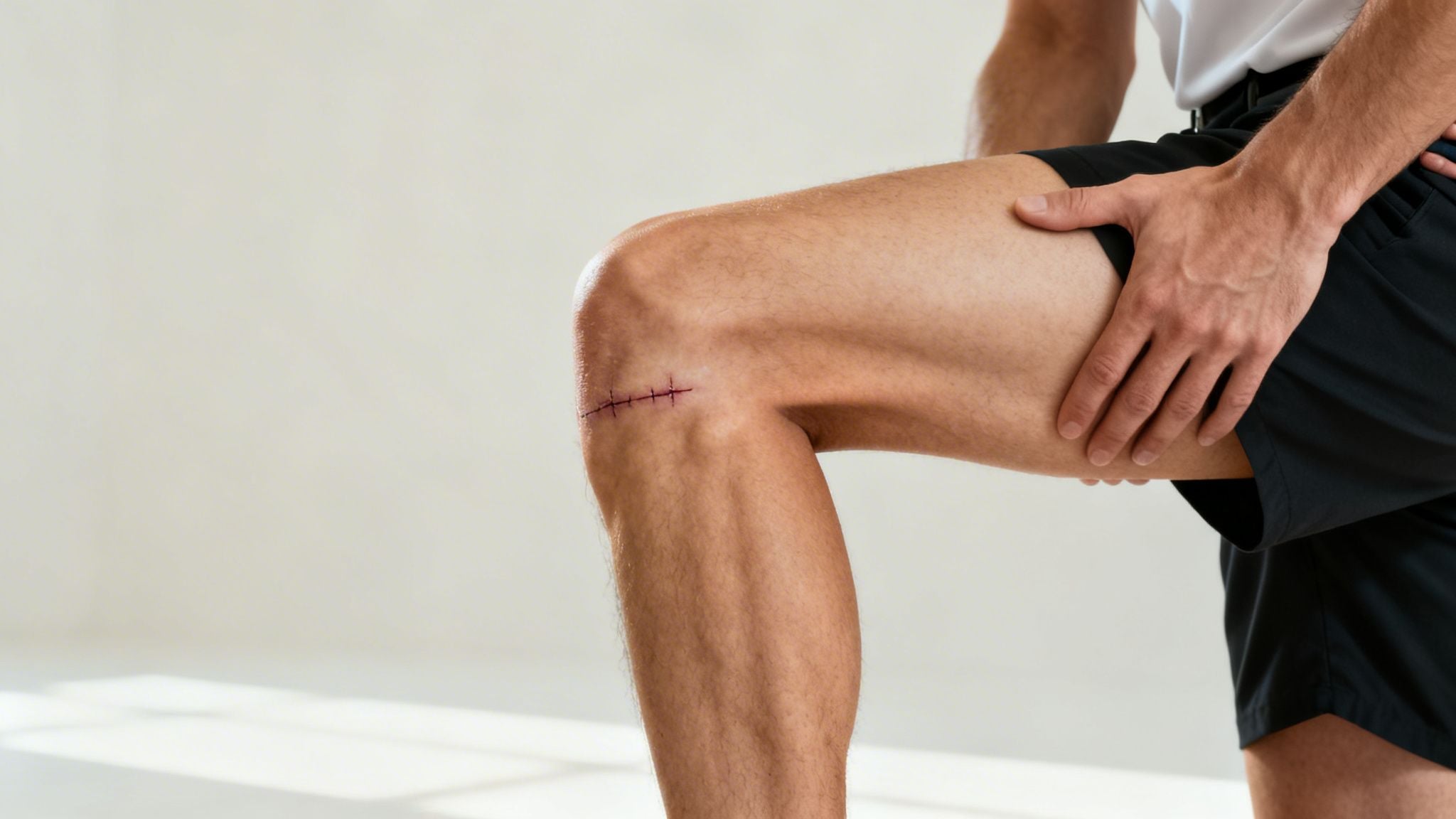
When you have surgery, your body kicks off an incredible healing process. Scar tissue is the natural "patch" your body creates to repair the damage. Think of it like biological superglue, made mostly of a protein called collagen, that reconnects and reinforces the injured area.
But that repair process isn’t always perfect. Sometimes, the body gets a little overzealous and produces too much collagen, or the collagen fibers get laid down in a disorganized, chaotic pattern. This is what creates excessive, restrictive scarring that can cause problems long after the skin has healed.
What Unchecked Scarring Can Do to Your Movement
Most of us think of a scar as just a line on the skin, but its real impact runs much deeper. Uncontrolled scar tissue can form adhesions, which are fibrous bands that essentially glue together tissues and muscles that are supposed to slide freely past one another.
This internal "stickiness" can lead to some very real consequences for your movement and comfort:
- Pain and Discomfort: Adhesions can tug on nerves and nearby tissues, causing a persistent, nagging pain or a sharp "catching" feeling when you move a certain way.
- Stiffness and Reduced Mobility: A classic example is the stiffness people feel after a total knee replacement. If scar tissue builds up around the joint, it can literally block the knee from bending or straightening all the way.
- Loss of Strength: When movement is painful and limited, the surrounding muscles can’t fire properly. This leads to weakness and a decline in function, making it harder to do everyday things.
At Highbar Physical Therapy, we see the real-world effects of this every single day. A patient recovering from rotator cuff surgery might find they can't reach into a high cabinet, not because the surgical repair failed, but because scar tissue is binding up their shoulder joint. Our passion is helping them break through that barrier to live a fuller, better life.
The Three Phases of Wound Healing and Scar Formation
Understanding your body’s healing timeline is the first step to influencing it. The process unfolds in three overlapping stages. Knowing what's happening and when allows you to take the right actions at the right time.
| Healing Phase | Typical Timeline | What Your Body Is Doing | Your Primary Goal |
|---|---|---|---|
| Inflammation | Days 1-6 | Your body’s "cleanup crew" arrives. Inflammatory cells fight bacteria and clear out damaged tissue. The area is red, swollen, and tender. | Protect the wound and manage swelling and pain. |
| Proliferation | Day 4 – Week 4 | The "rebuilding" phase begins. New blood vessels form, and cells start producing a collagen scaffold to create the initial scar. | Encourage healthy healing with gentle movement and proper wound care. |
| Remodeling | Week 3 – 1 Year+ | The scar matures. Disorganized collagen fibers are broken down and replaced with stronger, more aligned fibers. | Influence the scar's final form through massage, stretching, and strengthening. |
This remodeling phase is your biggest window of opportunity. With the right techniques, you can guide the scar to become more flexible and functional, rather than tight and restrictive.
This isn't a small problem. Every year, around 100 million people worldwide develop scars from surgery. Up to 91% of patients report wanting better healing outcomes, which tells you just how common this concern is.
Proactive management, especially with guidance from a physical therapist, makes all the difference. While every surgery is different, many of the core principles of recovering from foot surgery, for example, apply to other procedures as well. By taking the right steps, you can help ensure your scar is a simple mark of recovery, not a source of long-term limitation.
Post-Op Wound Care in the First Four Weeks
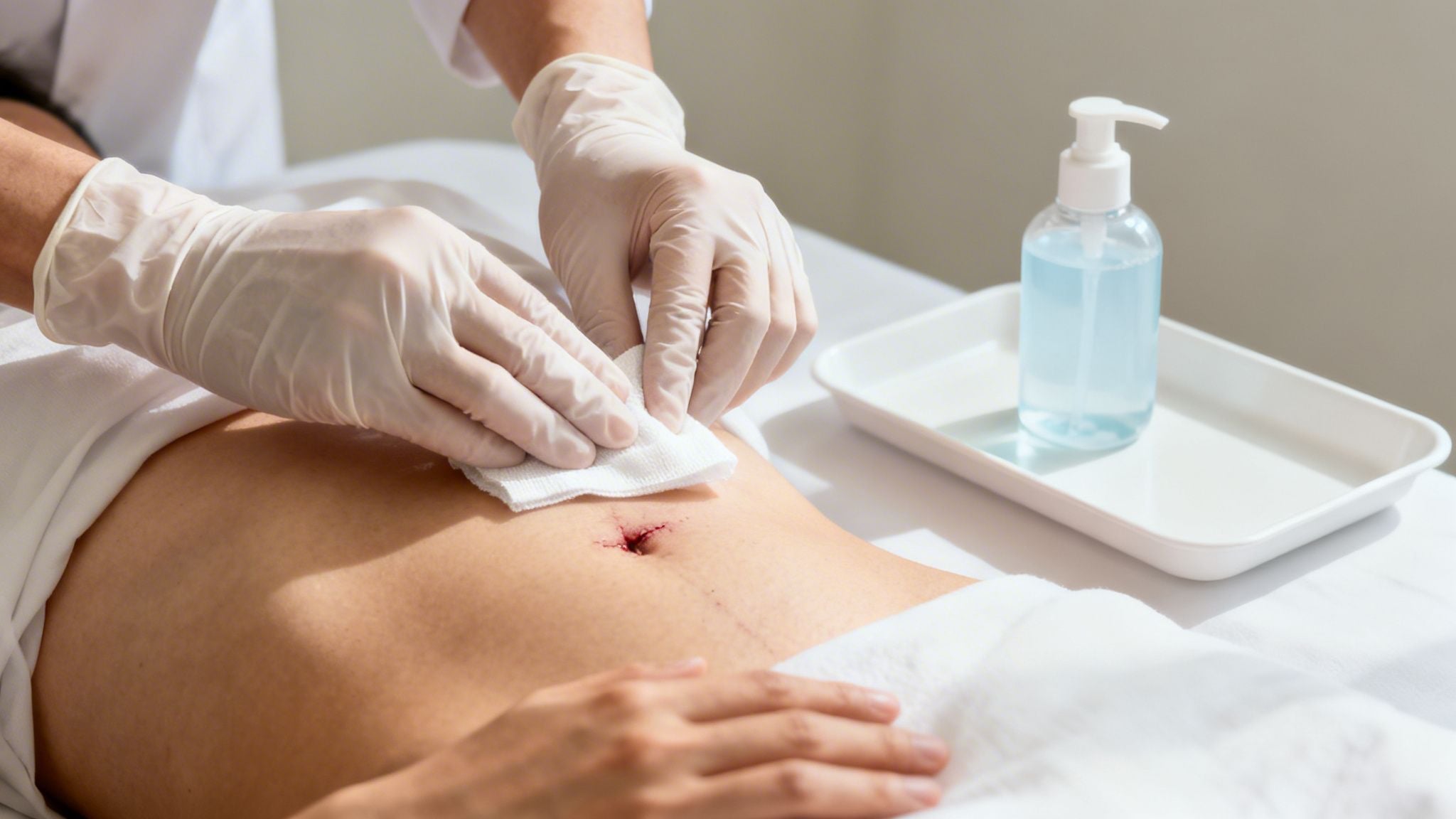
The first four weeks after surgery aren’t about passively waiting for things to heal. They’re about taking strategic action. This initial window is what we call the proliferation phase—it’s when your body is working overtime, rapidly building the new collagen framework that will become your scar.
Think of it like laying the foundation for a house. A messy, uneven concrete pour compromises everything built on top of it. It’s the same with your body. The care you provide now creates a clean, stable environment for healthy tissue to form, and that directly influences how mobile and pain-free your recovery will be.
Keeping the Incision Clean and Protected
Your absolute top priority in the first few weeks is preventing infection. An infection throws a major wrench in the healing process, triggering a prolonged and aggressive inflammatory response. This puts your body in emergency mode, forcing it to haphazardly throw down collagen just to close the wound. The result is often thick, dense, and painful scarring.
Your surgeon will give you specific instructions for your incision. Following them to the letter is non-negotiable.
General Wound Care Best Practices:
- Keep It Dry: For the first 24-48 hours, or however long your surgeon advises, the incision must stay completely dry to keep bacteria out.
- Follow Dressing Protocols: Whether you have Steri-Strips, glue, or stitches, you need to know exactly how to care for and change your dressings. Always start with meticulously clean hands.
- Watch for Infection: A little redness and some clear or light pink drainage can be normal. But if you see spreading redness, yellow or green pus, notice a foul odor, or develop a fever, call your doctor immediately.
Proper care isn't just about cleaning. For some surgeries, knowing techniques like how to wrap the knee for support and recovery is a vital part of protecting the surgical site and managing swelling during these first few weeks.
Fueling Your Body for Optimal Tissue Repair
Healing is an incredibly energy-intensive job. Your body needs the right building blocks to repair itself effectively, and those materials come directly from what you eat and drink. Skimping on nutrition can slow the whole process down and compromise the quality of your new scar tissue.
Just as a construction crew needs quality materials, your body needs adequate protein, vitamins, and water to build strong, flexible new tissue. A poor diet can lead to weak and disorganized collagen fibers, making it harder for you to get better.
To give your body what it needs, focus on a few key areas:
- Protein: This is the literal building block of collagen. Make sure you’re including lean protein sources—like chicken, fish, beans, and tofu—in every meal.
- Vitamin C: Absolutely essential for collagen synthesis. You’ll find it in citrus fruits, bell peppers, broccoli, and strawberries.
- Zinc: This mineral plays a crucial part in cell growth and wound healing. Nuts, seeds, and whole grains are all great sources.
- Hydration: Water is the transport system, carrying all those nutrients to the wound site and keeping your tissues pliable. Aim for at least eight glasses a day.
The Power of Protected Mobilization
Moving in the early post-op phase might sound wrong, but it's one of the most powerful things you can do to prevent restrictive scar tissue. We’re not talking about hitting the gym. We’re talking about protected mobilization—the gentle, controlled movements prescribed by your physical therapist.
This early movement actually encourages the new collagen fibers to lay down in an organized, parallel fashion, mimicking the structure of healthy, flexible tissue. Without this guidance, they tend to form in a tangled, random mess, which is the very definition of a restrictive adhesion.
A physical therapist is your expert guide here. They know the delicate balance between promoting healing and protecting the new repair. For instance:
- After ACL Reconstruction: Your PT might have you start gentle passive knee bends and quad sets within a day or two of surgery. This prevents the kneecap and surrounding tissues from getting "stuck" down.
- After a C-Section: A therapist can teach you how to engage your deep core muscles and perform gentle pelvic tilts. These tiny movements help prevent adhesions from forming between the abdominal layers, which can otherwise cause that permanent "pouch" and even lead to lower back pain.
These early movements are crucial. Research shows that patients who start early, guided mobilization are significantly less likely to develop problematic adhesions. It's a fundamental part of getting you back to living your best life. For a deeper dive into managing post-operative discomfort, our article on using ice packs in physical therapy offers valuable tips that complement your mobilization efforts.
Getting Hands-On With Scar Massage and Manual Therapy
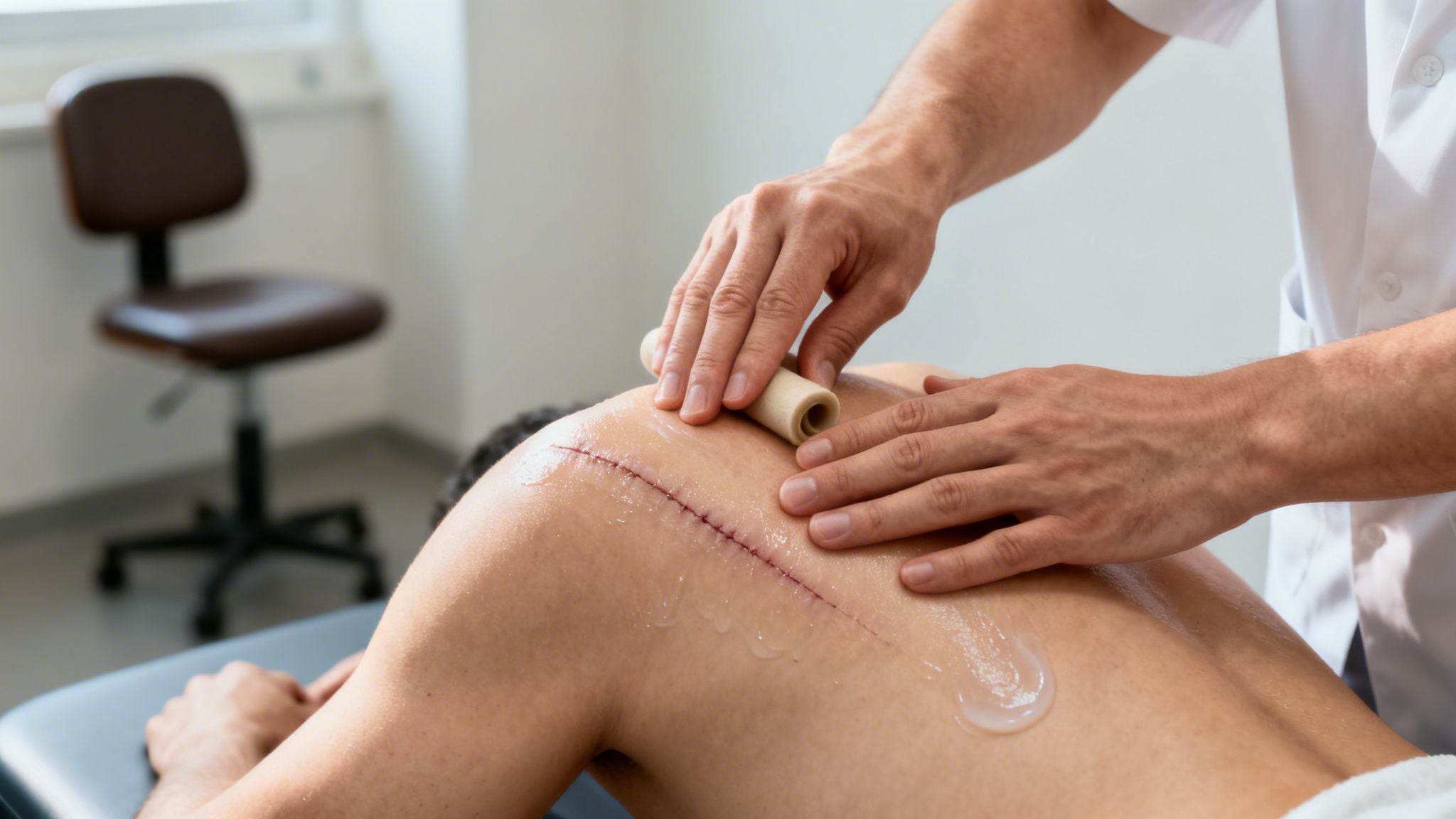
Once your incision has fully closed and any scabs have fallen off—usually around three to four weeks after your surgery—you can move into a powerful new phase of recovery. This is where hands-on techniques like scar massage and manual therapy become critical for preventing stiff, restrictive scar tissue from forming.
Think of new scar tissue like wet cement. In its early stages, it’s pliable and can be molded. Gentle, targeted pressure helps smooth it out, encouraging it to set into a flexible, functional surface instead of a lumpy, rigid block that pulls on surrounding tissues and limits your movement.
The science behind it is pretty direct. Massage helps break up the disorganized web of collagen fibers that causes stiffness. This process also boosts blood flow, bringing in the oxygen and nutrients your body needs for the final stages of healing. The ultimate goal is to get the skin, muscles, and fascia gliding freely over one another again, just like they did before.
When to Start and What to Expect
Timing is everything. Starting too early can irritate the healing incision, but waiting too long allows adhesions to set in and become much tougher to deal with. Always get the green light from your surgeon or physical therapist before you start working directly on the scar.
When you do begin, you should feel a firm pressure or a gentle stretch, not sharp pain. It's normal to feel some discomfort, especially when you find a particularly tight spot, but real pain is your body’s signal to ease up.
A good rule of thumb is to apply just enough pressure to see the skin under your finger turn a little lighter (a technique called blanching) without causing any irritation or bruising.
Essential Self-Massage Techniques
You can do these simple but effective techniques at home for just a few minutes each day. Always use a bit of lotion or oil to help your fingers glide smoothly over the skin.
- Direct Pressure: Use your thumb or fingertips to apply steady, gentle pressure right on top of the scar. Hold for 10-15 seconds in one spot before moving along the scar line. This directly helps to soften the tissue.
- Skin Rolling: Gently pinch the skin on one side of the scar and try to "roll" it between your thumb and fingers, moving across the scar to the other side. This is fantastic for lifting the skin away from deeper tissues it may be stuck to.
- Cross-Friction Massage: Place a couple of fingers directly on the scar and make small, deep movements back and forth, perpendicular to the scar line. This specific technique helps realign the collagen fibers and break up adhesions.
We often see this after a C-section, where the scar can adhere to the abdominal wall and create a "shelf" or puckered look. Consistent, gentle skin rolling and cross-friction massage can make a huge difference in both the scar’s appearance and the mobility of the tissue underneath, which is key for restoring core function and helping you feel good in your body again.
The Role of a Physical Therapist
While self-massage is a great starting point, some scars—especially those that are deep, long, or just plain stubborn—really benefit from professional help. A physical therapist has the advanced training to figure out exactly which layers of tissue are restricted and why.
Their expertise goes way beyond basic massage. Therapists can use specialized manual techniques, including instrument-assisted soft tissue mobilization (IASTM), to reach deep adhesions that you simply can't get to on your own. It's the difference between sweeping your floor and having it professionally deep-cleaned; both are helpful, but one gets a much more intensive result. These hands-on treatments work on similar principles to other manual therapies, and you can learn more about how they help in our guide to what trigger point therapy is.
Problematic scarring is a significant issue for many. Globally, about 12.47% of all scars become either hypertrophic or keloid. But there's good news: clinical trials show that combining pressure therapy with manual techniques can reduce scar volume by as much as 50-70%, highlighting how powerful physical therapy can be. You can dive deeper into the findings about post-surgical scar management here.
Partnering with a PT empowers you to take control of your healing journey, ensuring you get back to a fuller, better quality of life.
Restoring Function with Progressive Movement

While good wound care and massage are crucial first steps, movement is what truly teaches your scar tissue how to be flexible and functional. Think of it this way: your body’s natural instinct after surgery is to protect the area by keeping it still. It's a useful defense mechanism at first, but it can quickly lead to chronic stiffness and adhesions if left unchecked.
A progressive movement plan, guided by a physical therapist, is how we re-educate those healing tissues. We have to gradually and safely challenge them, encouraging the new collagen fibers to align in a strong, organized way that actually supports your movement instead of blocking it.
From Gentle Motion to Active Stretching
Once your surgeon gives you the all-clear, your physical therapist will start you on a journey from passive motion to active control. The initial goal is always to restore your range of motion (ROM)—the full movement potential of a joint.
This progression is carefully planned and usually looks something like this:
- Passive Range of Motion (PROM): In the earliest stages, your therapist will gently move your joint for you. This re-establishes the movement pathway without putting any stress on the surgical repair. Research has shown time and again that this early, regular motion is absolutely critical for preventing adhesions.
- Active-Assisted Range of Motion (AAROM): Next, you'll start to participate. You might use your other arm to help lift the surgical one, or a strap to help guide your knee. This is the first step in re-engaging your muscles in a supported, controlled manner.
- Active Range of Motion (AROM): Finally, you’ll begin moving the joint entirely on your own. Your therapist is there to make sure you're firing the right muscles and not developing poor habits or compensations, which is incredibly common after surgery.
A perfect example we see all the time at Highbar is with patients recovering from rotator cuff surgery. Without a guided program, it's so easy to develop a "frozen shoulder" from excessive scar tissue. A progressive ROM plan, including specific exercises like pendulum swings and wall crawls, is what prevents this and gets them back to their lives.
You can learn more about this specific recovery in our guide on tips for recovering from rotator cuff surgery.
Reclaiming Core Function After Abdominal Surgery
Progressive movement is just as critical for surgeries on the torso. After a C-section, tummy tuck, or hernia repair, it’s completely natural to guard your core and avoid using those muscles. The problem is, this inactivity can cause the different layers of abdominal tissue to stick together, often creating a constant pulling sensation or even contributing to lower back pain.
A physical therapist will design a plan to help you safely reconnect with and mobilize your core.
Example Mobility Drills:
- Diaphragmatic Breathing: This is the foundation. It re-establishes the connection to your deep core muscles and gently mobilizes internal tissues from the inside out.
- Pelvic Tilts: These are small, controlled rocking motions of the pelvis that begin to stretch the lower abdominal area and keep scar tissue from binding things down.
- Trunk Rotation: Gentle, pain-free twisting movements are key for ensuring the abdominal wall can move freely and independently from the deeper tissue layers.
The Transition to Strengthening
Once you’ve regained most of your mobility, the final piece of the puzzle is rebuilding strength. Strong muscles don’t just help you function—they protect your joints and prevent future injuries.
Your physical therapist will design a program that carefully introduces resistance, which is what challenges the scar tissue to mature into a robust, resilient structure. It needs to be able to handle the demands of your daily life, whether that’s lifting your kids, getting back to the gym, or just moving without a second thought. This is how we ensure that your scar tissue doesn't become a lifelong limitation, allowing you to live a better, fuller life.
Recognizing When to See a Physical Therapist
While diligent self-care is a huge part of a successful recovery, sometimes you need an expert to get you across the finish line. A physical therapist is a movement specialist who can pinpoint exactly why your recovery has stalled and create a plan to get you moving again.
The goal is always to move freely and without pain. When scar tissue starts getting in the way of that, it’s time to get professional help.
Recognizing When a Scar Is Becoming a Problem
Your body is pretty good at telling you when something’s wrong. The key is to listen to those signals instead of trying to “push through the pain.” Ignoring them allows problematic scar tissue and adhesions to become more established, making them tougher to treat down the road.
Here are the signs we tell our patients to watch for—the red flags that mean it's time to see a PT:
- A constant “pulling” or “tugging” feeling. A mild stretch is one thing. But if you feel a persistent, tight pulling from the scar, especially when you try to reach or stretch, that’s a classic sign of deeper adhesions. It feels like the scar is tethered to the tissue underneath it.
- Puckering or a visible indentation. Take a look at your scar. Is the skin around it dimpling or getting pulled inward, especially when you move? This means the scar is stuck to deeper layers. It's not just a cosmetic issue; it’s a physical anchor holding you back.
- Pain that doesn’t go away. Some soreness after surgery is expected. Sharp, pinching pain at the scar site, or pain that shoots out from the area when you move, is not. This often means a nerve is getting irritated or trapped by the scar tissue.
- You’ve hit a wall with your mobility. Maybe you were making great progress getting your motion back, but now you’re completely stuck. Or even worse, you’re starting to lose the range of motion you’d already regained. This is a huge sign that scar tissue is winning the battle.
- The scar is becoming thick and raised. If your scar gets noticeably firm, raised, red, and itchy, it might be developing into a hypertrophic or keloid scar. Getting a physical therapist involved early is critical to manage these effectively.
A patient recovering from knee surgery might say it feels like a “tight rubber band is stuck inside my knee,” stopping it from fully straightening. That sensation isn't just muscle tightness—it’s a textbook example of restrictive scar tissue that needs targeted, professional hands-on work to release so they can get better.
Deciding whether what you're experiencing is a normal part of healing or a sign you need help can be confusing. Here’s a quick guide to help you tell the difference.
Self-Care vs Professional PT: A Quick Guide
Use this guide to determine if your scar healing is on track or if it's time to see a physical therapist.
| Symptom | What Is Usually Normal | When to Consult a PT |
|---|---|---|
| Sensation | Mild tightness or stretching with movement. | A constant, deep "pulling" sensation that limits your motion. |
| Appearance | A flat, pale line that gradually fades over time. | Significant puckering, dimpling, or indentation around the scar. |
| Pain | General soreness that improves with time and rest. | Sharp, pinching, or radiating pain at the scar site that worsens with movement. |
| Mobility | Steady, gradual improvement in your range of motion. | Progress has completely stalled or you're losing motion you previously had. |
| Texture | The scar feels soft and moves easily with the skin. | The scar becomes thick, hard, raised, red, and/or itchy. |
If you find yourself in the "When to Consult a PT" column for any of these symptoms, don't wait. The sooner we can intervene, the easier and faster it is to get your recovery back on track.
How a Physical Therapist Can Help
When you bring these issues to a physical therapist, you’re getting a much deeper level of care. As movement experts, we don’t just see a scar; we assess how it’s affecting your body’s entire movement chain. We figure out the root cause of the restriction and then use advanced techniques that go way beyond what you can do at home.
A personalized PT plan for scar tissue is an active strategy to get you moving better. It often includes:
- Advanced Manual Therapy: We use our hands to feel for specific restrictions, layer by layer, and apply precise techniques to release them. These methods are far more targeted than general self-massage.
- Instrument-Assisted Soft Tissue Mobilization (IASTM): We use specially designed stainless steel tools to scan for and break down tough, fibrous adhesions that are too deep or stubborn for fingers alone to address.
- Kinesio Taping: A therapist can apply specialized tape in a specific pattern to gently lift the superficial layers of skin away from the deeper fascia. This constant, gentle lift can reduce pulling, improve fluid flow, and calm down pain signals.
- Aquatic Therapy: For really painful, sensitive scars or when moving on land is just too difficult, exercising in the water can be a game-changer. The water’s buoyancy unloads your joints, letting you regain motion without pain, while its natural pressure helps manage swelling.
Working with a Highbar physical therapist means you’re getting a partner who is 100% dedicated to your recovery. We’ll help you overcome these hurdles so you can get back to living a fuller life, free from limitations.
Your Top Questions About Scar Tissue, Answered
After surgery, your mind is probably buzzing with questions. We get it. Understanding what’s normal and what you can do to help your body heal is a huge part of feeling back in control. Here are the questions our physical therapists hear most often about managing scar tissue—and the answers you need to feel confident in your recovery.
How Soon Can I Start Preventing Scar Tissue After Surgery?
The short answer is: right away. But how you do it changes dramatically as you heal. Think of it as a layered process that starts gently and becomes more hands-on over time.
In the very beginning, your job is to create the best possible environment for healing. That means:
- Preventing infection is priority number one. Follow your surgeon's wound care instructions to the letter.
- Giving your body the fuel it needs to repair itself with a nutrient-rich diet and plenty of water.
- Protecting the incision and doing what you can to manage swelling.
Gentle, controlled movement often begins within just a few days, guided by your physical therapist. But direct scar massage is a different story. You can only start hands-on techniques after the incision is fully closed and every last scab is gone. This is usually around three to four weeks after your surgery, but you should always get the green light from your surgeon or PT first.
Should Scar Massage Hurt?
Scar massage should feel like a firm stretch or a deep pressure, but it should never cause sharp pain. A bit of mild discomfort or tenderness is completely normal, especially when you’re working on an area that feels particularly tight or stuck. That sensation is often the tissue just starting to let go.
But if you feel any sharp, shooting, or radiating pain, you’re pushing too hard. Pain is your body’s way of saying, “Ease up.” A good rule of thumb is to apply just enough pressure to see the skin under your finger turn a little pale. If you see any bruising, new swelling, or major skin irritation after a session, you need to back off the pressure.
A physical therapist can be invaluable here. We can show you the exact amount of pressure to use for your specific scar and teach you how to differentiate between productive discomfort and pain that signals a problem, empowering you to take an active role in getting better.
Can I Prevent A Keloid Or Hypertrophic Scar?
While it’s true that some people are genetically prone to forming raised scars like keloids or hypertrophic scars, you can absolutely take steps to lower your risk. It isn’t a 100% guarantee, but proactive care makes a massive difference.
Your best defense is early and consistent action. This looks like:
- Strict wound care in those first few weeks to keep inflammation to a minimum.
- Using silicone gel sheets or tape once the wound has completely healed. These are clinically proven to help hydrate the scar tissue and regulate collagen production.
- Applying consistent, gentle pressure with special tape or compression garments, as recommended by your therapist.
- Committing to a physical therapy program that includes scar mobilization and specific stretching to keep the new tissue pliable.
If you start to notice your scar is getting intensely itchy, feels very firm, is becoming raised, or seems to be growing beyond the original incision line, it's critical to let your doctor or PT know right away. The sooner these types of scars are addressed, the better the outcome.
Is It Ever Too Late To Treat Old Scar Tissue?
Absolutely not. It is never too late to improve how an old scar feels and functions. Mature scar tissue—scars that are a year old or more—is definitely more established and can be stubborn. But it is not unchangeable.
Think of an old scar like a knotted rope that’s been sitting in a shed for years. It’s tight and stiff, but with patient and consistent effort, you can still work those knots out. The collagen fibers can still be remodeled.
A skilled physical therapist can make a huge impact on even decades-old scars. We use advanced manual therapy techniques, tools like IASTM, and targeted stretching programs designed specifically to break down those long-standing adhesions and bring pliability back to the tissue.
Many of our patients are genuinely shocked by how much more movement they can get back—and how much less pain they feel—even with a scar they’ve had for a decade or more. It takes consistency, but improvement is almost always possible. Don't ever assume you just have to live with the restriction.
At Highbar Physical Therapy, our passion is helping you move freely and live fully. If you're struggling with post-surgical recovery or scar tissue is limiting your life, our expert therapists are here to create a personalized plan to get you better. Book your appointment today and take the next step toward living a fuller, better life.