Ask a physical therapist how to avoid getting hurt playing pickleball, and you will probably get the same answer I give: warm up before you play.
It sounds almost too simple, which is exactly why so many people skip it. But it is the single easiest change most players can make, and it takes less time than waiting for a court.
Here is why the warm-up matters and what a good one actually looks like.
Why warming up matters for pickleball
Sprains and strains are the most common type of pickleball injury. That makes sense when you think about what the sport asks of your body. You are making quick lateral steps, lunging forward for dinks, reaching overhead, and stopping and starting constantly, often after sitting in a car or at a desk for the last hour.
Warming your muscles up first helps them loosen up and get ready to work, which makes them far less likely to get pushed past what they are prepared for on that first hard step or overhead swing.
I know how tempting it is to jump straight into a game the moment you arrive. Your friends are already there, the paddles are out, and nobody wants to be the person doing leg swings by the fence. But taking 5 to 10 minutes to warm up genuinely makes a big difference, and it costs you almost nothing.
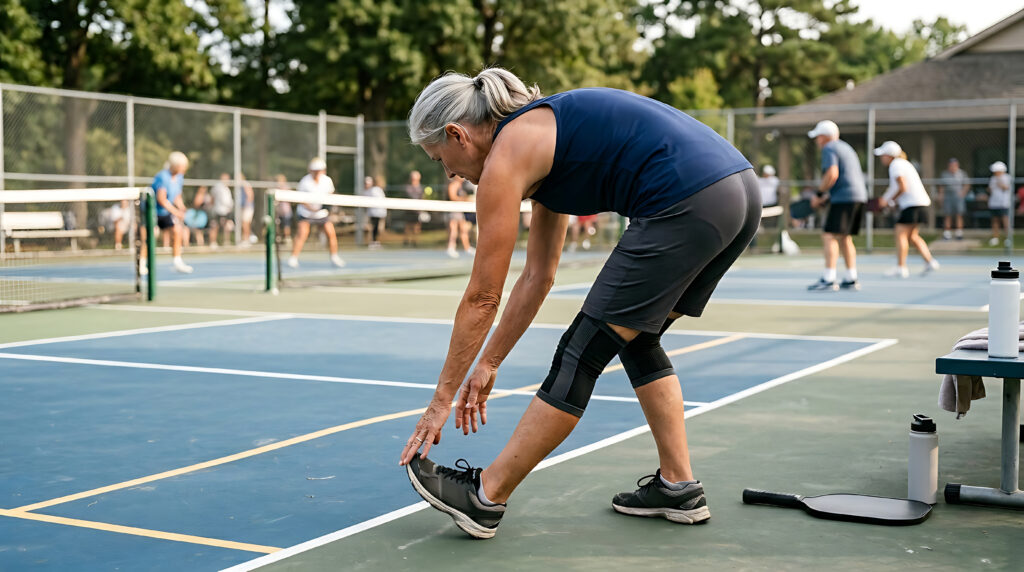
6 warm-up exercises you can do courtside
1. Light jog. Find an open area courtside where you can lightly jog back and forth for 45 to 60 seconds. This is just about getting your heart rate up and blood flowing.
2. Leg swings. Hold onto a fence, bench, or railing for support as needed. Swing each leg front and back 10 times. Then repeat the same thing side to side, 10 times in each direction.
3. Torso twists. Hold your arms out in front of you or crossed over your chest, and twist your torso back and forth 15 times to each side.
4. Arm circles. Bring your arms straight out to the sides. Do small circles forward 10 times, then backward 10 times. Then do big circles forward 10 times, and big circles backward 10 times.
5. Walking lunges. Take a long step forward into a lunge with one leg, then stand back up and bring the other leg forward into a lunge. Keep moving forward with these alternating lunges until you have done 10 total. Try not to let your knee travel too far past your toes, which helps you avoid putting extra stress on the knee joint.
6. Side shuffles. Find an open space courtside and shuffle 5 times to your right, then 5 times to your left. Repeat that 3 times.
Why this particular set
This series covers your arms, legs, and torso, which is basically everything pickleball asks of you. The leg swings and lunges open up your hips before you start lunging for dinks. The torso twists and arm circles get your trunk and shoulders ready for serves and overheads.
The side shuffles are the ones people skip most often, even though lateral movement is where a lot of pickleball injuries happen. Getting a few shuffles in first tells your body that quick side to side movement is coming.
Give it a try next time you head to the court and see how much better you feel in that first game.
Have a pickleball question?
This article is part of The Pickleball PT Playbook, a monthly column I write on playing better, reducing your injury risk, and recovering better, so you can spend more time on the court and less time on the sidelines.
If you have a question you want answered, send me an email at bweinman@highbarhealth.com, and it may be featured in a future edition.