Neck pain can be a persistent, frustrating barrier to living the life you want, turning simple activities like driving, working at a computer, or even sleeping into a challenge. While it's tempting to reach for a quick fix, true and lasting relief comes from addressing the root cause. The key isn't just to stop the pain, but to restore function, build resilience, and empower your body to move freely and fully. At Highbar Physical Therapy, where we are passionate about helping people get better and live fuller lives, we believe in the power of targeted movement.
This guide provides a structured, evidence-based collection of the most effective exercises for neck pain relief. These aren't just random stretches; they are foundational movements our licensed physical therapists use to help patients restore mobility, build crucial stability, and correct the postural habits that often lead to discomfort. We'll walk you through each exercise step-by-step, explaining not just the 'how' but the 'why' behind each movement, so you can take an active, informed role in your recovery.
This listicle will cover essential categories of exercises, including:
- Mobility and Range of Motion: To gently restore movement and reduce stiffness.
- Strengthening and Stability: To build support for the head and neck.
- Postural Correction: To address the underlying causes of strain from daily habits.
While consistent exercises are crucial for neck pain relief, ensuring you have proper support during sleep is equally vital. Explore how specialized neck pain pillows can complement your physical therapy efforts for lasting comfort. By integrating these targeted exercises into your routine, you can move beyond managing symptoms and start building a stronger, more resilient neck for the long term.
1. Cervical Range of Motion (ROM) Exercises
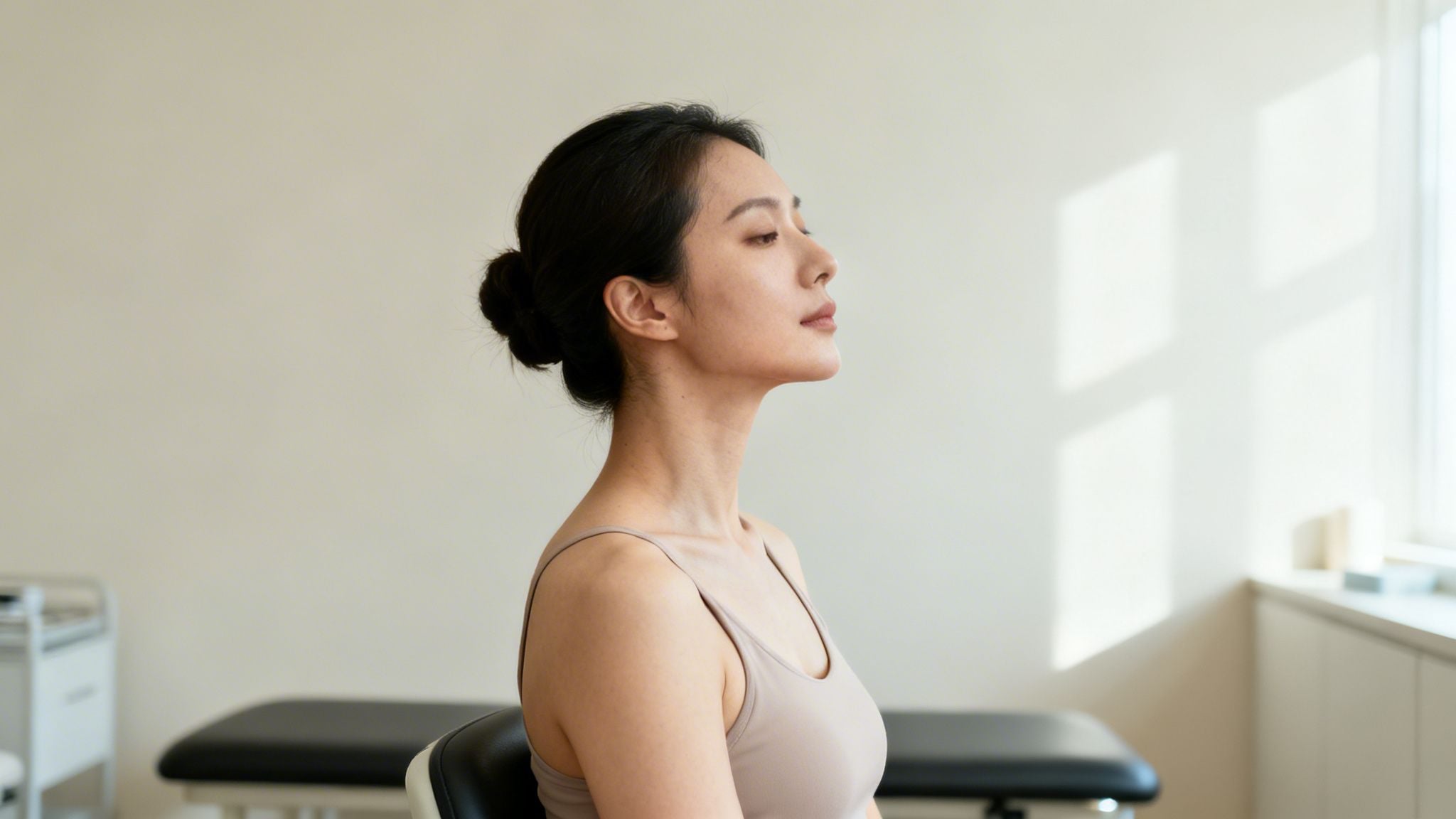
Cervical Range of Motion (ROM) exercises are the foundational movements for reclaiming neck health. These gentle, controlled motions are designed to move your neck through its natural planes of movement: forward (flexion), backward (extension), side-to-side (lateral flexion), and turning (rotation). The primary goal is not to force a stretch but to re-establish mobility, decrease stiffness, and reduce the brain's perception of threat associated with movement, which is a common factor in chronic pain. By methodically moving the joints and soft tissues, these exercises for neck pain relief improve circulation and lubrication within the cervical spine.
Why It Works
When your neck is painful, your natural instinct is to hold it still. While this is protective initially, prolonged immobility leads to increased stiffness, muscle guarding, and restricted blood flow, which can delay recovery. Cervical ROM exercises gently reintroduce movement, helping to break this cycle of pain and stiffness. They are particularly effective for individuals with neck stiffness from poor posture, such as office workers, or as an initial step in rehabilitation after an injury like whiplash, once cleared by a medical professional.
How to Perform Cervical ROM Exercises
Sit or stand with a tall, relaxed posture, keeping your shoulders down and back. Perform each movement slowly and smoothly.
- Flexion/Extension (Nodding): Gently lower your chin toward your chest, feeling a light stretch in the back of your neck. Hold for 2-3 seconds. Return to the start and slowly tilt your head back to look toward the ceiling.
- Rotation (Looking Side to Side): Slowly turn your head to look over your right shoulder, as far as is comfortable. Hold for 2-3 seconds. Return to center and repeat on the left side.
- Lateral Flexion (Ear to Shoulder): Gently tilt your right ear toward your right shoulder, keeping the shoulder relaxed and down. Hold for 2-3 seconds. Return to center and repeat on the left side.
Physical Therapist's Insight: The goal is motion, not a maximum stretch. Move only within a pain-free range. If you feel sharp or radiating pain, stop immediately and consult with a physical therapist at Highbar.
A good starting point is 5-10 repetitions of each movement, performed 2-3 times per day. During acute phases of stiffness, performing a few repetitions every hour can prevent the neck from becoming locked up.
2. Isometric Neck Strengthening Exercises
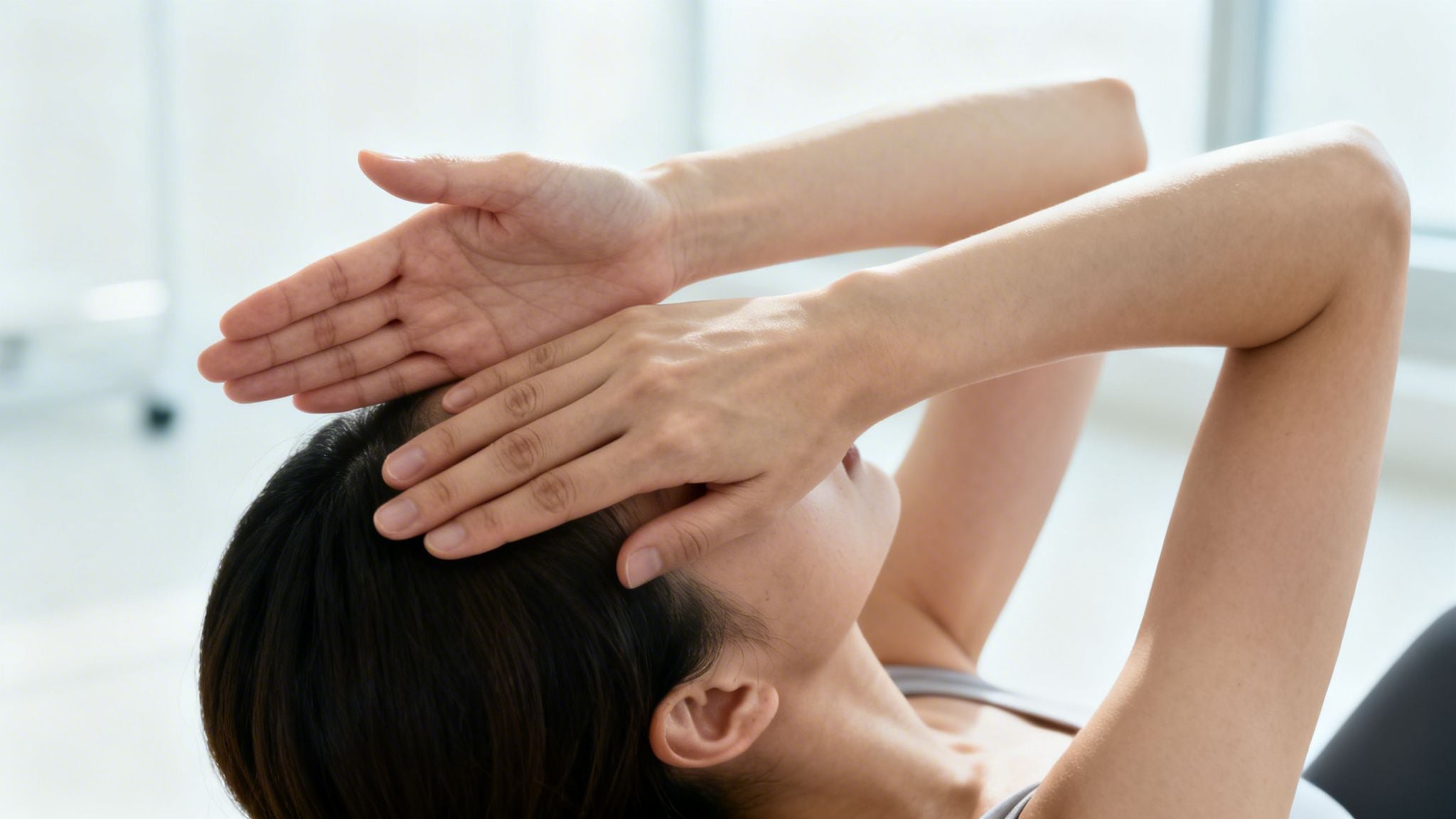
Isometric exercises are a powerful yet gentle method for rebuilding neck strength without requiring joint movement. The technique involves contracting your neck muscles against a stable resistance, such as your hand or a wall, while keeping your head and neck perfectly still. This static muscle activation builds endurance and stability in the deep cervical muscles, which are crucial for supporting your head and maintaining proper posture. For individuals with acute pain or healing injuries, these exercises for neck pain relief are often a safe starting point for strengthening.
Why It Works
When neck pain is present, especially after an injury like a muscle strain, dynamic movements can sometimes aggravate symptoms. Isometrics bypass this issue by strengthening the muscles without straining sensitive joints or soft tissues. This approach helps re-establish the connection between your brain and your neck muscles, improving control and stability. It's particularly effective for individuals rebuilding neck function after an injury or for those with chronic pain who need to strengthen their neck to prevent symptom flare-ups without causing irritation.
How to Perform Isometric Neck Strengthening Exercises
Sit or stand with a tall, neutral spine, ensuring your ears are aligned over your shoulders. For each movement, apply gentle pressure and match it with your neck muscles to prevent any motion.
- Forward Flexion: Place your palm on your forehead. Gently press your head forward into your hand while your hand provides equal resistance to keep your head still.
- Extension: Clasp your hands behind your head. Gently press your head backward into your hands, using your hands to resist the movement.
- Lateral Flexion: Place your right palm on the right side of your head. Gently press your head into your hand as your hand resists. Repeat on the left side.
- Rotation: Place your right palm on the right side of your head, just above your temple. Attempt to turn your head to the right as your hand prevents the motion. Repeat on the left.
Physical Therapist's Insight: The key is a gentle, sustained contraction, not a maximum effort. Start at 30-50% of your maximum force and focus on control. Never hold your breath; breathe steadily throughout the hold.
Begin with 5-second holds for 8-10 repetitions in each direction. As you get stronger, progress to 10-second holds. Aim to perform this routine 3-4 times per week.
3. Scapular Stabilization and Shoulder Complex Integration
Often overlooked, the position and stability of your shoulder blades (scapulae) are directly connected to the health of your neck. Scapular stabilization exercises focus on this relationship, addressing how poor shoulder mechanics can place excessive strain on the neck muscles. The goal is to train the muscles that control the scapula to create a strong, stable base for the cervical spine, which reduces compensatory tension in the neck and upper back. By restoring proper muscle activation patterns around the shoulder girdle, these exercises for neck pain relief help correct issues like forward-rolling shoulders and a slumped posture.

Why It Works
Your neck muscles don't work in isolation. Many muscles, such as the upper trapezius and levator scapulae, attach to both the cervical spine and the scapula. When the primary scapular stabilizers (like the serratus anterior and lower trapezius) are weak, these shared muscles overwork to compensate, leading to chronic neck tension, trigger points, and pain. By strengthening the correct shoulder blade muscles, you offload the overworked neck muscles, allowing them to relax. This approach is especially beneficial for office workers fighting forward shoulder posture and athletes needing stable shoulders for overhead movements.
How to Perform Scapular Stabilization Exercises
The key is to first build awareness of your scapular position before adding movement or load. Start with simple activation drills and progress from there.
- Scapular Squeezes: Sit or stand tall. Without shrugging your shoulders up toward your ears, gently squeeze your shoulder blades together as if you're trying to hold a pencil between them. Hold for 3-5 seconds, focusing on feeling the muscles between your shoulder blades engage.
- Prone "Y-T-I" Raises: Lie face down on the floor or a firm bed with your arms extended.
- "Y" Position: Form a "Y" with your arms overhead, thumbs pointing to the ceiling. Lift your arms off the floor by squeezing your shoulder blades.
- "T" Position: Move your arms straight out to your sides, thumbs up. Lift your arms by squeezing your shoulder blades.
- "I" Position: Bring your arms alongside your body, palms facing down. Lift your arms toward the ceiling.
Physical Therapist's Insight: The movement must originate from your mid-back, not by arching your low back or shrugging your shoulders. A common mistake is to overuse the large neck muscles instead of the smaller, deeper scapular stabilizers.
For scapular squeezes, perform 10-15 repetitions, holding each for a few seconds. For the Y-T-I series, aim for 8-12 repetitions in each position, focusing on quality over quantity. Perform these exercises 3-5 times per week.
4. Neck Stretching and Flexibility Work
While range of motion exercises restore movement, targeted stretching addresses the specific muscle tightness that often causes and perpetuates neck pain. Neck stretching and flexibility work focuses on gently elongating the key muscles supporting your head and upper back, such as the upper trapezius, levator scapulae, and sternocleidomastoid (SCM). The goal is to release built-up tension, improve tissue elasticity, and restore a more balanced muscular pull on the cervical spine, which is a critical component of effective exercises for neck pain relief.
Why It Works
Chronic postural stress, injury, or overuse can cause neck muscles to become short, stiff, and painful. This muscular tension not only limits your neck's mobility but can also contribute to referral pain like tension headaches. By performing slow, sustained stretches, you increase blood flow to these tissues and stimulate mechanoreceptors, which are sensory nerves that can help override pain signals. This process reduces muscle guarding and gradually restores the muscle to its optimal length, allowing for freer, more comfortable movement.
How to Perform Targeted Neck Stretches
Always warm up with a few minutes of light activity, like marching in place or performing gentle neck rotations, before stretching. For a structured warm-up, a dynamic stretching routine can effectively prepare your muscles.
- Upper Trapezius Stretch: Sit tall and gently place your right hand on the left side of your head. Slowly tilt your right ear toward your right shoulder. Apply very light pressure with your hand to deepen the stretch. Hold for 20-30 seconds and repeat on the other side.
- Levator Scapulae Stretch: Turn your head about 45 degrees to the right, then gently bring your chin down toward your chest, as if smelling your armpit. Use your right hand on your head to add a gentle overpressure. You should feel a stretch along the back-left side of your neck. Hold for 20-30 seconds and switch sides.
- SCM Stretch: Turn your head to the right and then gently tilt your head backward, looking up toward the ceiling. You should feel a stretch along the front-left of your neck. Hold for 20-30 seconds and repeat on the other side.
Physical Therapist's Insight: Stretching should create a feeling of mild tension, never sharp pain. Avoid bouncing or forcing the movement. Breathing deeply throughout the stretch helps the muscle relax and lengthen more effectively.
Aim to perform this series of stretches 1-2 times per day, holding each stretch for 2-3 repetitions on both sides. This consistency is key to making lasting changes in muscle flexibility and achieving a fuller, better life with less pain.
5. Deep Cervical Flexor Strengthening (Craniocervical Flexion)
Deep Cervical Flexor (DCF) strengthening targets the small, stabilizing muscles deep within the front of your neck, specifically the longus colli and longus capitis. These endurance muscles act like an internal brace for your cervical spine, controlling movement between vertebrae and maintaining proper posture. In people with chronic neck pain, these muscles often become weak and inhibited, forcing larger, superficial muscles like the sternocleidomastoid (SCM) to overwork, leading to strain and pain. Craniocervical flexion, or a subtle chin-nodding motion, specifically isolates and retrains these crucial deep stabilizers.
Why It Works
Pioneering research from figures like Professor Gwendolen Jull has shown a direct link between weak deep cervical flexors and persistent neck pain. Unlike exercises that move the entire head and neck, DCF training focuses on a precise, low-load contraction to re-establish neuromuscular control. This re-education helps restore proper support to the cervical spine, offloading overworked muscles and reducing strain on the joints. This makes it one of the most effective exercises for neck pain relief, particularly for those with chronic pain, postural issues, or cervicogenic headaches.
How to Perform Craniocervical Flexion
This exercise is about precision, not power. The goal is to feel a gentle contraction at the very front of your neck, just above your Adam's apple, without tensing the large, strap-like muscles on the sides.
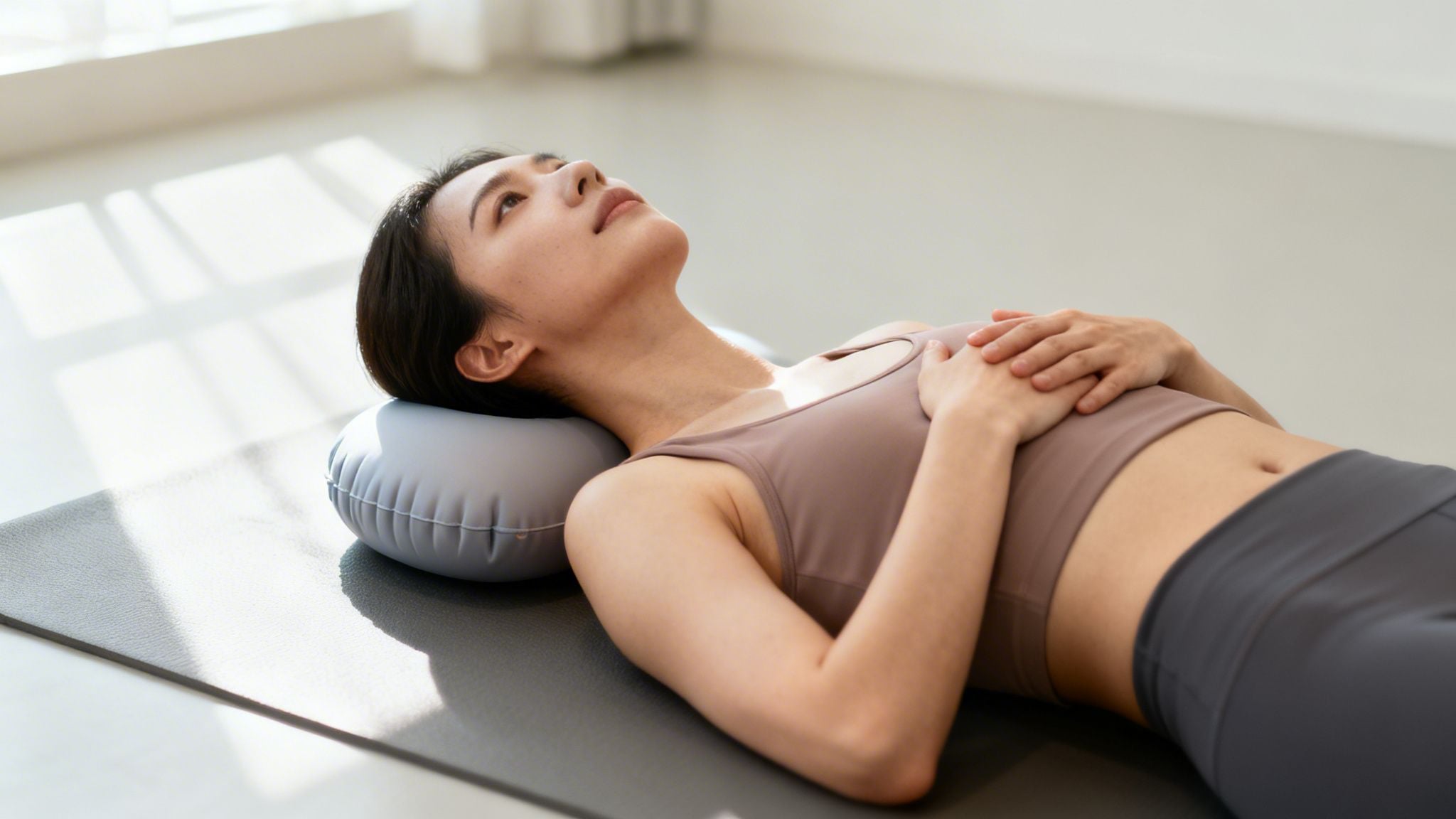
- Starting Position: Lie on your back with your knees bent and feet flat on the floor. Place a small, rolled-up towel under your neck to maintain a neutral spine. Your head and neck should be relaxed.
- The Movement: Keeping your head on the floor or towel, gently nod your chin as if you are saying "yes" in slow motion. Imagine lengthening the back of your neck. You should feel a subtle tightening deep under your chin.
- Hold and Release: Hold this gentle contraction for 5-10 seconds, then slowly relax back to the starting position.
Physical Therapist's Insight: The most common mistake is over-activating the superficial neck muscles (the SCMs). If you see the long muscles on the side of your neck bulge or feel them tense, you are using the wrong muscles. Reduce the effort until the movement is subtle and isolated. A physical therapist at Highbar can use a pressure biofeedback unit to provide real-time guidance and ensure you're performing it correctly.
Start with 10 repetitions, holding each for 10 seconds. Aim to perform this once per day. The key is consistency and proper form, not aggressive effort.
6. Thoracic Spine Mobilization and Extension Exercises
The health of your neck is directly linked to the mobility of your mid-back, or thoracic spine. Thoracic spine mobilization focuses on improving movement in this often-neglected area. When your mid-back becomes stiff from prolonged sitting or poor posture, it forces the smaller, more delicate joints of your neck to overcompensate, leading to strain, pain, and dysfunction. These exercises restore proper movement to the thoracic region, allowing the neck to move naturally without bearing an excessive mechanical load.
Why It Works
The thoracic spine is designed for rotation and extension, movements that support the neck and shoulders. A stiff mid-back disrupts this entire kinetic chain. By performing exercises that target thoracic mobility, you directly offload the cervical spine. This is a crucial concept for long-term relief, especially for office workers whose posture often promotes thoracic stiffness. Restoring mid-back movement is one of the most effective indirect exercises for neck pain relief because it addresses a root cause of the mechanical stress, not just the symptoms.
How to Perform Thoracic Spine Mobilization
Focus on controlled movements that encourage extension and rotation through the mid-back, keeping the low back stable.
- Foam Roller Thoracic Extension: Lie on your back with a foam roller positioned under your shoulder blades, perpendicular to your spine. Support your head with your hands, keeping your core engaged. Gently extend your upper back over the roller, then return to the start. Roll up or down slightly to target different segments.
- Quadruped Thoracic Rotation: Start on your hands and knees. Place one hand behind your head. Rotate your elbow and upper body down toward the supporting wrist, then rotate upward, opening your chest toward the ceiling. Follow your elbow with your eyes.
- Prone "Y-T-I" Raises: Lie face down with your arms extended. First, raise your arms into a "Y" shape with thumbs up. Lower and repeat in a "T" shape (arms straight out to the sides). Finally, repeat in an "I" shape (arms alongside your body). Squeeze your shoulder blades together with each lift.
Physical Therapist's Insight: Think of your thoracic spine as the foundation for your neck. If the foundation is stuck, the structure on top will be unstable. The key is to isolate movement to the mid-back without arching your lower back.
Perform 10-12 repetitions of each exercise. Foam rolling can be done daily, while the active mobility drills are effective when performed 3-4 times per week as part of a comprehensive program for neck pain.
7. Proprioceptive and Postural Re-education Training
Beyond simple stretches and strengthening, Proprioceptive and Postural Re-education Training addresses the brain-neck connection. Proprioception is your body's ability to sense its position, motion, and balance in space. After an injury or with chronic pain, this sense can become distorted, leading to faulty movement patterns and persistent discomfort. This training focuses on rebuilding that awareness to restore neuromuscular control, which is fundamental for stable, confident, and pain-free neck movement. It essentially retrains your brain and muscles to work together correctly, preventing future issues.
Why It Works
When neck pain becomes chronic, the brain can develop "smudged" or inaccurate sensory maps of the neck area. This leads to muscle guarding, inefficient movement, and a cycle of recurring pain. Proprioceptive exercises sharpen this map, improving coordination and reducing the perception of threat associated with neck movements. This approach is especially effective for those with chronic pain, athletes seeking to improve movement efficiency, and individuals recovering from accidents who need to regain confidence in their neck's stability. It’s also a key component in addressing cervicogenic headaches, where poor posture and neck dysfunction are primary triggers.
How to Perform Proprioceptive and Postural Training
This training is less about reps and sets and more about mindful, precise movements. Start with visual feedback and progress to more challenging variations.
- Mirror Feedback for Neutral Spine: Sit or stand in front of a mirror. Find your neutral cervical posture: chin gently tucked (not jammed back), and the back of your head aligned over your shoulders. This is your starting and ending position for all movements.
- Slow, Controlled Head Turns: From your neutral position, slowly turn your head to one side over a count of 3-5 seconds. Pause, then return to neutral just as slowly. The focus is on the smoothness and control of the movement, not the range.
- Eyes-Closed Position Sense: Once you can consistently find your neutral spine with eyes open, try closing your eyes. Move your head away from neutral in a random direction (e.g., up and to the left), then try to return precisely to the starting neutral position. Open your eyes to check your accuracy.
Physical Therapist's Insight: Think "quality over quantity." These are brain exercises more than muscle exercises. The goal is to correct harmful movement habits. Using your hands to gently feel the muscles on the sides of your neck can provide extra sensory feedback to your brain.
Practice these focused exercises for 5-10 minutes daily to build new habits. Integrating postural awareness into your daily life, like correcting your sitting posture at work, reinforces these gains and is a powerful strategy among exercises for neck pain relief. You can learn more about how improving neck function can alleviate tension headaches in our related guide.
8. Resistance Band and Weighted Cervical Exercises
Once you have restored comfortable neck motion, the next step is to build strength and endurance with progressive resistance. Using resistance bands or light weights, these exercises challenge the cervical muscles in a controlled way, improving their ability to stabilize and support your head throughout daily activities. The goal is to progress beyond basic mobility and create a neck that is resilient, less prone to fatigue, and better equipped to handle the demands of work, sports, and life. This approach is fundamental for creating long-term changes and preventing the recurrence of pain.
Why It Works
Neck pain is often linked to muscular weakness or endurance deficits in the deep cervical stabilizers and larger prime movers. Without adequate strength, these muscles fatigue easily, leading to poor posture, strain, and pain. Resistance band and weighted exercises directly target these muscles, building functional strength necessary for sustained neck stability. This form of training is crucial for athletes returning to sport, workers who need to maintain specific postures, and anyone with chronic neck pain looking to maintain their improvements and build a more robust, pain-free neck.
How to Perform Resistance Band and Weighted Cervical Exercises
Start with a light resistance band or a 1-2 pound weight. Focus on slow, controlled movements and perfect form. A door anchor for your band can make these exercises easy to perform at home.
- Banded Cervical Retraction: Anchor a light resistance band at head height in front of you. Loop the band around the back of your head. Gently pull your head backward, creating a double chin and keeping your gaze level. Hold for 2-3 seconds, then slowly release. This strengthens the deep neck flexors.
- Banded Cervical Extension: Face the anchor point and place the band across your forehead. Gently press your head backward into the band, as if nodding "yes" slightly. Hold for 2-3 seconds, then return to the start.
- Banded Lateral Flexion: Stand sideways to the anchor point and place the band over the side of your head. Gently tilt your head away from the anchor point, keeping your shoulder down. Hold for 2-3 seconds before slowly returning. Repeat on the other side.
Physical Therapist's Insight: Form is more important than resistance. Never use momentum or jerk your head. The movement should be small, precise, and completely controlled. If you feel pain or dizziness, stop and consult your physical therapist at Highbar to ensure the exercise is right for you.
Aim for 2-3 sets of 10-12 repetitions for each exercise. Perform these strengthening exercises 2-3 times per week, allowing at least 48 hours of rest between sessions for muscle recovery.
Comparison of 8 Neck Pain Relief Exercises
| Technique | Implementation complexity | Resource requirements | Expected outcomes | Ideal use cases | Key advantages |
|---|---|---|---|---|---|
| Cervical Range of Motion (ROM) Exercises | Very low — simple, controlled movements | None (chair/mirror optional) | Restores mobility, reduces stiffness; minimal strength gain | Acute pain phases, early rehab, office stiffness | Safe, quick, no equipment, repeatable |
| Isometric Neck Strengthening Exercises | Low–moderate — requires proper positioning | Minimal (hand, wall, band) | Improves muscle endurance and stability without joint motion | Acute/chronic stabilization, early strength rebuilding | Safe for many conditions, intensity easily adjusted |
| Scapular Stabilization & Shoulder Integration | Moderate — motor control and coordination training | Minimal–moderate (bands, mirror, possible props) | Restores scapular mechanics, reduces compensatory neck tension | Postural neck pain, desk workers, overhead athletes | Addresses root causes, improves upper-body mechanics |
| Neck Stretching & Flexibility Work | Low — basic static/dynamic stretches | None (optional props or assistance) | Reduces muscle tension, improves flexibility and ROM | Chronic tightness, warm-up/cool-down, daily maintenance | Immediate tension relief, low risk, self-managed |
| Deep Cervical Flexor Strengthening (Craniocervical Flexion) | Moderate–high — precise, subtle technique required | Recommended biofeedback (pressure unit) for accuracy | Improves deep stabilizer function, posture; reduces chronic pain | Chronic neck pain, cervicogenic headaches, postural deficits | Evidence-based, targets foundational stability, long-term benefit |
| Thoracic Spine Mobilization & Extension Exercises | Low–moderate — need to distinguish thoracic vs lumbar motion | Foam roller, mobilization tools optional | Restores thoracic mobility, reduces cervical compensation and pain | Desk workers with kyphosis, athletes with limited shoulder mobility | Addresses mechanical causes, improves posture and breathing |
| Proprioceptive & Postural Re-education Training | Moderate–high — requires patient engagement and feedback | Mirrors, video, tactile cues optional | Improves movement control and neuromuscular awareness; prevents recurrence | Chronic/recurrent pain, athletes, post-accident rehabilitation | Sustainable habit change, improves movement quality |
| Resistance Band & Weighted Cervical Exercises | Moderate — requires progression and strict technique | Bands, light weights, anchors | Builds functional strength, endurance and dynamic stability | Intermediate/advanced rehab, athletes, return-to-work programs | Progressive overload, versatile, portable for home programs |
Your Next Step Towards a Pain-Free Life with Highbar
You now possess a powerful toolkit of evidence-informed exercises for neck pain relief. From foundational range of motion and gentle isometrics to advanced scapular stabilization and deep neck flexor activation, this guide has laid out the building blocks for a stronger, more resilient cervical spine. Mastering these movements is about more than just quieting an ache; it’s about reclaiming control, restoring function, and rebuilding confidence in your body’s ability to move without fear or limitation.
The journey to resolving neck pain is not a one-size-fits-all path. The exercises covered, including thoracic spine mobilization and postural re-education, represent the core principles of effective neck rehabilitation. They work synergistically to address the complex interplay between muscular strength, joint mobility, flexibility, and neuromuscular control. Consistently applying these techniques can fundamentally change how you carry yourself, how your muscles support your head, and how you manage the daily stresses placed upon your neck and shoulders.
Key Takeaways for Lasting Relief
True progress lies in understanding the why behind the what. Remember these critical principles as you integrate these exercises into your routine:
- Consistency Over Intensity: Gentle, consistent practice is far more effective than sporadic, aggressive efforts. Daily mobility and activation work can produce significant long-term benefits for chronic neck pain.
- Listen to Your Body: Pain is a signal, not a challenge to be pushed through. Sharp, radiating, or increasing pain means you should stop the exercise and reassess. A licensed physical therapist can help you modify movements to work within a pain-free range.
- Support the Foundation: Neck pain rarely exists in isolation. Strengthening your scapular stabilizers and mobilizing your thoracic spine creates a stable, supportive base from which your neck can function optimally. Neglecting this foundation is a common reason for recurring symptoms.
- Posture is Dynamic: The goal is not to hold a single "perfect" posture but to build the endurance and awareness to move efficiently and avoid static, stressful positions for prolonged periods. The postural re-education exercises are designed to make good alignment your natural default.
Why Professional Guidance from Highbar Makes the Difference
While this guide offers a solid foundation, a targeted approach guided by an expert is the fastest and safest route to recovery. A physical therapist does more than just hand you a sheet of exercises; they perform a detailed assessment to diagnose the root cause of your pain. Is it a joint mobility issue, a specific muscular weakness, nerve irritation, or a combination of factors? The answer determines your treatment plan.
At Highbar Physical Therapy, our clinicians are dedicated to practicing at the top of their license, which means they are committed to lifelong learning and applying the most current, evidence-based techniques. This commitment, central to our mission as New England's leading teaching practice, ensures you receive exceptional care. We don't just treat symptoms; we empower you with the knowledge to understand your condition and prevent future recurrences, helping you live a fuller, better life.
If your neck pain persists for more than a week, worsens, or is accompanied by red flags like numbness, tingling, weakness in your arms, or severe headaches, it is crucial to seek professional medical evaluation. Don't let uncertainty or persistent pain dictate the terms of your life. Taking that next step is an investment in your well-being, allowing you to return to the activities you love, whether it's playing with your children, succeeding at work, or enjoying your favorite hobby, free from the constraints of pain.
Ready to move beyond generic advice and get a plan built just for you? The expert clinicians at Highbar Physical Therapy are here to provide a definitive diagnosis and personalized treatment plan to help you feel better, move freely, and live fully. Book your in-person or telehealth appointment today to start your journey toward lasting neck pain relief.