As a physical therapist, you know the moment. A patient, sitting across from you with a mix of hope and apprehension, asks the real question: "What does my recovery actually look like?" That question isn't just about a timeline; it's the start of a clinical partnership. How we answer it sets the tone for the entire journey of rehabilitation for the knee.
This is our opportunity to move beyond a simple list of exercises. It’s our chance to step into our role as a confident guide, framing recovery as a structured, hands-on process of getting a patient’s life back.
Redefining The Modern Knee Recovery Plan
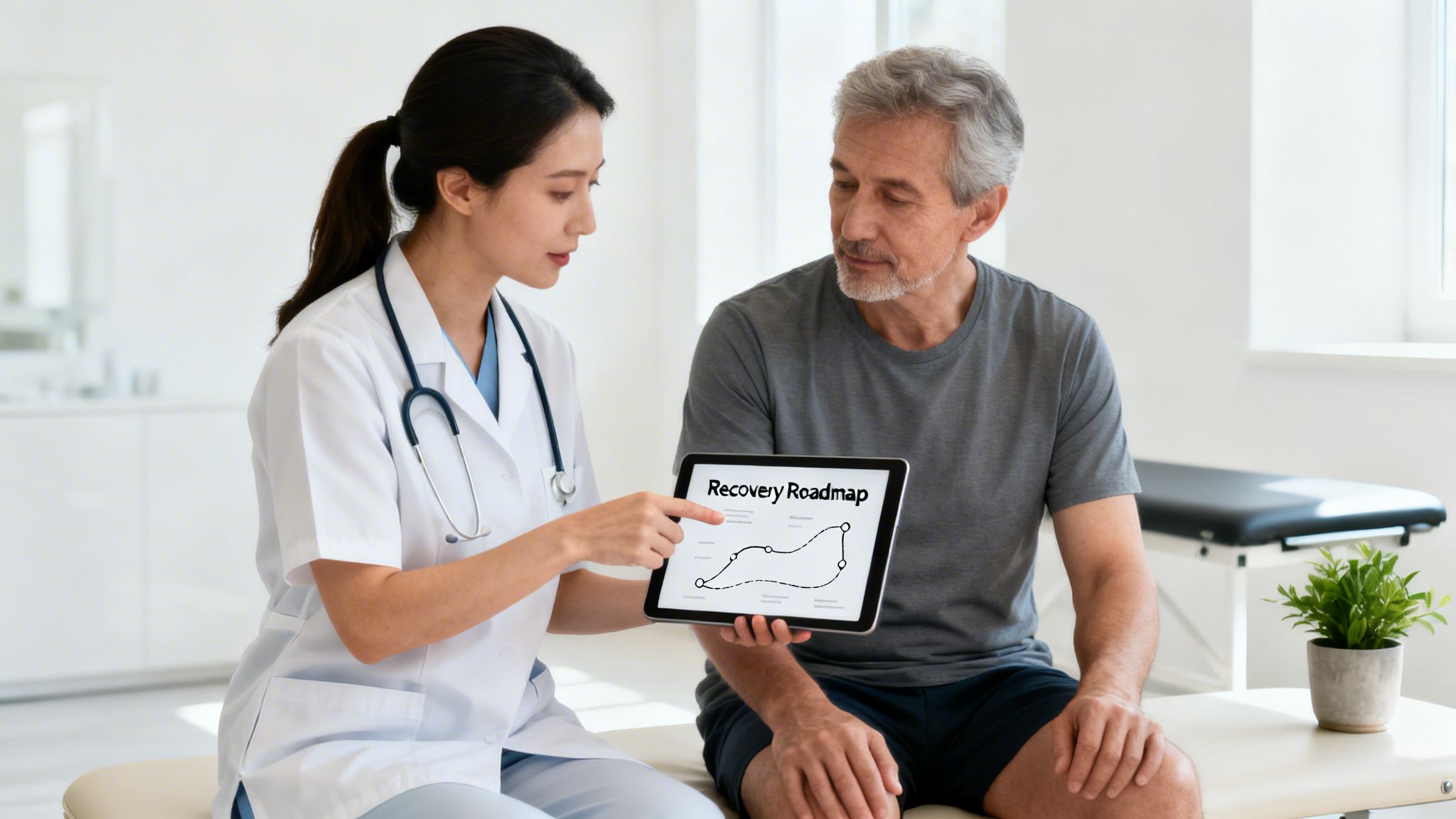
As clinicians, our role is to be the expert guide on that road to recovery. The days of handing out a generic, one-size-fits-all exercise sheet are over. Today, effective rehabilitation for the knee is about co-creating a personalized roadmap that adapts to a patient’s specific injury, body, and goals.
This shift is everything. Whether we're helping a patient manage chronic osteoarthritis, guiding them post-ACL surgery, or helping them avoid an operation altogether, our role is to build a clear, predictable path forward. We move past generic handouts to create a framework that’s structured enough to build on, yet flexible enough to adapt to their progress. This is how we build trust and deliver real, measurable results.
The Clinician as a Navigator
Think of yourself as the creator of a personalized GPS route for your patient's recovery. You know the final destination—returning to life without pain—and you understand the terrain they need to cross to get there. This journey always includes:
- A Clear Starting Point: A thorough evaluation that looks not just at the knee, but at the entire kinetic chain and movement patterns.
- Strategic Waypoints: Phased goals that mark progress, from reducing swelling and restoring motion to building back functional strength.
- Real-Time Adjustments: The ability to pivot the plan based on how the patient is feeling and what you're seeing in the clinic.
This approach transforms a patient from someone just following instructions into an active partner in their own recovery. When they understand why they're doing each exercise, it makes a world of difference in their motivation and ownership of the process.
Our real value comes from blending the science of physical therapy with a patient’s unique story. We create a plan that’s as individual as they are. That’s the art and science of clinical practice in action.
The Growing Need for Expert Guidance
The need for this kind of expert guidance has never been greater. Conditions like osteoarthritis affect millions, and the market for knee replacements alone is projected to hit $22.73 billion by 2034, driven by a massive volume of annual procedures.
Great physical therapy is what turns a successful surgery into a successful life outcome. In fact, studies show that with quality rehab, 80-90% of patients report major pain relief and a return to mobility. You can explore the full market projections on knee replacement trends.
Ultimately, our modern approach is about leading with confidence. By framing rehabilitation for the knee as a collaborative journey with a clear map, we demystify the process for our patients. This is how we build trust, inspire hope, and help them get back to their lives, one step at a time.
The Four Phases Of Effective Knee Rehabilitation
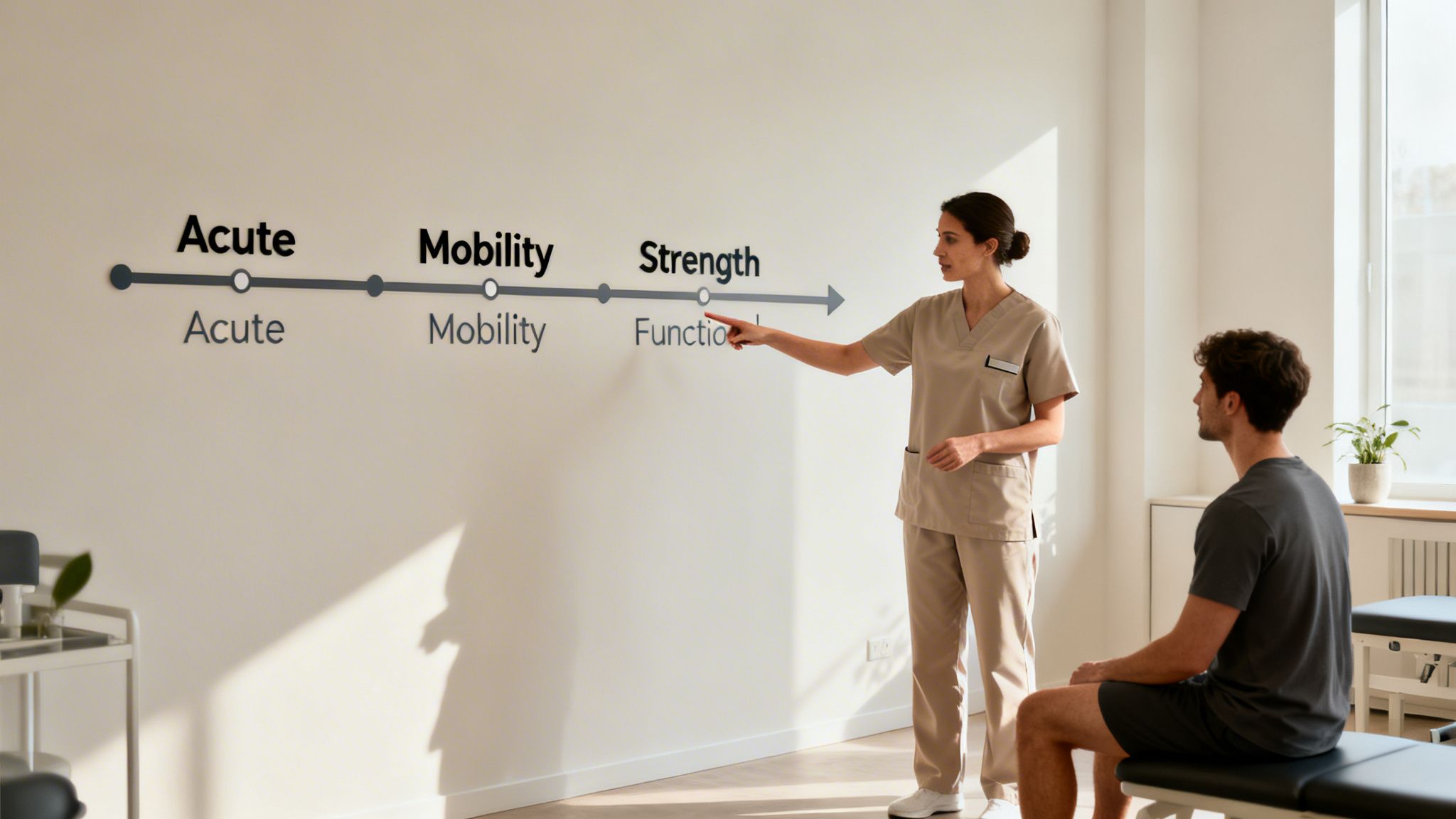
One of the most impactful things we do as physical therapists is map out the recovery journey. When we break down rehabilitation for the knee into clear, manageable phases, it transforms the experience for our patients. A long, uncertain road suddenly becomes a series of achievable milestones.
This framework helps us set realistic expectations, celebrate small victories, and build the clinical trust that’s essential for a successful outcome.
This phased approach isn't just a list of exercises; it's a logical progression where each stage builds on the last. Let's walk through the four core phases that turn the abstract goal of recovery into a concrete, step-by-step plan.
Phase 1: The Acute Phase
The first few days or weeks after an injury or surgery are all about damage control. Think of this as calming the storm. The knee is often swollen, painful, and instinctively guarded, so our first job is to create an environment where healing can begin.
Our focus is on managing pain and inflammation—the body’s natural but sometimes excessive response to trauma. We introduce gentle, controlled movements to prevent stiffness from setting in, but we’re careful not to push too hard and irritate sensitive tissues. It’s a delicate balance.
Primary Goal: Control pain and swelling while protecting the joint to create an optimal environment for healing.
We educate patients on how to use proven strategies like the R.I.C.E. principles (Rest, Ice, Compression, Elevation) and help them learn the difference between a “good” stretch and a harmful strain. This empowers them as active partners in managing their own symptoms from day one.
Phase 2: The Mobility and Activation Phase
Once the initial inflammation settles, our focus shifts. We move from simply protecting the joint to waking it back up and restoring its fundamental ability to move.
After being out of commission, the neuromuscular connection between the brain and knee musculature can get rusty. That’s why we start with exercises like quad sets and heel slides. These aren't about building brute strength yet; they're about re-establishing that crucial mind-muscle connection, ensuring the quadriceps and hamstrings fire on command.
This is also where we tackle any stiffness that’s developed. Using gentle manual therapy and targeted stretches, we work to reclaim every precious degree of extension and flexion.
With over 600,000 knee replacements performed each year in the U.S. alone, structured rehabilitation for the knee is more critical than ever. Consistent post-operative rehab can reduce the risk of complications by up to 30%. You can learn more about the data on postoperative knee recovery trends.
Phase 3: The Strengthening and Stability Phase
With range of motion improving and muscles firing again, it’s time to build. This phase is all about developing the strength and stability the knee needs to handle the demands of everyday life. We begin to systematically add load to make the joint stronger and more resilient.
This is where the principle of progressive overload comes into play. We guide patients from simple exercises like straight leg raises to more functional, weight-bearing movements like mini-squats, lunges, and step-ups, always emphasizing perfect form to protect the joint.
Primary Goal: Systematically build strength in the quadriceps, hamstrings, glutes, and core to provide dynamic stability to the knee joint.
We also integrate balance and proprioception training. By having patients perform exercises on unstable surfaces or practice single-leg stances, we’re retraining the knee’s reflexive ability to stabilize itself. We’re essentially teaching the joint how to react quickly to prevent future injuries.
The 4 Phases of Knee Rehabilitation at a Glance
| Phase | Primary Goal | Common Interventions |
|---|---|---|
| Phase 1: Acute | Reduce pain and swelling; protect the joint. | R.I.C.E., gentle range-of-motion exercises, patient education. |
| Phase 2: Mobility & Activation | Restore full range of motion; reactivate muscles. | Heel slides, quad sets, gentle stretching, manual therapy. |
| Phase 3: Strengthening & Stability | Build strength in supporting muscles. | Squats, lunges, step-ups, single-leg balance exercises. |
| Phase 4: Functional & Return-to-Sport | Prepare for specific real-world activities. | Jumping, cutting, sport-specific drills, agility training. |
Each phase is a stepping stone to the next, guiding patients safely from the initial injury all the way back to their goals.
Phase 4: The Functional and Return-to-Activity Phase
This is the final—and often most rewarding—phase of rehabilitation for the knee. Here, we bridge the gap between the controlled environment of the clinic and the unpredictable demands of a patient's life. The goal is to get them back to their sport, job, or favorite hobby safely and with complete confidence.
The exercises become much more dynamic and specific to their goals. For an athlete, this means we’ll incorporate jumping, cutting, and drills that mimic the movements of their sport. For a grandparent who wants to lift their grandkids, it might mean practicing lifting weighted objects from the floor in a way that simulates that exact motion.
We’ll test the knee under fatigue and challenge it with multi-directional movements to ensure it’s ready for the real world. This is where all the foundational work pays off, allowing us to confidently clear our patients for a full return to the activities they love.
Evidence-Based Exercises That Drive Recovery
As clinicians, we know that the right exercises are the engine of recovery. They’re not just random movements; they are the specific tools we use to turn a treatment plan into tangible progress. Each one has a precise job, carefully chosen to match where a patient is in their healing journey.
This is where the art and science of physical therapy truly converge. We don’t just hand out a sheet of exercises. We build a program that carefully challenges the body, promotes adaptation, and guides a patient safely back to doing what they love. Let’s look at some foundational, evidence-based exercises we use and why they work.
Mobility And Activation Exercises
In the beginning, our goals are simple: get the knee moving again and wake up the muscles that have gone quiet, all without overloading the joint. These exercises are the bedrock of recovery, focused on restoring range of motion and re-establishing that crucial mind-muscle connection.
Quad Sets: This is often one of the first and most important exercises after an injury or surgery. It’s a simple isometric contraction of the quadriceps without moving the knee. It sounds easy, but it’s a powerful way to retrain a muscle that has "shut down" due to pain and swelling. It’s the first defense against atrophy.
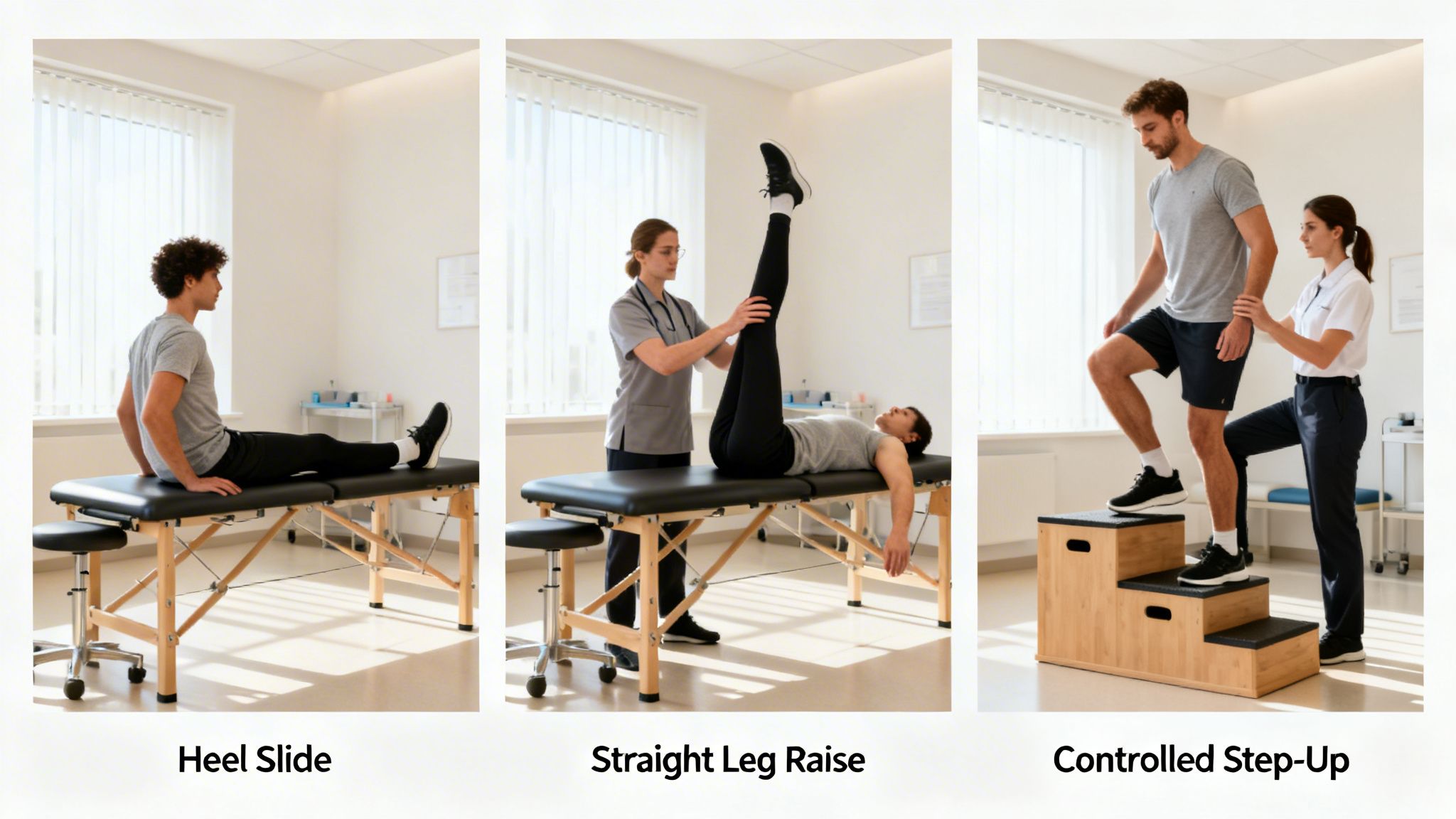
Heel Slides: A classic for restoring knee flexion, the heel slide allows a patient to gently and safely work on bending. Because they control the movement, they can ease into the stretch, making it an incredibly effective way to combat stiffness and improve mobility day by day.
These early movements are precision tools designed to prepare the knee for the harder work ahead. They also help rebuild a patient's confidence in moving their knee, which is a huge psychological win.
Strengthening And Stability Exercises
Once a patient has some basic movement and muscle control back, we shift gears to building strength. This is where we start to carefully load the knee and its supporting musculature in a controlled, step-by-step way. The goal is to build a strong, stable knee that can handle the demands of daily life.
A key principle here is following a well-designed progressive overload training program. This simply means we gradually increase the challenge, moving from non-weight-bearing exercises to full-weight-bearing activities as the knee gets stronger.
Clinical Takeaway: Our job is to find that "sweet spot" of loading—just enough to trigger adaptation and strength gains, but not so much that it causes a flare-up. This is where a therapist's expert eye and hands-on guidance are absolutely essential.
Here’s how we methodically build that strength back:
Straight Leg Raises (SLRs): This is a perfect example of a non-weight-bearing strengthening exercise. It targets the quadriceps without putting direct compressive stress on the knee joint itself. By isolating the quad and hip flexors, we build foundational strength needed before safely progressing to standing exercises.
Mini-Squats: This is often a patient's first introduction to loading the healing leg in a functional pattern. The mini-squat lets us load the knee in a controlled way. We obsess over perfect form here—ensuring the knee stays aligned over the foot and the glutes are firing—to retrain proper movement patterns from the start.
Step-Ups: This is a fantastic functional exercise that mimics climbing stairs and builds single-leg strength and control. By controlling the movement both concentrically and eccentrically (up and down), patients improve not only strength but also the ability to absorb shock, which is vital for knee stability during walking or running.
Functional And Return To Activity Drills
In the final phase, our job is to close the gap between the clinic and real life. The exercises become more dynamic, preparing the knee to handle the quick, unpredictable movements of the real world. We’re building confidence and ensuring the knee is truly ready for sports, work, or whatever high-level activity a patient is aiming for.
Key exercises in this stage often include:
Single-Leg Balance: Simply standing on one leg, especially on a slightly compliant surface, is a powerful way to retrain proprioception—the knee’s sense of its position in space. This fine-tunes reflexive stability, helping the knee protect itself automatically during quick movements.
Agility Drills: Here, we start adding multi-directional movements like side shuffles, carioca, and gentle box jumps. These drills teach the knee how to stay stable while moving in different directions, preparing it for the cutting and pivoting required in sports and many daily activities.
Sport-Specific Movements: This is where we get personal. For an athlete, it might be practicing proper landing mechanics. For a gardener, it could be practicing how to lunge and get up from the ground safely. We customize these drills to mimic the exact demands of a patient's goals, ensuring their rehabilitation for the knee directly translates back to their life.
By guiding patients through these phases, we build a clear, logical, and effective path to recovery. We're not just strengthening a knee; we're rebuilding their ability to move freely and live fully.
Beyond Exercises With Modalities And Manual Therapy
A smart, progressive exercise plan is the engine of any successful knee rehab. But it’s not the whole story. As experienced clinicians, we know that getting the best results often means going beyond the exercises.
This is where skilled, hands-on techniques and specific technologies come into play. They’re the tools we use to solve problems that exercise alone can’t fix, helping us break through plateaus, manage pain, and accelerate a patient's return to life.
The Power Of Manual Therapy
Manual therapy is where our craft truly shines. It’s the use of our hands to directly assess and treat stiff joints, tight muscles, and restricted soft tissues. For a patient struggling with a stiff knee after surgery or from chronic arthritis, our hands-on work can be the key that unlocks their progress.
Joint Mobilizations: These are gentle, skilled, passive movements we apply to the knee and surrounding joints. They help reduce stiffness, improve range of motion, and can even modulate pain. A few minutes of skilled mobilization can make the stretches and strengthening exercises that follow feel dramatically easier and more effective.
Soft Tissue Work: This involves specific techniques aimed at a patient's muscles, fascia, and tendons. By addressing adhesions and trigger points, we can reduce pain, improve flexibility, and ensure the muscles supporting the knee are functioning optimally.
We don't see manual therapy as a separate treatment. It's an integrated part of a session that prepares the body for movement, making active participation more comfortable and productive.
Strategic Use Of Modalities
Modalities are the technological tools in our toolkit. When used for the right reason, at the right time, they can give recovery a serious boost. Think of them not as a passive fix, but as a way to target specific physiological problems.
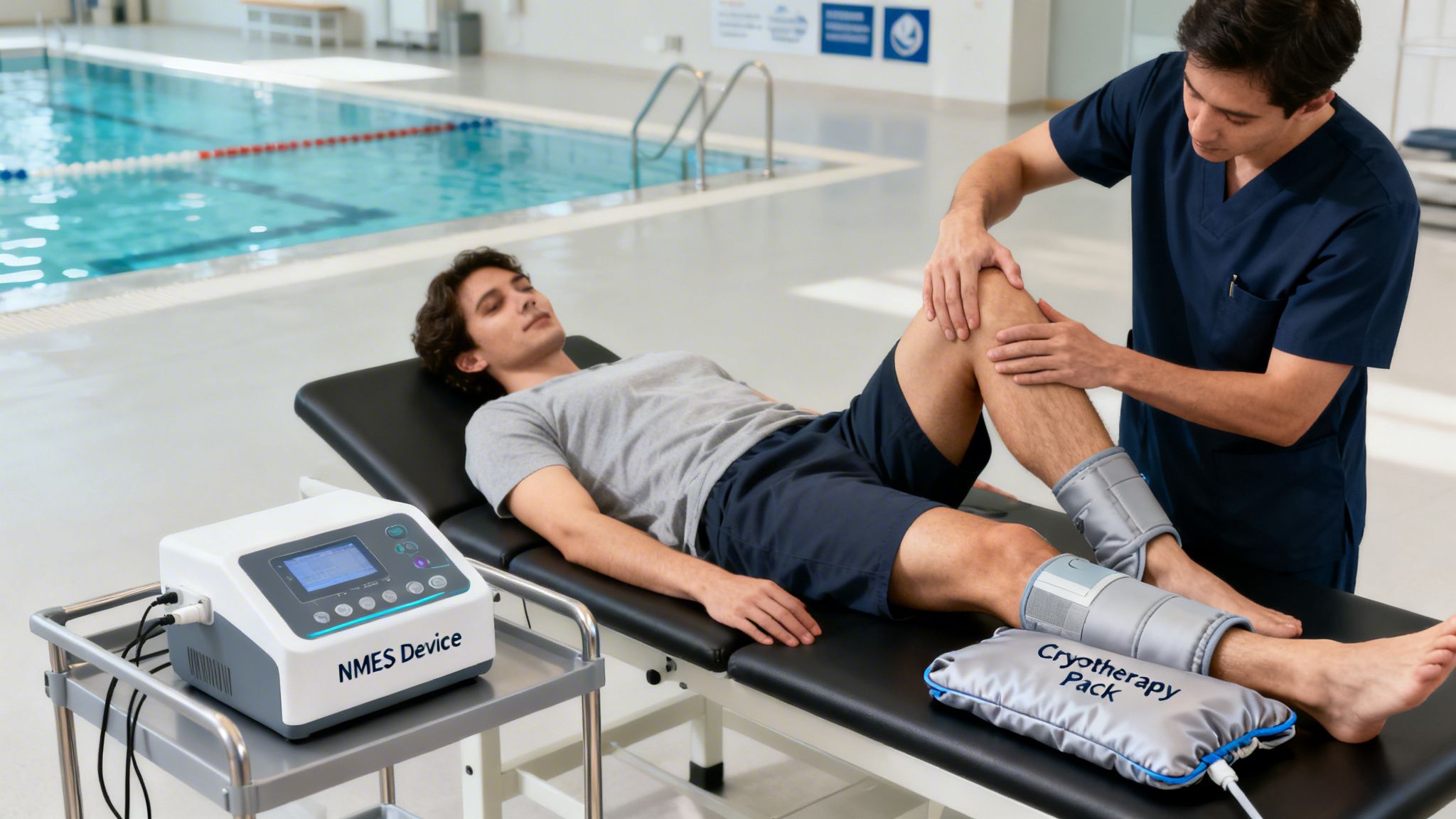
Neuromuscular Electrical Stimulation (NMES): After an injury or surgery, it’s incredibly common for the quad muscles to "forget" how to fire properly due to arthrogenic muscle inhibition. NMES uses a gentle electrical current to contract the muscle, helping re-establish that brain-muscle connection and jump-start the strengthening process.
Cryotherapy and Thermotherapy: The simple, strategic use of cold (cryotherapy) or heat (thermotherapy) is fundamental. Cold is fantastic for calming acute inflammation and reducing pain after a tough session. Heat, on the other hand, is great for increasing blood flow and loosening up tight muscles before stretching.
This integrated approach is more important than ever. With these industry growth trends showing a growing demand for knee procedures, the need for high-quality rehab is undeniable. Effective rehabilitation for the knee, including these methods, has been shown to reduce reoperation risks significantly.
Other tools, like aquatic therapy to unload the joint or Blood Flow Restriction training, can further accelerate results. By combining targeted exercise with skilled manual therapy and smart modalities, we create a complete, patient-centered approach that sets our patients up for lasting success.
Navigating Recovery Timelines And Red Flags
"How long will this take?" It's the first question on nearly every patient's mind, and for good reason. As clinicians, how we answer that question sets the tone for the entire recovery journey. Our job isn't just to treat the knee—it's to manage expectations, build trust, and provide a clear roadmap of what lies ahead.
When we can explain the process and teach patients what to look out for, we empower them to become confident drivers of their own recovery. They'll understand what their body is telling them and feel more secure every step of the way.
Setting Realistic Timelines
Every recovery is unique. A 65-year-old healing from a total knee replacement follows a different path than a 22-year-old athlete coming back from an ACL tear. That’s why we talk about timelines in terms of ranges and phases, not rigid deadlines. This approach gives patients a clear picture while respecting their body’s individual healing process.
- Total Knee Replacement (TKR): Most people return to basic daily activities within 6-12 weeks. However, returning to 100% strength and higher-impact activities often takes 6 months to a year.
- ACL Reconstruction: The path back to the field is a marathon, not a sprint. While a patient will be walking and strengthening in the first 3 months, a safe return to sport typically falls in the 9-12 month range. Rushing it is a major risk factor for re-injury. You can learn more in our guide on the road to recovery from ACL tears.
Setting these expectations from day one helps prevent frustration and keeps patients focused on their own steady, forward progress. And for those early stages when they can’t put weight on their leg, knowing how to use a knee walker for safe recovery can be a game-changer for maintaining mobility.
Empowering Patients With Red And Green Flags
Beyond timelines, one of the most powerful things we can do is teach patients how to listen to their own body. We break it down into a simple framework of "red flags" (signs to call us) and "green flags" (signs they're on the right path). This gives them a sense of control and confidence in their day-to-day recovery.
Our role as clinicians is to be the expert guide, but the patient is the one living in their body 24/7. Empowering them with this knowledge is one of the most impactful things we can do.
Red Flags: When to Call for Help
These are non-negotiable signs that need immediate attention. We ensure every patient knows to watch for:
- Signs of Infection: Increasing redness, warmth, or swelling around an incision. A fever or any purulent drainage are also major red flags.
- Signs of a Blood Clot (DVT): This often presents as sudden, unexplained calf pain, swelling, or tenderness. The area might also feel warm and look red.
- Sudden, Sharp Pain: This is pain that feels completely different from normal post-activity soreness. If it's sharp, intense, and makes it hard to bear weight, they need to call.
Green Flags: Signs of Progress
It's just as important to celebrate the wins! These green flags are proof that a patient's hard work is paying off:
- Decreased swelling and pain after performing their home exercise program.
- Hitting a new range of motion milestone, like finally achieving full knee extension.
- Feeling stronger and more stable during an exercise that felt impossible a week ago.
- Walking with a more natural gait and less of a limp.
Your Partnership In Lasting Knee Health
When we talk about rehabilitation for the knee, it’s easy to think of it as just fixing a joint. But that’s never been our real goal. As clinicians, our true job is to be a partner, guiding patients toward a lifetime of confident, joyful movement—long after their scheduled sessions are over.
This is the heart of modern physical therapy. It’s not about just getting patients through a series of exercises. It’s about building a relationship where we serve as both expert clinicians and trusted guides. We listen, we educate, and we adapt, making sure the path to recovery is always clear, safe, and focused on what matters most to them.
Taking the Lead in Your Recovery
Every patient interaction is a chance to lead. It’s an opportunity to replace uncertainty with confidence, fear of re-injury with understanding, and limitations with proactive strategies for long-term health. This is where our work creates its most meaningful impact.
By guiding patients proactively, we do more than just help them feel better in the short term. We teach them how to trust their body again and give them the tools to move freely and live more fully. This shared mission—to restore function and empower lifelong health—is the standard we hold ourselves to every single day at Highbar.
Our greatest achievement is seeing our patients thrive on their own, armed with the knowledge and confidence we helped them build. This is what true clinical success looks like.
A Shared Commitment to Patient Goals
This partnership model is a win-win. Patients achieve better, more lasting results, and we find a deeper purpose in our work. We get to see firsthand how our expertise helps someone get back to hiking, playing with their grandchildren, or just walking through the grocery store without pain. You can learn more about finding the right clinical partner by reading our guide on how to choose a physical therapist.
This is the approach we champion. By embracing our role as leaders and partners, we not only elevate our profession but, more importantly, give our patients the tools they need not just to recover, but to stay healthy for life.
Common Questions About Knee Rehab
When a patient's knee is in pain, they have questions. We get it. As physical therapists, we spend a lot of our day talking through these common concerns, and getting clear answers is the first step toward taking control of recovery. Here are a few of the questions we hear most often about rehabilitation for the knee.
How Long Will My Physical Therapy Sessions Be?
The first visit is always the most in-depth. Plan on about 60 minutes for the initial evaluation. This gives us the time we need to listen, perform a thorough movement assessment, and collaboratively map out a clear plan.
After that, follow-up appointments typically run between 45 to 60 minutes. These sessions are all about action—progressing exercises, using hands-on techniques to improve mobility, and ensuring patients are hitting their targets.
Do I Need a Doctor's Referral to Start?
This is a question we love answering. In many states, direct access laws mean patients can see a physical therapist without needing a referral from a physician first.
This is a huge advantage. It allows patients to book an appointment directly and start addressing the problem right away, often saving time, money, and unnecessary pain. They get to be in the driver's seat of their recovery from day one.
Is Knee Rehab Going to Be Painful?
It’s the number one fear we hear, and it’s a valid one. Let’s be clear: our goal is never to cause sharp, unbearable pain. We’re experts at finding the line between challenging the body to heal and pushing it too far.
We often talk about “good pain” versus “bad pain.” Good pain might feel like muscle soreness or a productive stretch—a sign that the knee is adapting and getting stronger. Bad pain is sharp, stabbing, or increases swelling. Our job is to guide patients into that productive zone while ensuring they always feel safe and in control.
What if I Can't Make It to the Clinic?
Life happens. Whether it’s a work trip, childcare issues, or just a day when getting out of the house feels impossible, we have a solution. Telehealth physical therapy has become an incredibly effective way to keep recovery on track.
Through a secure video call, we can guide patients through their exercises, observe their form, update their program, and answer any questions they have. It’s a fantastic tool for ensuring that nothing stalls progress, no matter where they are.
At Highbar Health, we believe that an informed and empowered patient gets the best results. If you’re ready to move past knee pain and get back to living your life fully, we're here to build that plan with you. Find a location near you and book an appointment instantly.