You’ve been cruising along, feeling great, and then it happens—a sharp, vise-like pain seizes your calf or hamstring. A sudden cramp can derail a perfect run, but it’s more than just bad luck; it’s a signal that your body needs attention. While many runners blame dehydration, modern research points to a different primary cause: neuromuscular fatigue. Understanding this helps you move beyond temporary fixes and toward a plan that lets you enjoy running and live a fuller life.
Why You Really Get Cramps When You Run
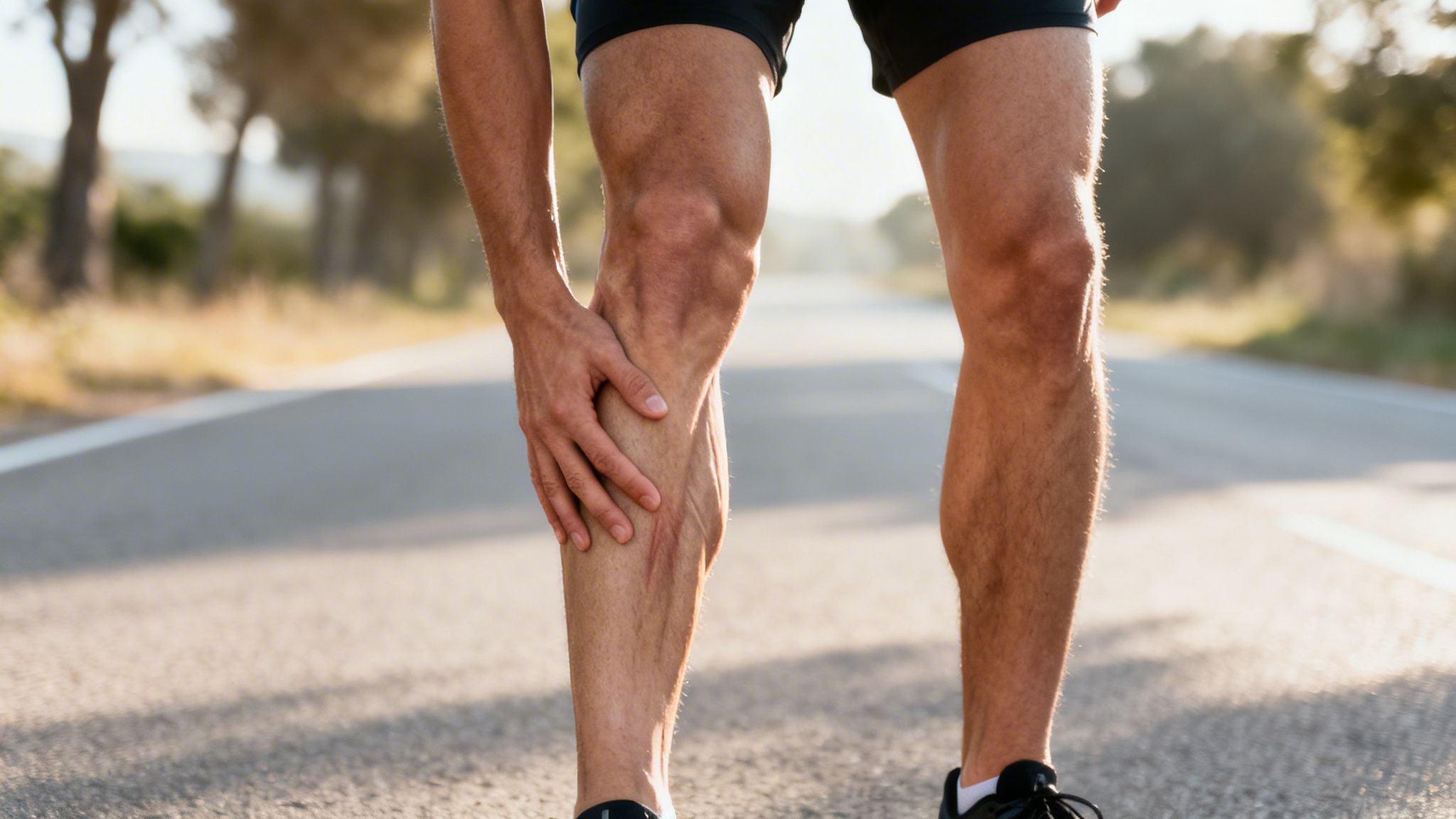
That sudden, painful muscle lock-up is a sign that your nervous system is overloaded. The leading scientific theory is that as you run longer or harder than your muscles are conditioned for, the electrical signals between your nerves and muscles get scrambled.
Think of it like a faulty light switch. The nerve signal telling the muscle to contract (the "on" switch) becomes overexcited, while the signal telling it to relax (the "off" switch) gets suppressed. The result is that powerful, involuntary contraction you feel as a cramp.
The core issue isn't just a lack of fluid, but a breakdown in communication between your brain and your muscles due to fatigue. Addressing that fatigue is key to getting you back to running consistently and comfortably.
Key Factors That Contribute to Running Cramps
While neuromuscular fatigue is the root cause, several factors can push your muscles past their breaking point. Identifying your personal triggers is crucial for building a prevention strategy that lets you get back to living a full and active life.
The table below summarizes the primary factors that increase your risk of cramping. Understanding how they connect to muscle overload will empower you to adjust your training and finally get ahead of the pain.
| Factor | How It Contributes to Cramps | Quick Tip |
|---|---|---|
| Training Load | Pushing your pace or mileage too quickly without giving your body time to adapt. | Increase your weekly running distance by no more than 10%. |
| Muscle Conditioning | Lacking the strength and endurance needed to handle the demands of a particular run. | Incorporate strength training two times per week, focusing on calves, quads, and hamstrings. |
| Running History | Runners with a personal or family history of cramping are often more susceptible. | Be extra vigilant with a proper warm-up and a gradual increase in intensity. |
| Running Terrain | Hilly or uneven surfaces place new and greater stress on specific muscle groups. | If you're new to hills, start with shorter hill repeat sessions to build specific strength. |
Ultimately, these factors all feed into the same problem: asking your muscles to do more work than they are prepared to handle. By managing your training load and improving your muscle conditioning, you give your neuromuscular system the capacity it needs to perform without misfiring, helping you feel better and get back to the activities you love.
The Science Behind a Running Muscle Cramp
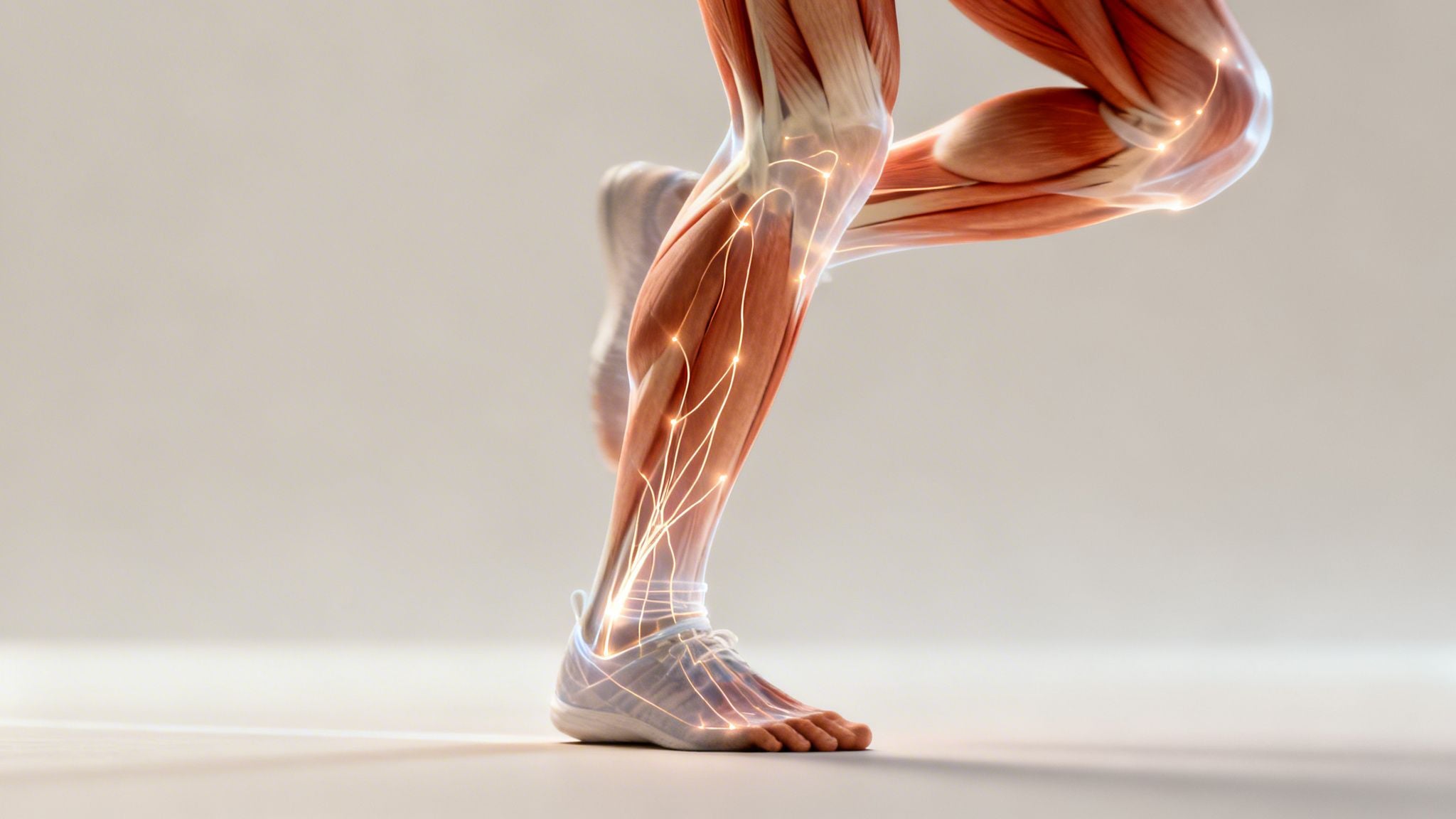
For decades, runners have been told that cramps are all about dehydration and low salt. While those things certainly don't help, modern science points to a much more direct cause: muscle fatigue.
The leading theory is something called altered neuromuscular control. It sounds complicated, but the concept is pretty straightforward. Once you grasp it, you'll see why preventing cramps is less about what you drink and more about how you train for a more resilient body.
Think of your nervous system as the electrical wiring connecting your brain to your muscles. On a good run, this system sends perfectly timed signals back and forth, telling your muscles precisely when to fire and when to ease off. But as you start pushing your body longer or harder than it's used to, fatigue starts to build.
This isn't just about your legs feeling heavy. That fatigue is actively messing with the delicate balance of your body's wiring.
The Neuromuscular Short-Circuit
A muscle cramp is basically a biological short-circuit. It’s a sudden, uncontrolled surge of power where you don’t want it.
Here’s what’s happening. As a specific muscle gets overworked and exhausted, the nerve signals telling it to contract become over-excited and start firing way too fast. At the exact same time, the signals from your spinal cord that are supposed to tell the muscle to relax get quieter and become overwhelmed.
In essence, your muscle gets stuck in the "on" position. The "go" signal is screaming, while the "stop" signal is barely a whisper, resulting in that sudden, powerful, and involuntary contraction we know as a cramp.
This perfectly explains why cramps almost always hit near the end of a long race or during a tough speed workout. It's not a random event. It's a direct consequence of a muscle group hitting its absolute fatigue limit.
Duration and Intensity: The Critical Factors
The longer and harder you run, the more demand you place on your neuromuscular system—and the higher the risk of that system breaking down.
This link between exercise intensity and cramping is well-documented. For example, a massive study looking at over 71,000 marathon runners found a direct connection between race distance and cramping. Ultramarathon runners reported a lifetime cramping prevalence of 20.0%, which is more than double the 8.5% seen in half-marathoners.
The data also showed that cramps love to show up late. A staggering 46.4% of all cramp incidents happened during the final quarter of the race, highlighting the undeniable role of accumulated fatigue. You can dig into the full findings from this marathon cramping research to see the data for yourself.
Understanding this science is empowering. It shifts the focus away from scrambling for a salt tablet mid-race and toward a much more effective, long-term solution: building a body that is more resistant to fatigue. By improving your conditioning, you give your neuromuscular system the capacity it needs to handle the stress of running without short-circuiting.
While we know neuromuscular fatigue is the root cause of a running cramp, a few common triggers are notorious for pushing your muscles over the edge. Think of it this way: fatigue loads the gun, but these triggers are what pull it.
Figuring out which ones apply to you is the first real step toward getting back to running without that constant fear of seizing up.
The single biggest offender is a simple case of "too much, too soon." When you jump from 10 miles a week to 25, or suddenly throw in a bunch of high-intensity speedwork without building up to it, you’re essentially ambushing your own body. Your muscles and nervous system just don't have time to adapt, making overload and cramping almost inevitable.
Challenging Running Conditions
The ground beneath your feet and the incline of your route play a huge role. Your muscles might feel great on a flat, predictable path, but new environmental challenges can overwhelm them in a hurry.
- Hilly Terrain: Running uphill and downhill puts a much greater, more specific load on certain muscles—especially your calves (triceps surae) and quads. This focused demand accelerates fatigue like nothing else.
- Uneven Surfaces: Trail running is a perfect example. All those roots, rocks, and changing cambers force your muscles to make countless tiny adjustments to keep you stable. That extra stabilization work is exhausting.
In fact, trail runners are at a particularly high risk. One study looking at recreational trail runners found that 20% had experienced cramps in the last month alone. That number shot up to 36% when looking at the last 12 months, with calf muscles being the most common culprits. If you want to dive deeper into the data, you can review the cramping prevalence study on trail runners.
Your Personal Risk Profile
Beyond your training plan and terrain, some personal factors can make you more prone to cramping. A history of cramping is one of the biggest predictors—if you’ve cramped before, you’re far more likely to do it again unless you address what’s causing it.
Think of these triggers as warning lights on your car's dashboard. They aren’t the engine failure itself, but they’re blinking to tell you the whole system is under stress and getting dangerously close to its limit.
Other key factors include skipping a proper warm-up, which robs your muscles of the chance to prepare for the work ahead, and any underlying muscle imbalances or weaknesses you might have.
And while diet isn’t the primary cause, if you suspect certain eating or hydration habits are making things worse, try keeping a daily food journal. It can be a surprisingly effective way to spot patterns. By looking at these triggers honestly, you can start building a real plan to make your body more resilient.
What to Do the Moment a Running Cramp Strikes

There's nothing like a sudden, seizing cramp to bring a great run to a painful halt. But knowing exactly how to respond in that moment gives you control and helps you recover much faster. The most effective thing you can do is stop running immediately and gently stretch the seized muscle.
This isn’t just about yanking on a tight muscle. You’re actually sending a powerful message to the overactive nerve that’s causing the problem. A slow, steady stretch stimulates sensory receptors in the muscle, telling that hyper-excited nerve to back off. This allows the muscle fibers to finally relax and the cramp to release its grip.
Think of it like a manual reset. The muscle’s electrical signal is stuck in the "on" position, and a gentle stretch is your way of overriding the system and convincing it to turn off.
Once that initial, intense pain starts to fade, a few other simple actions can help you manage the after-effects and decide if you're ready to start moving again.
Immediate Actions for Cramp Relief
The second you feel a cramp coming on, slow to a complete stop and work through these steps.
Gently Stretch: This is your best first response. Ease into a slow, static stretch and hold it for 15-30 seconds. For a calf cramp, a classic runner's stretch against a wall works perfectly. If it's a hamstring cramp, sit down and gently reach for your toes. The key is to soothe the muscle, not fight it, so don't force the stretch.
Lightly Massage: After the first stretch, use your hand to gently knead the area. This helps boost blood flow and encourages the muscle to relax even further. Applying broad, steady pressure with your palm is often enough to do the trick.
Walk It Out: Once the worst of the pain has passed, try walking slowly for a minute or two. This can help restore normal circulation and muscle function before you even think about picking up the pace again.
Apply Gentle Heat: If you're close to home, applying a warm compress can also provide relief by relaxing the muscle. For more detailed advice, our article on when to use ice versus heat can help you figure out the best approach for different kinds of muscle pain.
By using these simple techniques, you can confidently take control when a cramp strikes, lessen its severity, and get back to moving comfortably—all essential for living a full and active life.
Your Proactive Plan to Prevent Running Cramps
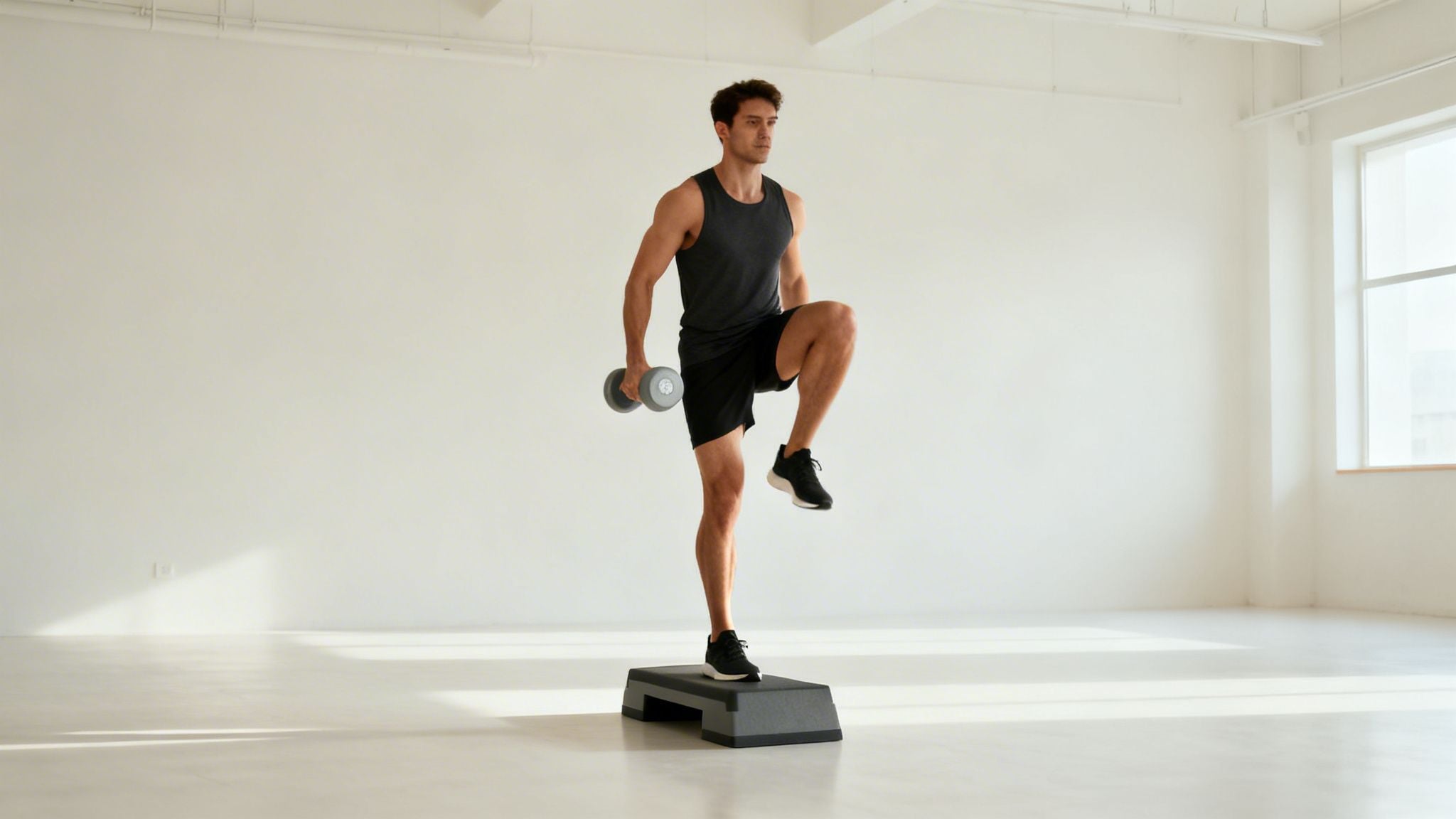
Knowing what to do when a cramp hits is one thing, but the real goal is to keep them from happening in the first place. A proactive plan shifts the focus away from just managing the pain and toward building a more resilient body so you can live the life you want.
This strategy gets to the root of the issue: preventing the neuromuscular fatigue that we now know is the primary culprit behind most running cramps. It’s all about smart training.
The foundation of any solid cramp-prevention strategy is progressive training. This simply means you should gradually increase your running distance and intensity. A sudden jump in mileage or a new focus on speed work is a classic recipe for overloading your system and triggering cramps.
Your body is incredibly adaptable, but it demands time. Smart, gradual progression is how you teach your neuromuscular system to handle more stress, which effectively raises its cramp threshold.
Build a Stronger, More Resilient Body
For runners looking to stop cramps for good, strength training is an absolute game-changer. Why? Because stronger muscles are more fatigue-resistant muscles. By making key running muscles more robust, you improve their ability to handle the demands of your runs, pushing back the point of exhaustion where cramps love to strike.
- Target Key Muscles: Your calves, hamstrings, quads, and glutes do most of the work when you run, so they’re often the first to cramp. Focus your exercises here.
- Incorporate Plyometrics: Drills like box jumps and skipping train your nerves and muscles to communicate more efficiently. Think of it as upgrading your body's internal wiring for faster, more coordinated firing, which reduces those misfires that cause cramps.
- Don't Forget Your Core: A strong core acts as your stabilizing platform. It reduces wasted energy and takes excess strain off your legs, making you a more efficient—and less cramp-prone—runner.
Prepare Your Body for Every Run
How you start your run can make all the difference. A proper warm-up isn’t just about getting your blood flowing; it's about priming your entire neuromuscular system for the work ahead. It's a non-negotiable step for warding off cramps.
For a great routine to get you started, check out our guide on dynamic stretching.
While the science has shifted away from electrolytes being the main cause, some runners find that topical solutions can help soothe tired muscles after a run. Exploring the benefits of magnesium oil for muscle comfort can be a useful part of your post-run recovery kit.
The sheer prevalence of exercise-related cramps shows just how important a good prevention plan is. Cramps affect up to 67% of triathletes and anywhere from 18-70% of marathon runners. Even environmental factors play a huge role; one study found 37% of football players experienced heat cramps in the first week of a hot-weather camp. These numbers highlight that a personalized prevention plan is crucial for staying active and cramp-free.
How a Physical Therapist Can End Cramps for Good
If stubborn cramps are derailing your runs and holding you back from the life you want, it's time for some expert guidance. While all those prevention tips are great, they work best when you know exactly what problem you're trying to solve.
A physical therapist is your best ally here. Think of us as movement detectives, trained to uncover the real source of your pain.
At Highbar, our clinicians look past the generic advice. We know that what causes cramps when running is almost always a complex mix of factors unique to your body. We perform a thorough assessment, analyzing your movement patterns, individual muscle strength, and training history to find the specific root cause.
This isn't a one-size-fits-all approach; it's a personalized investigation into your body's mechanics. Our goal is to understand why your neuromuscular system is becoming overloaded and create a plan that empowers you to live a better, fuller life.
Crafting Your Personalized Treatment Plan
Once we pinpoint the underlying issues—whether it’s a hidden muscle imbalance, subtle flaw in your running form, or a weak core that’s forcing your legs to overwork—we build your treatment plan. This is where you see the real power of physical therapy in helping you get better, so you can live a fuller, more active life.
Your plan will likely combine a few different strategies, all designed to build true resilience against cramping:
- Hands-On Manual Therapy: We use techniques like soft tissue mobilization to release stubborn muscle tightness and improve your mobility. This directly addresses the areas that are prone to cramping. For those really deep, knotted-up muscles, we might also discuss the benefits of Trigger Point Dry Needling to release trigger points that are fueling the dysfunction.
- Targeted Strengthening Exercises: You'll get specific exercises to fortify the exact muscles that are fatiguing too quickly on your runs. This isn’t about just getting stronger in general; it’s about building endurance precisely where you need it most.
- Neuromuscular Re-education: This sounds complicated, but it's really about improving the conversation between your brain and your muscles. We use specific drills and exercises to retrain these pathways, helping your body move more efficiently and reducing the strain that leads to overload and cramping.
When you partner with a Highbar physical therapist, you’re not just chasing the symptom. You are actively correcting the biomechanical and conditioning problems that cause cramps in the first place. It’s about empowering you to run pain-free and get back to the activities you truly love.
Your Top Questions About Running Cramps, Answered
Even with the best prevention plan, cramps can still be confusing. Let's clear up some of the most common questions we hear from runners so you can get back on the road with confidence, feeling better and living fully.
Does Drinking Pickle Juice Actually Stop a Cramp?
It’s a trick plenty of runners swear by, and it can work—but probably not for the reasons you think. The magic isn’t in the salt or electrolytes.
The leading theory is that the intensely sour taste of pickle juice triggers a powerful nerve reflex in the back of your throat. This signal is so strong it can override and interrupt the faulty nerve signals causing your muscle to cramp up, acting like a quick "reboot" for the system.
Think of it as a helpful trick to stop a cramp in its tracks. It provides immediate relief, but it doesn't fix the underlying muscle fatigue that caused the cramp in the first place.
Pickle juice can be a helpful tool for immediate relief, but it’s not a substitute for proper training and conditioning. Addressing the root cause is the only real long-term solution.
Are Side Stitches and Muscle Cramps the Same Thing?
No, they’re completely different problems. A side stitch is that sharp, stabbing pain you feel right under your rib cage, usually on your right side. While its exact cause is still debated, most experts believe it’s related to irritation of the parietal peritoneum—the membrane that lines your abdominal cavity.
A muscle cramp, on the other hand, is a sudden, powerful, and involuntary contraction of a muscle itself, like in your calf, hamstring, or quad. They might both stop you mid-run, but their origins and how you manage them are totally different.
When Should I See a Professional for Cramps?
It’s time to see a professional when cramps become a regular feature of your runs. If they’re severe, happen frequently despite your best efforts, or are consistently holding you back from enjoying running, it's a clear signal you need an expert opinion.
A physical therapist at Highbar will run a detailed evaluation to uncover hidden factors that other approaches might miss, like subtle muscle imbalances, running form flaws, or strength deficits. From there, we build a personalized plan to fix those root causes, helping you not only get better but stay better.
Can My Running Shoes Cause Cramps?
Indirectly, yes. The shoe itself isn't going to make your muscle seize up, but the wrong footwear can absolutely set the stage for it. Worn-out or poorly fitting shoes can throw your running mechanics out of whack, forcing certain muscles to work much harder than they should.
This extra work leads to quicker fatigue in those specific muscle groups—a primary trigger for the neuromuscular overload that leads to cramping. A gait analysis with a physical therapist is one of the best ways to see if your footwear is playing a role in your cramping issues.
If recurring cramps are keeping you from the activities you love, don't just put up with the pain. The expert physical therapists at Highbar Physical Therapy can create a personalized plan to find the root cause, build your body’s resilience, and help you run pain-free. Book an appointment today and take the first step toward living a fuller, better life. Learn more and schedule your visit at https://highbarhealth.com.