A dynamic stretching routine is all about active, controlled movements that take your body through a full range of motion. Unlike holding a stretch, this approach actively readies your muscles, joints, and nervous system for what's next, making it the perfect warm-up to boost performance, reduce injury risk, and help you live a fuller, more active life.
Why Your Warm-Up Needs a Dynamic Stretching Routine
If your pre-workout ritual still involves grabbing an ankle and counting to 30, it’s time for an update. For years, static stretching—holding a stretch in a fixed position—was the default. But our understanding of how to properly prepare the body for movement has come a long way.
Here at Highbar Physical Therapy, our entire mission is to get people better so they can live fuller, better lives. That process starts with smarter, evidence-based preparation before you even begin your workout.
An effective warm-up isn't about passively yanking on cold muscles. It’s about actively preparing your body for the demands of your specific activity. This is precisely where a dynamic stretching routine comes in. Think of it as a dress rehearsal for your muscles, joints, and nervous system, helping you move with more confidence and less pain.
From Static Holds to Active Movement
The big shift away from pre-workout static stretching isn't just a trend; it's rooted in solid science. Research that started gaining traction in the 1980s and 1990s began showing that holding stretches before activity could actually dull muscle responsiveness and reduce power.
In fact, one landmark study highlighted that adding dynamic stretching to a warm-up led to major improvements in hamstring flexibility, with dynamic flexibility jumping by nearly 5.7 points on a measured scale. It's no wonder physical therapists now overwhelmingly recommend dynamic movements before exercise. The goal is to prime the body for a better life, not put it to sleep.
A proper warm-up does more than just prevent injury; it actively enhances performance. Dynamic stretching increases blood flow, activates the nervous system, and improves mobility without compromising muscle power—setting the stage for a better, safer workout.
Key Benefits of a Dynamic Routine
When you start your session with dynamic stretching, you're getting some very specific, powerful benefits that set you up for a better life.
- Increases Core Body Temperature: These active movements get your heart rate up and literally warm your muscles, making them more pliable and ready to work efficiently.
- Improves Range of Motion: Dynamic stretches take your joints through their full, functional range. This lubricates them and prepares them for the more complex movements of your workout or sport.
- Enhances Neuromuscular Activation: This is what's often called the "mind-muscle connection." Dynamic movements wake up the communication pathways between your brain and your muscles, leading to better coordination and helping you live with greater control.
- Reduces Stiffness: Unlike static stretching, which can sometimes make cold muscles feel even tighter, dynamic movements actively reduce that stiff feeling and prepare you for fluid, powerful motion.
Dynamic Stretching vs Static Stretching At a Glance
To make it even clearer, it helps to see the two approaches side-by-side. Dynamic and static stretching both have their place, but their goals and timing are completely different. This table breaks down their core characteristics and when to use each one.
| Feature | Dynamic Stretching (Active Warm-up) | Static Stretching (Post-Activity Cooldown) |
|---|---|---|
| Movement | Active, controlled, and continuous movement | Stationary hold |
| Primary Goal | Prepare the body for activity, improve performance | Increase flexibility, promote recovery |
| Duration | Short, repetitive movements (e.g., 10-12 reps) | Long, sustained holds (e.g., 30+ seconds) |
| Timing | Before exercise (warm-up) | After exercise (cooldown) |
| Effect on Muscles | Increases blood flow and temperature, "wakes up" muscles | Relaxes muscles, reduces excitability |
| Best For | Improving power, coordination, and mobility before a workout | Lengthening tight muscles, improving overall flexibility |
Understanding this distinction is crucial. Using the right tool for the job ensures you get the most out of every single training session, from the first rep to the last.
This guide is designed to give you actionable, evidence-based routines you can use right away. Whether you're an athlete, coming back from an injury, or just want to move better day-to-day, knowing the "why" behind these movements helps you take control of your health and start every workout on the right foot. If you're looking to dive deeper, you might also be interested in learning about the crucial role of mobility in physical health.
The Science Behind How Dynamic Stretching Works
To really get the most out of a dynamic stretching routine, it helps to understand what’s actually happening inside your body. This isn’t just random movement for the sake of it; it’s a specific, physiological strategy to get your body ready for whatever you're about to ask of it. Think of it as methodically turning on all the right systems before putting them under pressure.
We don't just tell our patients what to do; we want you to understand the why. When you know the science, you can take real ownership of your health and see how every single movement contributes to a better, more capable you, empowering you to live your best life.

Waking Up the Brain-Muscle Connection
One of the most important things a dynamic stretching routine does is fire up your neuromuscular system—the intricate communication network between your brain and your muscles. When you perform controlled movements like leg swings or walking lunges, you're sending clear signals along these pathways.
This process essentially "wakes up" your motor units, which are the nerves and the muscle fibers they control. It's like flipping on the lights in a room before you try to walk through it. The result is better coordination, quicker reactions, and more efficient muscle contractions when it's go-time.
When your nervous system is primed, your movements become more precise and powerful. You’re not just moving; you’re moving with intention and control, which is the cornerstone of both high performance and getting you back to living better.
Increasing Muscle and Tendon Readiness
Imagine a cold rubber band. If you try to stretch it too fast, it’s liable to snap. Your muscles and tendons are surprisingly similar. Dynamic stretching gently increases the temperature of these tissues by boosting blood flow.
This warmth makes your muscles more pliable and improves what we call muscle-tendon compliance. In simple terms, this means the tissues can absorb and release energy more effectively, almost like a well-oiled spring. Better compliance allows for more powerful movements and a much lower risk of strains because the tissues aren't being forced into action while they're cold and stiff.
While dynamic stretching is fantastic for muscle activation, exploring the science of foam rolling offers another layer of insight into preparing your muscles and aiding recovery through myofascial release.
Improving Your Active Range of Motion
Dynamic stretching is all about preparing your body for action by taking your joints through their full, functional range of motion. This is a big deal, and it's completely different from the passive range you might get from holding a static stretch. Your active range is the mobility you can actually control and use to live a fuller life.
- Synovial Fluid Production: Movement stimulates the production of synovial fluid, which is your joints' natural lubricant. This allows for smoother, less restricted motion.
- Sport-Specific Patterns: Many dynamic stretches mimic the exact movements of your sport or activity. This primes the specific joints and muscles you’ll be using, making your warm-up incredibly efficient.
- Reduced Stiffness: By moving actively, you send a clear signal to your body that it's time to get going. This helps reduce that feeling of stiffness and gets you mentally prepared for the workout ahead.
Why It Outperforms Static Stretching for Warm-Ups
The scientific evidence overwhelmingly supports dynamic stretching as the go-to for pre-activity warm-ups. A major analysis confirmed that dynamic stretching doesn't cause the strength or performance deficits often seen with static stretching.
In fact, one controlled study showed that when participants performed dynamic stretches for just 225 seconds, they saw significant improvements in both their static and dynamic flexibility. This reinforces why it's our preferred method for helping people get better and move more freely.
Your Foundational Full-Body Dynamic Stretching Routine
Alright, enough with the science. Let's get you moving. The best way to prep your body for a workout—or just a long day—is with a smart, foundational warm-up. This isn't about holding a stretch for 30 seconds; it's about waking up your muscles and joints with active, controlled movements so you can live a better life.
We're going to build a routine that gets you ready for just about anything, whether it's general fitness, your daily mobility work, or the start of a more intense training session. For each movement, I’ll walk you through the proper form and, more importantly, give you a PT Focus Point. These are the insider tips we give our patients to make sure they're getting the most out of every single rep.

Building Your Routine From The Ground Up
A great dynamic warm-up has a natural flow. You don't jump straight into explosive movements. Instead, you start small and build up, methodically increasing your heart rate, warming your muscles, and improving joint mobility.
Think of it as starting a car on a cold day—you let the engine warm up before you hit the highway. We’ll begin by mobilizing the hips and spine before moving into bigger patterns that get the whole body working together. Let's get to it.
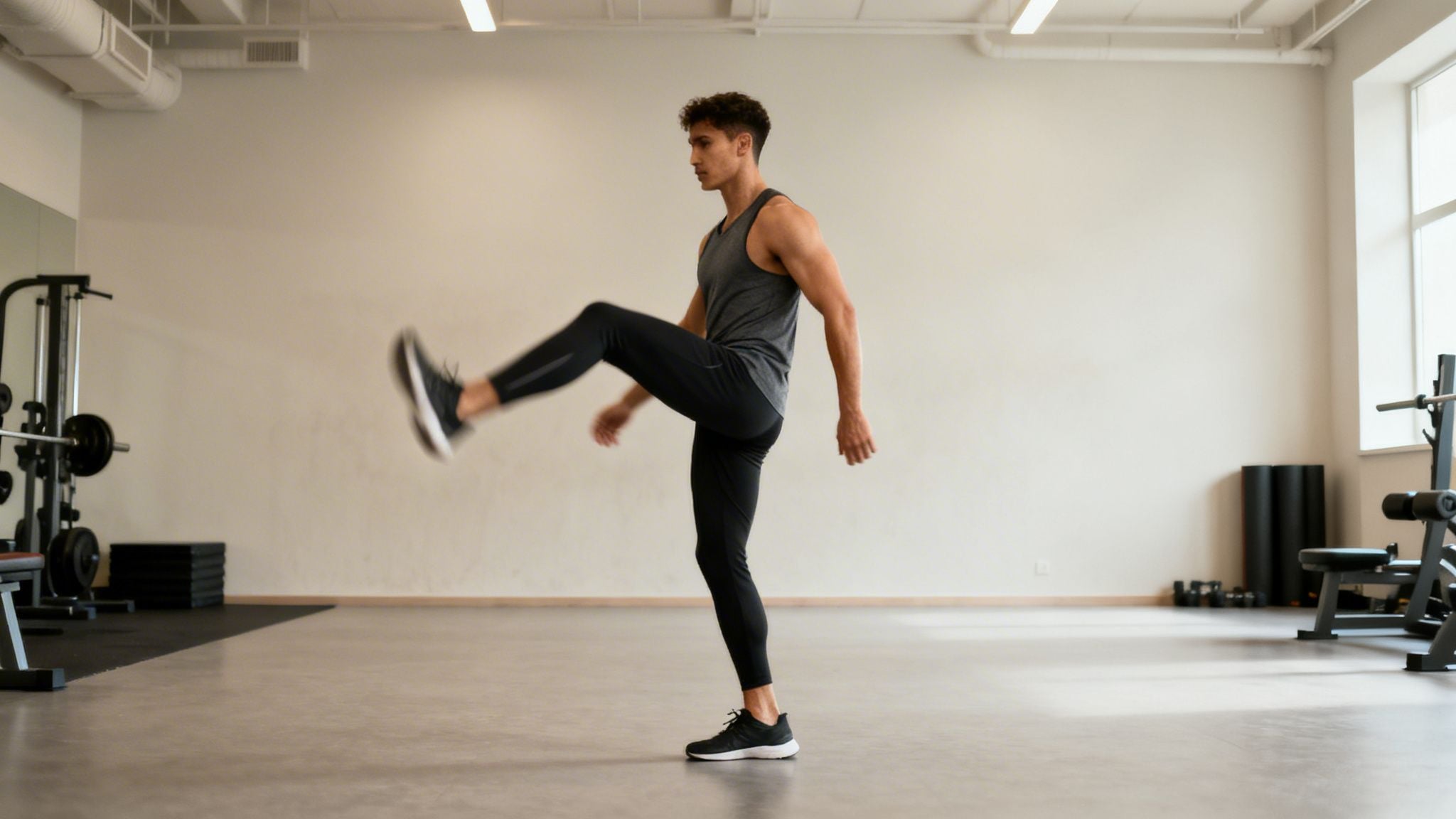
Leg Swings (Forward and Backward)
This is a classic for a reason. It’s one of the best ways to open up your hips while activating your hamstrings and hip flexors.
- How to Perform: Stand tall next to a wall or a sturdy chair for a bit of balance. Keep your core tight and your back straight as you swing one leg forward and backward in a smooth, controlled arc. Don't force it—focus on the rhythm, not how high you can kick.
- Muscles Targeted: Hamstrings, glutes, quads, and hip flexors.
- Tempo and Reps: Go for 10-12 smooth swings on each leg.
PT Focus Point: Avoid the temptation to arch your lower back when you swing your leg backward. All the movement should come from your hip. If your back is swaying, tighten your core to lock your pelvis in place.
Leg Swings (Side to Side)
Now, let's hit the inner and outer hip muscles. These are absolutely crucial for providing stability, especially during any kind of side-to-side or cutting movement.
- How to Perform: Turn to face your support object. Swing one leg out to the side and then across the front of your body. Again, keep the movement fluid and controlled, like a pendulum.
- Muscles Targeted: Hip adductors (inner thigh) and abductors (outer hip).
- Tempo and Reps: Complete 10-12 swings on each side.
Walking Lunge With a Torso Twist
This is where we start putting it all together. You're getting a great lower-body stretch combined with spinal mobility, which is perfect for preparing your body for more athletic, integrated movements.
- How to Perform: Step forward into a lunge with your right leg, lowering down until both knees are at about a 90-degree angle. As you lunge, gently twist your torso over your front (right) leg. Push off that front foot to stand back up, and then repeat on the left side.
- Muscles Targeted: Quads, glutes, hip flexors, and obliques, while promoting rotation in your upper back.
- Tempo and Reps: Alternate sides, performing 8-10 lunges per leg.
PT Focus Point: Watch that front knee. Make sure it tracks right over your ankle and doesn't dive inward or shoot out past your toes. The twist should come from your upper/mid-back, not your low back. A good cue is to think "let my chest follow my front knee."
Thoracic Spine Rotations (Cat-Cow)
If you spend any amount of time sitting at a desk, this one is non-negotiable. It’s fantastic for mobilizing your mid-back (the thoracic spine), getting rid of stiffness, and prepping your core for real work.
- How to Perform: Get on your hands and knees, with hands directly under your shoulders and knees under your hips. On an inhale, let your belly drop and look forward (Cow). As you exhale, round your spine up toward the ceiling, tucking your chin (Cat).
- Muscles Targeted: Spinal extensors and flexors, rhomboids, and core stabilizers.
- Tempo and Reps: Flow smoothly between the two positions for 10-12 total reps.
Remember, improving your movement is a lifelong journey. If you're interested in going deeper into how mobility affects your overall health, our guide on achieving flexibility for life is a great resource.
A Sample 10-Minute Full-Body Dynamic Warm-Up
So, how do you put all this together into a routine that actually works? Here’s a quick and effective 10-minute warm-up you can use before almost any activity. The key is to focus on the quality of each movement, not just rushing through the reps.
| Exercise | Sets & Reps | Primary Target Area | PT Focus Point |
|---|---|---|---|
| Leg Swings (Forward/Back) | 1 set of 12 reps per leg | Hamstrings & Hip Flexors | Keep your core tight to prevent your back from arching. |
| Leg Swings (Side to Side) | 1 set of 12 reps per leg | Inner & Outer Hips | Focus on a smooth, pendulum-like motion without twisting your torso. |
| Walking Lunges with Twist | 1 set of 10 reps per leg | Full Body & Core | Keep your front knee aligned over your ankle; twist from your upper back. |
| Thoracic Spine Rotations | 1 set of 12 reps | Mid-Back & Core | Inhale on the extension (Cow), exhale on the flexion (Cat) to sync breath with movement. |
| Arm Circles (Forward/Back) | 1 set of 15 reps each way | Shoulders & Upper Back | Start with small circles and gradually increase the size to warm the shoulder joint fully. |
This routine is a fantastic starting point. Always listen to your body—a good warm-up should leave you feeling energized and ready, never pushed into pain.
Tailoring Your Routine for Sport, Rehab, and Daily Life
A general dynamic stretching routine is a great place to start, but the real magic happens when you make it specific. A one-size-fits-all warm-up just doesn’t work because it ignores the unique demands of your body and your goals. At Highbar, individualized care is the bedrock of our practice, and that same principle should apply to how you prepare for movement.
Your warm-up should be a direct preview of what you're about to ask your body to do. A distance runner has completely different needs than a weightlifter. Someone recovering from surgery requires a vastly different approach than an office worker trying to undo the damage of sitting all day. Customizing your routine is what makes it truly effective, helping you get better and live a fuller life.

For the Athlete Building Explosive Power
For competitive athletes, a warm-up is more than just getting loose—it’s about flicking the switch on your nervous system for peak performance. The goal here is to build explosive power, sharpen your multi-directional agility, and rehearse the exact movement patterns you’ll need on the field or court.
Your routine should feel energetic and focused. Think less about slow, gentle movements and more about crisp, powerful actions that mimic the sport itself.
- High Knees: This isn’t a casual jog. Drive your knees up with force, focusing on a quick turnover and a powerful arm swing. This directly preps your hip flexors and core for sprinting and jumping.
- Butt Kicks: Just like high knees, do these with intent. Actively pull your heel toward your glute to dynamically stretch the quads and get your hamstrings ready for rapid contraction.
- Carioca (Grapevine): A classic drill for a reason. It's essential for sports that involve a lot of lateral movement, like basketball, soccer, or tennis. It warms up the hips and improves your coordination for those quick changes of direction.
- Walking Lunges with an Overhead Reach: This variation adds another layer of activation. As you lunge, reaching both arms straight up engages your core and stretches the lats, preparing your body for integrated, full-body power.
This approach gets real results. A significant clinical trial found that athletes who followed a structured dynamic warm-up saw major improvements in lower body function. After just two weeks of performing six targeted stretches, participants showed a mean vertical jump increase of 4.5 cm. It's a clear example of how a specific warm-up can produce measurable gains.
For the Patient in Rehabilitation
When you’re coming back from an injury or surgery, your body is in healing mode. A dynamic warm-up in a rehab setting has a completely different purpose. It’s not about power; it's about the gentle restoration of movement. The goal is to activate key stabilizing muscles and promote blood flow to healing tissues without causing pain or setbacks.
Every movement has to be slow, deliberate, and controlled. This is where the guidance of an expert physical therapist is so valuable—knowing exactly how to dose movement for healing is a science. This is the perfect time to explore sports physical therapy to ensure your recovery is safe and effective.
In rehab, a dynamic warm-up is medicine. The focus shifts from performance enhancement to rebuilding confident, pain-free movement patterns, one controlled repetition at a time, to get you back to living a fuller life.
Think about incorporating these kinds of gentle, rehab-friendly movements:
- Pendulum Swings for the Shoulder: If you're recovering from a shoulder issue, let the arm hang loosely and use your body to create small, easy swinging motions. This mobilizes the joint without forcing the muscles to work.
- Seated Spinal Rotations: While sitting tall in a chair, gently twist your upper body from side to side. This is a great way to mobilize the thoracic spine without putting stress on your lower back or hips.
- Heel Slides: Lying on your back, slowly slide your heel toward your glute to bend the knee, then just as slowly slide it back out. This is a foundational exercise for restoring knee and hip mobility after surgery.
For the Desk Worker Counteracting Sitting
Sitting all day creates a very predictable pattern of problems: tight hip flexors and chest muscles, paired with weak, inactive glutes and upper back muscles. Your dynamic warm-up should be the direct antidote to that slumped posture.
The entire focus should be on opening up the front of your body and waking up the back.
- Open the Hips: Start with simple movements like Standing Hip Circles to lubricate the joint. Then, you can move on to Walking Lunges, but focus on feeling a gentle stretch in the hip flexor of your back leg, not on power or depth.
- Mobilize the Thoracic Spine: The Cat-Cow stretch is your absolute best friend here. It gently moves your mid-back through flexion and extension, directly fighting that desk slouch.
- Activate the Shoulders and Upper Back: Basic Arm Circles are great, but Wall Slides are even better. Stand with your back against a wall and slide your arms up and down, keeping your elbows and wrists in contact with the wall. It’s fantastic for activating those weak upper back muscles and improving your posture.
By customizing your dynamic stretching to your specific context—whether you're an athlete, a patient, or a professional—you turn it from a generic checklist into a powerful tool for moving better and living a fuller life.
Common Mistakes to Avoid for a Safe and Effective Warm-Up
A great dynamic stretching routine can be a game-changer for your workouts, but only if you get the details right. At Highbar, we often see clients making a few common mistakes that either limit how effective their warm-up is or, worse, actually increase their injury risk.
Getting these small things right is what allows you to move with confidence and feel in control of your health. Let’s walk through the most common errors we see and how you can fix them to make every movement count toward getting you better.
Moving Too Fast or Bouncing
This is probably the biggest mistake we see. It’s easy to confuse dynamic stretching with ballistic stretching, which involves using uncontrolled momentum or "bouncing" at the end of a movement. Think of a jerky leg swing or a lunge where you bounce at the bottom.
- Instead of This: Using fast, uncontrolled swings that force your joints past their comfortable range of motion.
- Do This Instead: Focus on smooth, deliberate movements. A dynamic stretch should flow, but you need to be in complete control from start to finish. Your leg swings should feel more like a pendulum, not a forceful kick.
Bouncing can trigger a protective stretch reflex in the muscle, causing it to tighten up—the exact opposite of what you want from a warm-up. Controlled movements, on the other hand, gently signal to your nervous system and muscles that it’s time to prepare for activity.
Pushing Through Pain
This is a non-negotiable rule in physical therapy and any kind of training: pain is a signal to stop, not an invitation to push harder. A good dynamic stretch should feel active and maybe a little challenging, but it should never be painful.
Your body communicates through sensation. A gentle stretch is a sign of progress; sharp pain is a warning sign. Honoring this distinction is fundamental to preventing injury and building a healthy relationship with movement so you can live a fuller life.
If you feel any sharp, pinching, or stabbing sensation, you’ve gone too far. Back off immediately. Reduce your range of motion or slow down the movement until it feels comfortable again. If the pain persists, it’s a clear sign you should get it checked out by a physical therapist.
Holding Your Breath
When you’re concentrating on getting a movement right, it’s incredibly common to hold your breath without even realizing it. This creates unnecessary tension throughout your body, stiffens your core, and can even spike your blood pressure.
- Instead of This: Tensing up and holding your breath, especially during a more complex move like a lunge with a torso twist.
- Do This Instead: Breathe rhythmically and continuously. A great rule of thumb is to exhale on the effortful part of the stretch—for example, as you lower into a lunge or twist your torso—and inhale as you return to the starting position.
Breathing properly helps your muscles stay relaxed and supplied with oxygen. This simple shift makes your entire dynamic stretching routine safer and far more effective.
Neglecting Muscle Activation
A solid warm-up isn't just about stretching tissues; it's also about waking up, or "activating," the right muscles for the job. If your glutes and core aren't firing properly before a workout, other muscles are forced to compensate, which often leads to poor form and potential strain.
To truly achieve a safe and effective warm-up, it’s also helpful to understand how to handle issues that can disrupt your workout. Learn more about How To Prevent Muscle Cramps to keep your routine smooth and pain-free.
Frequently Asked Questions About Dynamic Stretching
As physical therapists, we get a lot of questions about how to properly use dynamic stretching. Getting clear answers to these common concerns is the best way to build a warm-up routine that truly works for you, ensuring you feel prepared and confident before every workout so you can live a fuller life.
Let's clear up a few things we often hear in the clinic.
How Long Should a Dynamic Stretching Routine Be?
Most people will get everything they need from a solid 5 to 15-minute warm-up.
For a general gym session or moderate-intensity workout, a focused 5-10 minute routine is usually perfect. That’s enough time to get your heart rate up, warm the muscles, and start mobilizing your joints.
If you’re gearing up for something more demanding—like a sports competition or a heavy lifting day—you’ll want to lean toward the 10-15 minute mark. This gives you extra time to perform movements that specifically mimic what you're about to do, priming your body for the exact demands of your sport. The goal is to finish feeling energized and ready, never tired.
Can I Use Dynamic Stretching as a Cooldown?
This is a common mix-up, but the short answer is no. Dynamic stretching and a cooldown are designed to do opposite things for your body.
- Dynamic Stretching (Warm-up): Think of this as your body's "on switch." The active movements increase your core temperature, fire up your nervous system, and get your muscles ready for action.
- Cooldown (Post-workout): This is the "off switch." It uses static stretches—where you hold a position for 20-30 seconds—to help your body gradually return to a resting state, ease muscle tension, and improve your flexibility over the long run.
A good way to remember it: dynamic stretching is the wake-up call, and static stretching is the wind-down.
Key Takeaway: Dynamic stretches are for before your workout to get you ready to perform. Static stretches are for after to help you recover and improve flexibility.
Should Dynamic Stretching Be Painful?
Absolutely not. You should never, ever feel sharp, stabbing, or pinching pain during a dynamic stretch—or any stretch, for that matter.
The movements are meant to feel active and controlled. You might feel a gentle pull as you move through your range of motion, but that's it. Pain is your body’s warning signal that you're pushing too hard, moving too fast, or using bad form.
If you feel pain, the first thing to do is make the movement smaller or slow it down. If the pain continues, it might be a sign of an underlying issue that needs a professional eye.
Is a Dynamic Stretching Routine Good for Back Pain?
Yes, for many people, a gentle dynamic stretching routine can be a fantastic tool for managing back pain. Controlled movements like Cat-Cow, pelvic tilts, and gentle seated torso twists are great for mobilizing the spine and activating the deep core muscles that support it—all without putting a lot of strain on sensitive tissues.
But this comes with a huge caveat. If your pain is acute, severe, or shoots down your leg, it's critical to get a proper diagnosis before you start any new exercises. What helps one kind of back pain can easily make another kind worse.
At Highbar Physical Therapy, our licensed physical therapists are movement experts. We can diagnose the root cause of your pain and design a safe, effective plan to help you move freely and get back to living your life. If you're dealing with pain or just want to make sure your routine is right for you, book an appointment at https://highbarhealth.com today.