The right knee routine can dramatically reduce pain, restore range of motion, and keep flare-ups from coming back. Below are the stretches, strengthening drills, and progressions our physical therapists rely on most.
Related Articles
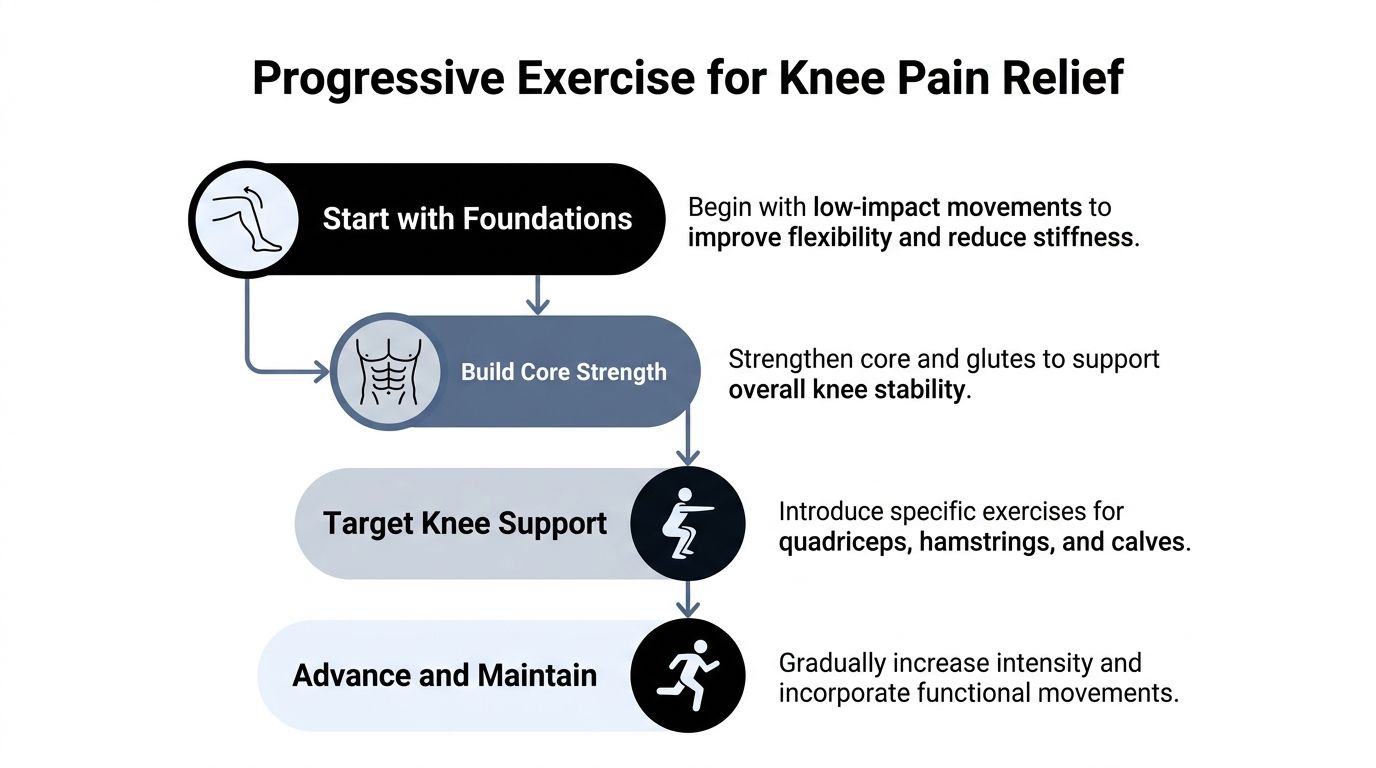
Effective exercises for knee pain relief
The right combination of stretching, strengthening, and mobility work can ease knee pain and prevent recurrence. Start gently and progress as tolerated. Stop any movement that produces sharp pain.
- Quad sets and straight-leg raises — foundational quadriceps activation that protects the patella. Review pre-surgical prep in our guide to knee pain relief without surgery.
- Glute medius side-lying clamshells — strengthens hip stabilizers that control knee alignment. See our breakdown of gluteus medius exercises for hip stability.
- IT band foam rolling and lateral hip mobility — addresses tightness that often drives lateral knee pain. Learn more in our IT band pain guide.
- Hip flexor stretching — releases anterior chain tension that affects knee mechanics. Try these PT-recommended hip flexor stretches.
- Step-ups and mini-squats — functional strengthening for stairs and daily activity.
- Heel slides and wall sits — restore range of motion and build isometric strength.
For tissue mobility after injury or surgery, see our PT guide on how to break up scar tissue. Curious how knee pain fits into the bigger picture? Head over to our knee pain overview.
Quick answers about knee exercises
FAQS
How often should I do knee exercises?
Most people benefit from a daily routine of 10–15 minutes, with strengthening work performed 3–4 times per week. Consistency matters more than intensity, and a licensed PT can personalize frequency based on your diagnosis.
Should I exercise if my knee hurts?
Mild discomfort during exercise is often okay, but sharp pain, swelling, or pain that lingers more than 24 hours is a sign to back off. If you are unsure, an evaluation can clarify what is safe — read our guide to knee pain relief without surgery.
Which exercises should I avoid with knee pain?
Deep loaded squats, lunges with poor form, plyometric jumps, and high-impact running often aggravate irritated knees. Lower-impact options like cycling or pool walking are usually better tolerated until symptoms settle.
Can stretching alone fix knee pain?
Stretching helps with mobility but rarely resolves knee pain on its own. Most patients need a combination of strengthening (especially the glutes and quadriceps) and stretching for lasting results.
How long until I see results?
With consistent exercise, many people notice meaningful improvement in 4–6 weeks. Structural issues or post-surgical recovery may take longer, and a PT can help you set realistic milestones.
Are home exercises enough, or do I need a physical therapist?
Home routines work well for mild, well-defined issues. For persistent pain, instability, or post-surgical recovery, a PT can identify the root cause and tailor a progression — learn more about what manual therapy adds.
Will exercises help arthritis-related knee pain?
Yes — research consistently shows that targeted exercise reduces pain and improves function in knee osteoarthritis. Strengthening is generally more effective than rest, and a PT can help you find the right intensity.