You look at the bill, then look back at the front desk, then at your insurance app, then back at the bill again.
Maybe you expected physical therapy to cost about as much as a routine office visit. Instead, you see a copay that feels high, a deductible that hasn’t been met, or a cash rate that makes you wonder whether stretching at home would be cheaper. That reaction is normal. Patients ask some version of the same question every week: why is physical therapy so expensive?
The frustrating part is that the answer usually isn’t simple. A PT bill reflects clinical expertise, clinic operating costs, insurance contracts, and the strange math of American healthcare pricing. It also reflects a mismatch between what physical therapy costs upfront and what it can help you avoid later.
From the patient side, the experience often feels backward. You’re being asked to pay for exercise, coaching, and manual treatment now, even though the actual payoff may be fewer injections, less imaging, less time off work, and lower odds of ending up in a surgeon’s office later. If you’re already in pain, that’s a hard sell unless someone explains the trade-offs clearly.
That’s what patients deserve. Not a defensive answer. Not billing jargon. A straightforward explanation of where the money goes, why prices vary so much, and what you can do to make care more affordable.
That Moment of Sticker Shock From Your PT Bill
You call to schedule after your back locks up, your runner's knee will not settle down, or your shoulder starts throbbing every time you reach overhead. Then you hear the estimate, open your insurance app, and realize the number in your head was nowhere close.
That reaction is common.
Patients usually are not upset only because the price feels high. They are upset because the price feels unpredictable. One clinic quotes a specialist copay. Another says your deductible applies. A hospital-owned clinic may bill very differently from a private practice, even for a visit that looks similar on your calendar.
Physical therapy prices also vary widely by state, facility type, and insurance contract. Earlier research cited in this article found large differences in both insured and cash rates for similar services. From the patient side, that kind of spread can feel arbitrary, even when there are real reasons behind it.
The result is sticker shock. And sticker shock often leads to a risky conclusion. "Maybe I should wait. Maybe I can just YouTube this."
Sometimes symptoms do calm down with time and home exercise. I tell patients that directly. But waiting is not a neutral decision if pain is limiting sleep, work, training, or basic movement. A few weeks of delayed care can turn an easier problem into a longer, more expensive one through more visits, more missed work, more imaging, more specialist appointments, or a condition that becomes harder to reverse.
That is the part many bills do not show clearly. PT is one of the few services in musculoskeletal care that can lower downstream spending when it is used early and used well. The upfront cost is visible. The costs it may help you avoid usually are not.
Timing also changes how expensive PT feels. Medication costs are often broken into smaller monthly payments. Surgery costs are wrapped into a larger medical event and may arrive later. Physical therapy sits in the middle. You see the charge early, and you see it repeatedly, which makes it easier to label as expensive even when the total cost of the full episode is lower than the alternatives.
So the better question is not only, "Why does this visit cost this much?" It is, "Compared with doing less, doing nothing, or choosing a more invasive path, what is this care likely to save me?"
The Expertise Behind the Price Tag What Your Physical Therapist Provides
A PT visit can look simple from the outside. You talk, move, do some exercises, maybe get hands-on treatment, then go home with a plan. But its true value isn’t in supervising movement alone. It’s in clinical decision-making.

A PT session is a cognitive service
Physical therapists are trained to evaluate movement, identify likely pain drivers, screen for red flags, and build a treatment plan that matches the person in front of them. That sounds straightforward until you consider how many variables can affect the same complaint.
Low back pain is a good example. Two people may both say, “My back hurts when I bend.” One needs graded loading and reassurance. Another needs post-surgical precautions respected. Another may need referral because their presentation doesn’t fit a routine musculoskeletal pattern. The visit fee covers that judgment.
A good therapist is constantly answering questions like these:
- What tissue or movement pattern is most likely involved?
- Is this problem irritable, stable, or worsening?
- What can the patient safely do today without flaring symptoms?
- What should improve first if the plan is working?
- When does this need imaging, physician input, or a different level of care?
That work is why physical therapy shouldn’t be confused with generic fitness instruction or a handout of stretches from the internet.
The training is long for a reason
In the United States, physical therapists complete doctoral-level professional training before licensure. That pathway includes foundational science, anatomy, biomechanics, clinical reasoning, and supervised clinical education. Patients don’t need the academic details to recover, but they do need to know this: the person treating them was trained to do far more than count repetitions.
Specialized knowledge matters even more in complex cases. Post-operative rehab, vestibular disorders, pelvic health, sports return-to-play decisions, chronic pain, and neurologic conditions all require a level of assessment that goes well beyond “exercise is good for you.”
Clinical reality: The most valuable part of physical therapy often happens before the exercise starts. It’s the judgment about which exercise, how much, how soon, and for whom.
You’re not paying only for time. You’re paying for direction
Patients sometimes compare PT to massage, personal training, or home exercise videos because those are easier to visualize. But what they’re really purchasing is a structured plan designed to reduce trial and error.
That matters financially. The American Physical Therapy Association reported in its 2023 analysis of the economic value of PT that physical therapy delivered net savings ranging from $3,514 to $51,906 per patient across common conditions. For acute low back pain alone, PT was associated with $4,160 in net savings compared with alternatives such as injections.
Those numbers don’t mean every session feels cheap. They do mean the service often has a high return when it keeps care moving in the right direction and away from costlier alternatives.
What doesn’t work
Patients spend more when treatment is unfocused. That can happen when:
- The diagnosis is too vague: “Do these ten exercises and see what happens.”
- Progress isn’t measured: No one adjusts the plan when symptoms stall.
- Visits become passive: Heat, stimulation, and table time without a clear progression.
- The home program is unrealistic: If you can’t do it consistently, it won’t help much.
The strongest value in PT comes from precise assessment, a targeted plan, and ongoing adjustments. That expertise is one of the main reasons the bill is higher than many people expect.
Anatomy of a Physical Therapy Bill Clinic Overhead and Business Costs
A patient finishes an evaluation, feels better about the plan, then looks at the estimate and wonders how one hour can cost that much. That reaction is understandable. The bill reflects far more than face-to-face time with the therapist.
A physical therapy clinic is a healthcare operation, not a rented room with a treatment table. The cost of each visit has to support the people, systems, equipment, and regulatory requirements that make safe outpatient care possible. If those pieces are cut too aggressively, patients usually feel it through rushed visits, poor follow-up, limited availability, or generic treatment.
What a clinic is actually paying for
Some expenses are easy to see. Many are not.
- Clinical space: Commercial rent, private treatment areas, accessibility requirements, utilities, laundry, cleaning, and maintenance.
- Equipment and replacement: Treatment tables, exercise tools, cardio equipment, balance systems, and specialty devices wear out and need upkeep.
- Front-office staff: Scheduling, intake, benefit checks, referral tracking, phone calls, and patient questions all require trained staff.
- Clinical documentation and billing software: Secure systems for charting, coding, claims submission, and appointment management are expensive but necessary.
- Licensing, compliance, and liability costs: Malpractice coverage, privacy protections, credentialing, and audits are part of operating in healthcare.
- Administrative insurance work: Authorizations, denials, resubmissions, and payer follow-up take staff time long after the visit ends.
This is one reason a clinic cannot price visits like a gym membership or a fitness class. The business model is closer to other regulated medical services, even when the treatment itself looks simple from the outside.
Administrative work adds cost before treatment starts
Insurance friction is expensive. A clinic may spend significant time checking benefits, confirming visit limits, requesting authorization, and fixing claim errors before payment ever arrives.
Patients rarely see that work, but they pay for the system that supports it. If a claim is delayed or denied, the clinic still has payroll, rent, software fees, and therapist schedules to cover. Those costs do not disappear because an insurer makes payment hard to collect.
For readers who want help with understanding the nuances of deductibles and copays, that guide explains why your final out-of-pocket number can feel disconnected from the care you received.
Why the same PT visit can cost more in one setting than another
Clinic setting matters. A lot.
A review from Rehab Associates on hospital versus private practice PT pricing found that hospital-based physical therapy clinics often charge 2.5 to 3.5 times more than private practices for similar services, largely because hospital systems carry higher overhead and facility-based billing structures.
That does not make hospital-based care inappropriate. Some patients need that environment because of medical complexity, post-surgical coordination, or referral patterns inside a hospital system. But for routine orthopedic or sports rehab, the site of care can change the total bill more than patients expect.
| Cost Component | Private Practice (Example) | Hospital-Based Clinic (Example) |
|---|---|---|
| Base therapy visit | Lower standalone clinic rate | Higher negotiated outpatient hospital rate |
| Facility fee | Usually not separate | May be included in hospital billing |
| Administrative overhead | Smaller operational structure | Larger system-wide cost structure |
| Out-of-pocket impact before deductible | Often easier to estimate | Often harder to predict |
| Best fit | Routine outpatient rehab, sports, orthopedic care | Patients already tied to hospital care or needing that setting |
Why cheaper care can become more expensive care
Price matters. So does value.
A lower sticker price is not always the better financial choice if it leads to slower progress, unnecessary visits, or a delayed return to work, exercise, or daily function. I often tell patients to compare PT the same way they would compare car repairs. Paying less for the wrong fix usually means paying twice.
That is also why salary alone does not explain your bill. Therapist pay is one part of the total cost structure, and readers who want that context can review physical therapy salary trends and compensation factors. The larger issue is whether the clinic delivers efficient care that reduces the chance of more expensive downstream treatment.
Questions worth asking before you start
Patients can lower surprises by asking direct questions up front:
- Is this clinic hospital-based or independently owned?
- Will any facility-related charges apply to my visits?
- What is my estimated cost per visit under my current plan?
- Do you offer a self-pay rate if insurance pricing is worse than cash pay?
- How often do you expect I’ll need to come, and how will you measure progress?
That last question matters. A higher-quality plan of care may cost more per visit and still save money overall if it gets you better in fewer visits and helps you avoid imaging, injections, repeat physician appointments, or missed work.
A high PT bill can reflect a costly delivery system. It can also fund the structure that helps treatment work the first time.
Navigating the Insurance Maze Why Your Plan Dictates Your Price
You call two clinics about the same shoulder problem. Both are in-network. Both can see you this week. One quote sounds reasonable, and the other makes you wonder whether physical therapy is even worth starting.
That gap often comes from your insurance plan, not from a big difference in the treatment itself.
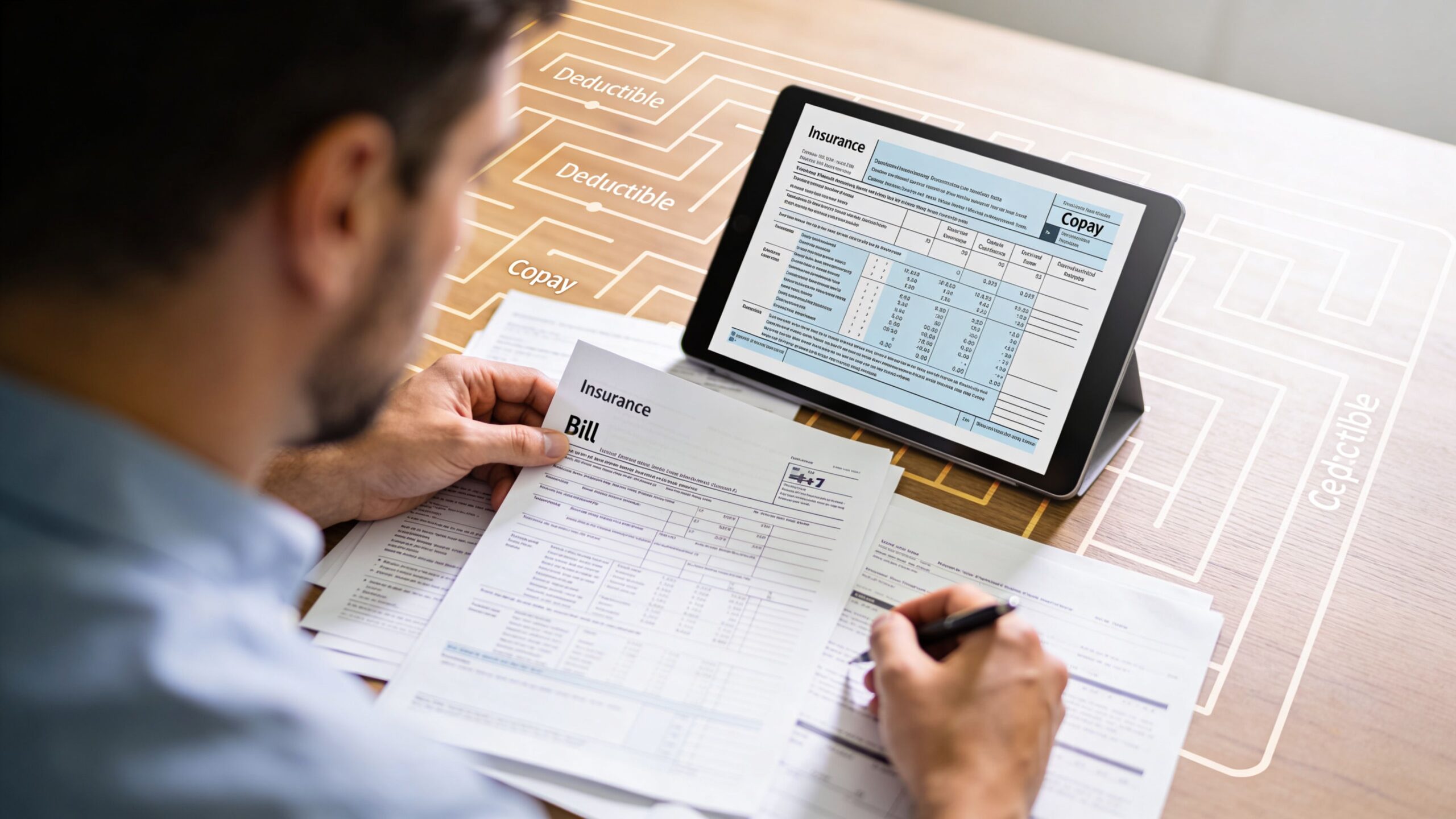
Deductibles make “covered care” feel uncovered
Patients hear that PT is covered and reasonably assume their out-of-pocket cost will be low. Then the first explanation of benefits arrives, and they learn they are still responsible for the contracted rate because their deductible has not been met.
That is common with high-deductible health plans. Early in the year, insurance may process the claim without reducing what you owe in any meaningful way. From the patient side, it can feel like paying cash at insurance prices.
If you want a plain-language resource for understanding the nuances of deductibles and copays, that article explains how those parts of a plan affect what you pay at each visit.
A longer plan of care can make this hit harder. ProgBeg’s discussion of PT costs under high-deductible plans notes that a typical 12-week course of care with 2-3 sessions per week can add up to over $960 in copays alone before the deductible is met. That kind of total is exactly why patients need to look at the full episode cost, not just the price of one appointment.
Copays, coinsurance, and visit limits
A copay is a fixed fee per visit. Coinsurance is a percentage of the allowed amount. Those sound simple until the rest of the policy gets involved.
The main questions are practical:
- Do I pay a copay or coinsurance for PT?
- Does the deductible apply first?
- Is there a visit limit or medical necessity review?
- Do I need pre-authorization before the first visit or after a certain number of visits?
- Will I owe more at a hospital-based clinic than at a private practice?
I encourage patients to ask those questions before the first session, not after the third bill. A lower-premium plan often shifts more of the rehab cost back to you, and that trade-off is easy to miss until you need care.
Pre-authorization adds friction and risk
Pre-authorization is not just an administrative annoyance. It can delay treatment, interrupt progress, and create extra uncertainty around what your insurer will approve.
That matters because musculoskeletal problems rarely stay frozen while paperwork is pending. People keep limping, sleeping poorly, avoiding exercise, or working around pain. Sometimes they schedule extra physician visits or imaging while they wait. Those costs count too, even if they do not show up on the PT bill.
For some patients, direct-pay care is worth comparing against insurance billing, especially when the deductible is high or approval rules are strict. If you are sorting through those details, Highbar’s insurance coverage and payment information shows the kind of clinic-specific guidance that can help you estimate costs before you commit.
Insurance can lower costs. It can also shift costs, delay care, and make a high-value treatment feel overpriced in the short term. The right question is not only “What do I owe today?” It is also “What does this plan setup make more likely over the next three months?”
The High Cost of Delay Why Waiting Is More Expensive Than Treatment
A patient tweaks a back lifting a box, decides to wait it out, and tries to push through work for a few weeks. By the time they finally come in, the problem is no longer just pain. Now they are sleeping poorly, moving less, missing exercise, and guarding every bend and reach. The bill they worry about is the PT bill, but the actual cost started building long before the first visit.

Early care changes the whole episode
In practice, early PT often shortens the arc of a musculoskeletal problem. A stiff shoulder stays a stiff shoulder for less time. A back flare is less likely to turn into weeks of guarded movement, lost strength, and fear of activity. That shift matters clinically and financially.
A summary from Sword Health on Medicare findings reports that patients who start physical therapy early instead of going straight to surgery can have 75% lower healthcare costs for the same condition. That does not mean every patient needs the same treatment plan. It means timing changes the total cost of the episode.
I explain it to patients this way. The first few weeks after pain starts are often the cheapest time to intervene. The body has not adapted as much yet. Compensation patterns are less ingrained. Function is usually easier to restore.
Delay changes the math.
By the time symptoms become severe, treatment often takes longer and the path is less direct. People may add imaging, specialist visits, prescription medications, injections, or procedures before they ever address the strength, mobility, load tolerance, or movement problem underneath. For common spine complaints, that is one reason many patients benefit from understanding the differences in physical therapy vs. chiropractic care for back pain before choosing a path.
The costs people forget to count
Patients usually compare PT to doing nothing this week. The more accurate comparison is PT now versus a larger care bill later.
The missing costs are often practical, not theoretical:
- Work time lost because pain limits sitting, standing, lifting, or commuting
- Extra appointments with primary care, orthopedics, or pain management
- Medications, imaging, injections, or urgent visits that may not solve the root issue
- Reduced activity that leads to deconditioning and slower recovery
- Stress, poor sleep, and the mental drain of ongoing pain
Those costs do not always arrive on one statement, but patients feel them all the same.
The most expensive rehab plan I see is not usually the one that starts promptly. It is the one that starts after months of weakness, compensation, and declining function.
That is why I do not frame physical therapy as a luxury purchase. In many cases, it is a high-return investment. You are paying for symptom relief, yes, but also for a better chance of avoiding a longer, more invasive, and more expensive chain of care.
7 Actionable Strategies to Make Physical Therapy More Affordable
A patient comes in after putting off care for six weeks because the price felt hard to justify. By that point, they are sleeping poorly, missing workouts, and changing how they lift, walk, or sit to avoid pain. The bill for PT still matters, but the bigger financial problem is often everything that piled up while they waited.
That is the frame to use here. The goal is not just to lower the cost per visit. It is to lower the total cost of getting your life back.
1. Compare care settings, not just clinic names
Start by asking what kind of facility you are calling.
Hospital outpatient departments often bill differently than independent private practices, even when the treatment plan looks similar from the patient side. In practical terms, two clinics may both offer evaluation, exercise, and hands-on care, but your out-of-pocket cost can differ a lot based on the setting and your insurance contract.
Call two or three options. Ask for the setting, the billing model, and the expected patient responsibility.
2. Ask for the number you are likely to pay
“Do you take my insurance?” is not enough.
A better set of questions usually gets you closer to the cost:
- What will I owe for the initial evaluation?
- What will I owe per follow-up visit before my deductible is met?
- What will I owe after my deductible is met?
- Do I need prior authorization?
- Is there a visit cap?
- Do you offer a self-pay rate if that is lower?
If a clinic cannot explain the basics of your financial responsibility, expect confusion later.
3. Compare insurance rates against self-pay
Insurance does not always produce the lowest bill.
I have seen patients with high-deductible plans pay more through insurance than they would have paid with a transparent cash rate. That does not mean cash pay is always better. It means patients should compare both options before the first visit, especially early in the year when deductibles are still untouched.
Ask the clinic to spell out both paths. Then choose the one with the lower total cost for your likely plan of care.
4. Start while the problem is still simpler
Small problems are usually cheaper to treat than entrenched ones.
If pain is spreading, your activity is shrinking, or daily tasks are getting harder, delaying care can raise the total bill through extra appointments, medication use, missed work, and slower recovery. For spine symptoms in particular, patients often save themselves time and detours by understanding the difference between physical therapy and chiropractic care for back pain before committing to a treatment path.
The least expensive episode of care is often the one that starts before compensation patterns take over.
5. Get full value from the home program
Clinic visits matter. What you do between visits matters just as much.
A good home program reduces waste because each follow-up can focus on reassessment, progression, and problem-solving instead of repeating the same basics. Patients who understand their exercises clearly often need fewer unnecessary visits and get better value from the visits they do attend.
Ask these questions before you leave:
- Which one or two exercises matter most right now?
- How often should I do them?
- What amount of soreness is acceptable?
- What change should tell me this is helping?
6. Use visit formats that fit the stage of recovery
Every visit does not need the same format.
Some cases need frequent in-person treatment early, especially when the diagnosis is unclear, symptoms are irritable, or hands-on assessment matters. Other cases do well with a mix of in-person care and remote follow-up once the plan is established and exercise progression becomes the main focus.
Highbar Physical Therapy is one example of a clinic model that offers outpatient care, telehealth, and direct-access scheduling, which can give patients more than one way to start care based on timing, symptoms, and coverage.
7. Finish the part of rehab that prevents relapse
Pain relief is only one checkpoint.
Stopping care as soon as symptoms ease can look cheaper in the short term, but it often leaves the underlying weakness, stiffness, balance deficit, or load intolerance in place. That is when patients cycle back into the same problem, then pay again through another flare, another round of visits, or another referral.
The better value is a plan that gets you to durable function. In plain terms, that means staying long enough to return to work, exercise, lifting, parenting, or sport with less risk of ending up back at the starting line.
Your Path Forward Investing in Your Health
Physical therapy can feel expensive because the bill is visible, the insurance rules are messy, and pricing changes from one setting to another. Those concerns are real. Patients shouldn’t be talked out of them.
But cost and value aren’t the same thing. PT reflects professional expertise, clinic overhead, and insurance complexity. It also offers something many treatments don’t: a credible chance to improve function while helping you avoid more invasive and more expensive care later.
The practical move is to treat physical therapy like any other major health decision. Ask better questions. Compare settings. Understand your benefits. Look at both the upfront price and the likely downstream cost of waiting.
The first step to feeling better is understanding your options. If you’re ready to take control of your recovery, find a physical therapist near you today.
Common Questions About Physical Therapy Costs
A lot of cost questions come up after the first bill or even before the first visit. That is reasonable. Patients are trying to balance pain, function, work, family obligations, and a healthcare system that rarely gives a straight price up front.
Is physical therapy worth the money
Often, yes, if the treatment changes the trajectory of the problem. Good PT can reduce pain, restore function, and lower the chance that a manageable issue turns into imaging, injections, repeat doctor visits, or surgery. That is where the return on investment shows up.
The value drops when care is generic, passive, or poorly matched to the diagnosis. Patients should expect a clear exam, a plan tied to specific goals, and regular progression.
How many sessions will I actually need
The honest answer comes after the evaluation. A mild ankle sprain, chronic back pain, and a rotator cuff repair all have different timelines, different risks, and different visit frequencies.
I tell patients to ask a better question than "How many visits?" Ask what milestones should happen, how quickly progress should show up, and what would change the plan. That gives you a more useful forecast of both recovery time and total cost.
Why can’t I just use YouTube videos for my exercises
Because the exercise itself is only one part of treatment.
What matters is choosing the right movement for the right problem, at the right dose, at the right stage of healing. A video cannot test strength, identify movement compensation, screen for nerve involvement, or adjust the plan when pain changes. Free exercise content can be helpful after a diagnosis is clear, but it is a weak substitute for skilled assessment.
Should I use insurance or pay out of pocket
Compare both before you decide. If you have a high deductible, cash pay may be simpler and, in some cases, less expensive per visit than using insurance. Insurance can still make sense if you have already met your deductible or have a favorable copay.
There is also a timing issue. An explanation from Method Physical Therapy notes that pre-authorization requirements and insurance delays can postpone care, while direct pay may allow faster access to treatment in some situations: why paying out of pocket for physical therapy is the best option. That delay matters. Waiting often means more pain, more missed activity, and a harder problem to treat.
Is one expensive clinic automatically better than a cheaper one
No. Price often reflects the setting, local contracts, staffing model, and overhead, not only treatment quality.
Ask practical questions. Who will treat you each visit? How much one-on-one time will you get? What is the plan if you are not improving within a few visits? What will the full episode of care likely cost, not just the first session? Those answers tell you more than the sticker price.
If you want clear answers about your options, Highbar Physical Therapy can help you understand coverage, costs, and the next step for your recovery.