Your rotator cuff is a small group of muscles with a big job: stabilizing your shoulder, the body's most mobile joint. Whether you're an overhead athlete, a desk worker, or recovering from an injury, a strong, healthy rotator cuff is essential for living a full, pain-free life. However, navigating the world of shoulder exercises can be confusing and even risky without proper guidance.
This article cuts through the noise. Drawing on the evidence-based principles we practice at Highbar Physical Therapy, we've curated the definitive list of the best exercises for rotator cuff strengthening. We will move beyond generic advice to provide a physical therapist's perspective on not just what to do, but how and why each movement is critical for your recovery and long-term health. You will learn specific, actionable techniques for each exercise, including:
- Step-by-step execution cues.
- Recommended sets and repetitions.
- Common mistakes to avoid.
- Progressions and regressions to match your ability.
Our goal isn't just to give you a list of exercises; it's to empower you with the knowledge to build resilient shoulders, prevent future injuries, and get back to the activities you love, better and stronger than before. This guide is designed to help you understand your body and build a foundation for a fuller, more active life.
1. Band External Rotation at 0° Abduction
Considered a cornerstone of any effective rotator cuff program, the band external rotation at 0° abduction is a fundamental movement for strengthening the shoulder. This exercise directly targets two key rotator cuff muscles: the infraspinatus and the teres minor. These muscles are responsible for externally rotating the humerus (upper arm bone) and are critical for decelerating the arm during overhead movements, making this exercise one of the best for rotator cuff strengthening.
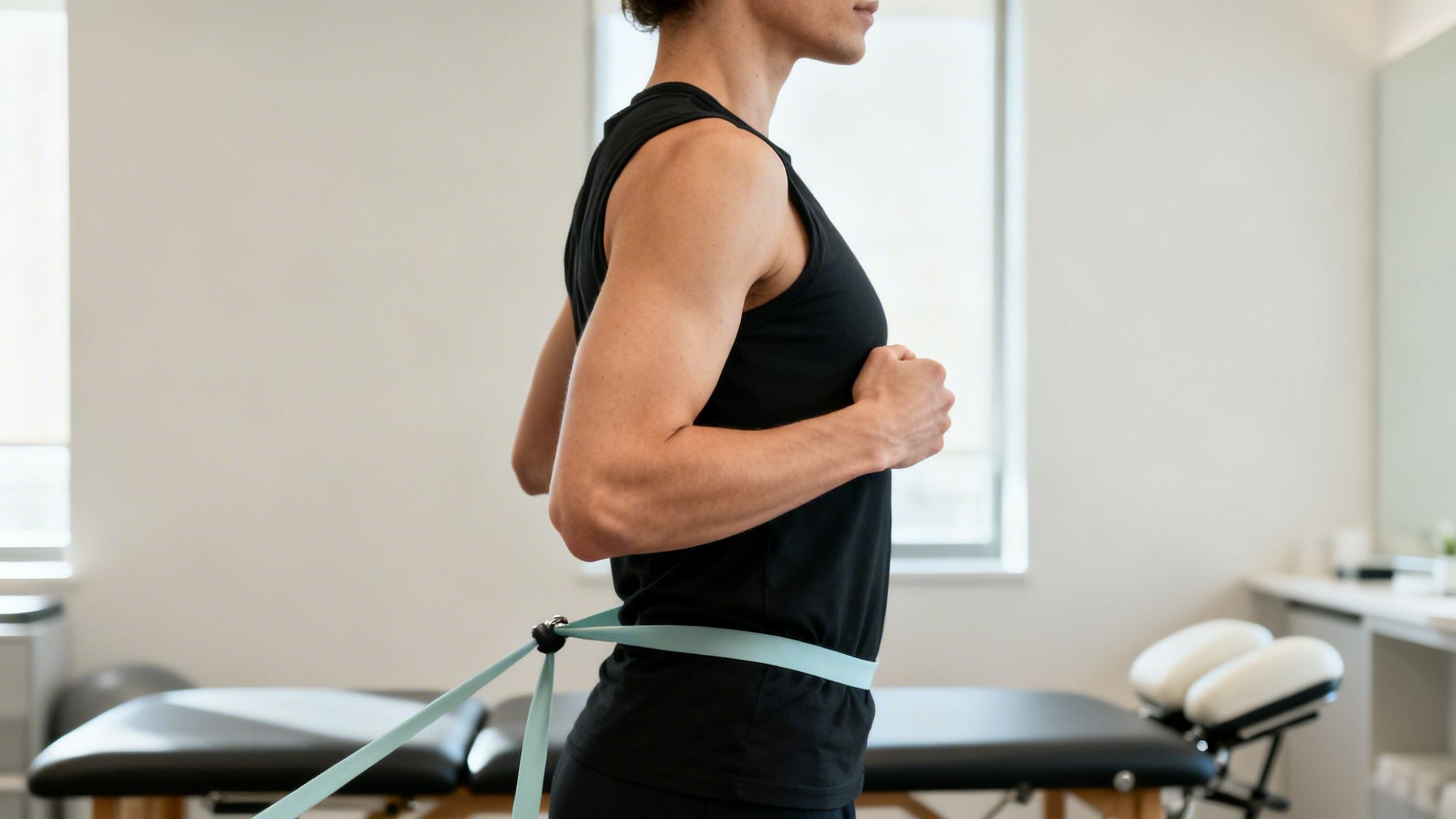
The "0° abduction" part is vital; it means your arm stays tucked against your side. This specific position isolates the external rotators without placing undue stress on the supraspinatus tendon or other joint structures. It's an ideal starting point for rehabilitation and a safe, effective motion for long-term shoulder health maintenance.
How to Perform It
Follow these steps for proper execution:
- Setup: Anchor a light resistance band to a stable object at elbow height. Stand sideways to the anchor point with your working arm furthest from it.
- Position: Grasp the band with your hand. Bend your elbow to 90 degrees and keep it firmly pressed against your side. You can place a small, rolled-up towel between your elbow and torso to help maintain this position.
- Execution: Keeping your elbow fixed to your side, slowly pull the band away from your body, rotating your forearm outward. Move only as far as you can without letting your elbow drift away from your torso or shrugging your shoulder.
- Hold & Return: Pause for 1-2 seconds at the end of the rotation, squeezing your shoulder blade. Slowly and with control, return to the starting position.
When to Use This Exercise
This movement is incredibly versatile. It's a staple in early to mid-stage post-operative protocols where protecting the surgical repair is paramount. For those seeking to explore more about post-surgical care, you can review some excellent tips for recovering from rotator cuff surgery. It's also a go-to for desk workers experiencing postural strain and for athletes (swimmers, pitchers, tennis players) as a pre-activity warm-up or a post-activity cool-down to build endurance and prevent injury.
Clinical Insight: At Highbar Physical Therapy, we emphasize this exercise because it teaches how to isolate and activate specific muscles. This control is the foundation upon which more complex, functional strengthening is built, helping people get better and live fuller lives. We typically recommend 2-3 sets of 15-20 repetitions, focusing on impeccable form over heavy resistance.
2. Side-Lying External Rotation with Dumbbell
A classic and highly effective movement, the side-lying external rotation with a dumbbell uses gravity as its primary source of resistance. This exercise is one of the best for rotator cuff strengthening because it precisely targets the same external rotators as the band version-the infraspinatus and teres minor-but in a different orientation. By lying on your side, you work against gravity's downward pull, which provides a consistent and easily measurable challenge.
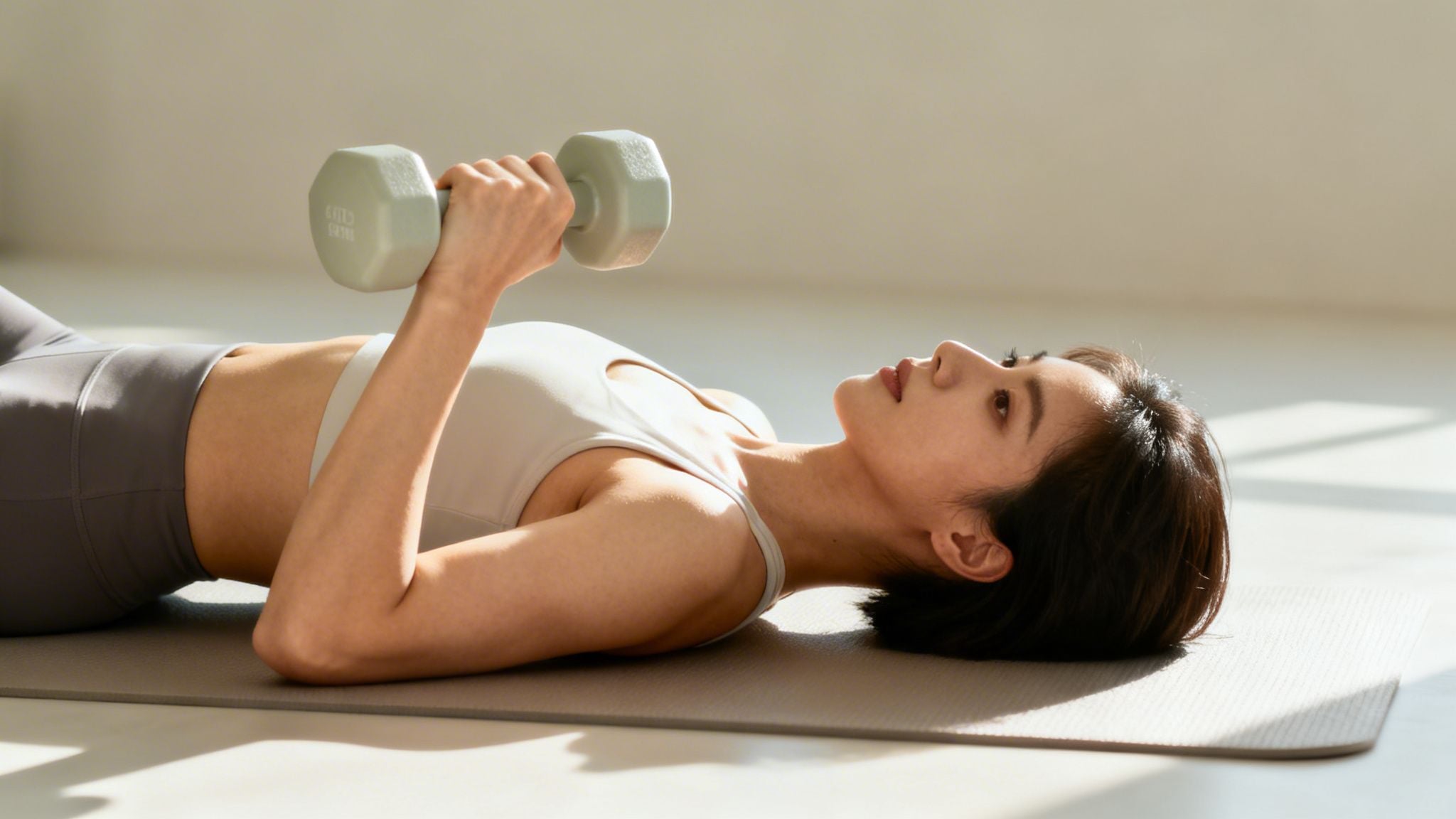
This position offers excellent stability for the shoulder blade and torso, allowing you to focus purely on the rotational movement of the shoulder joint. The ability to incrementally increase the dumbbell weight makes it a great choice for tracking progressive strength gains over time, a key component of both rehabilitation and performance training.
How to Perform It
Follow these steps for proper execution:
- Setup: Lie on your non-working side on a firm surface, with your hips and knees slightly bent for stability. Support your head with your bottom arm or a pillow.
- Position: Hold a light dumbbell (e.g., 3-5 lbs) in your top hand. Bend your working elbow to 90 degrees and rest it against your side, with your forearm parallel to the floor.
- Execution: Keeping your elbow securely against your side, slowly rotate your arm upward, lifting the dumbbell toward the ceiling in a smooth arc. Ensure the movement comes from your shoulder, not from rolling your body backward.
- Hold & Return: Pause at the top of the movement for a second. With deliberate control, slowly lower the dumbbell back to the starting position over 2-3 seconds. This controlled eccentric phase is crucial for building strength.
When to Use This Exercise
This exercise is frequently introduced in the mid-to-late stages of rotator cuff rehabilitation once initial pain and inflammation have subsided. It's also a staple in strength maintenance programs for overhead athletes and return-to-work conditioning for manual laborers who need robust shoulder stability. If you're experiencing persistent pain or are unsure if this exercise is right for you, it's always best to seek specialized guidance for your shoulder condition. We recommend performing it 3-4 times per week with at least one rest day in between sessions.
Clinical Insight: At Highbar Physical Therapy, we value this exercise for its ability to provide measurable progress. You can clearly see and feel your strength improving as you graduate from a 3-pound to a 5-pound dumbbell. This tangible success is a powerful motivator, helping people stay committed to their recovery and ultimately return to living fuller, more active lives. We typically start with 2-3 sets of 12-15 repetitions, emphasizing a slow, controlled lowering phase.
3. Prone I-Y-T Raises
The Prone I-Y-T Raise is a dynamic sequence that powerfully strengthens the entire posterior shoulder complex. Performed lying face down, this movement targets not only the rotator cuff but also crucial scapular stabilizing muscles like the rhomboids and lower/middle trapezius. These muscles work together to control the shoulder blade, which is essential for healthy shoulder function and proper scapulohumeral rhythm.
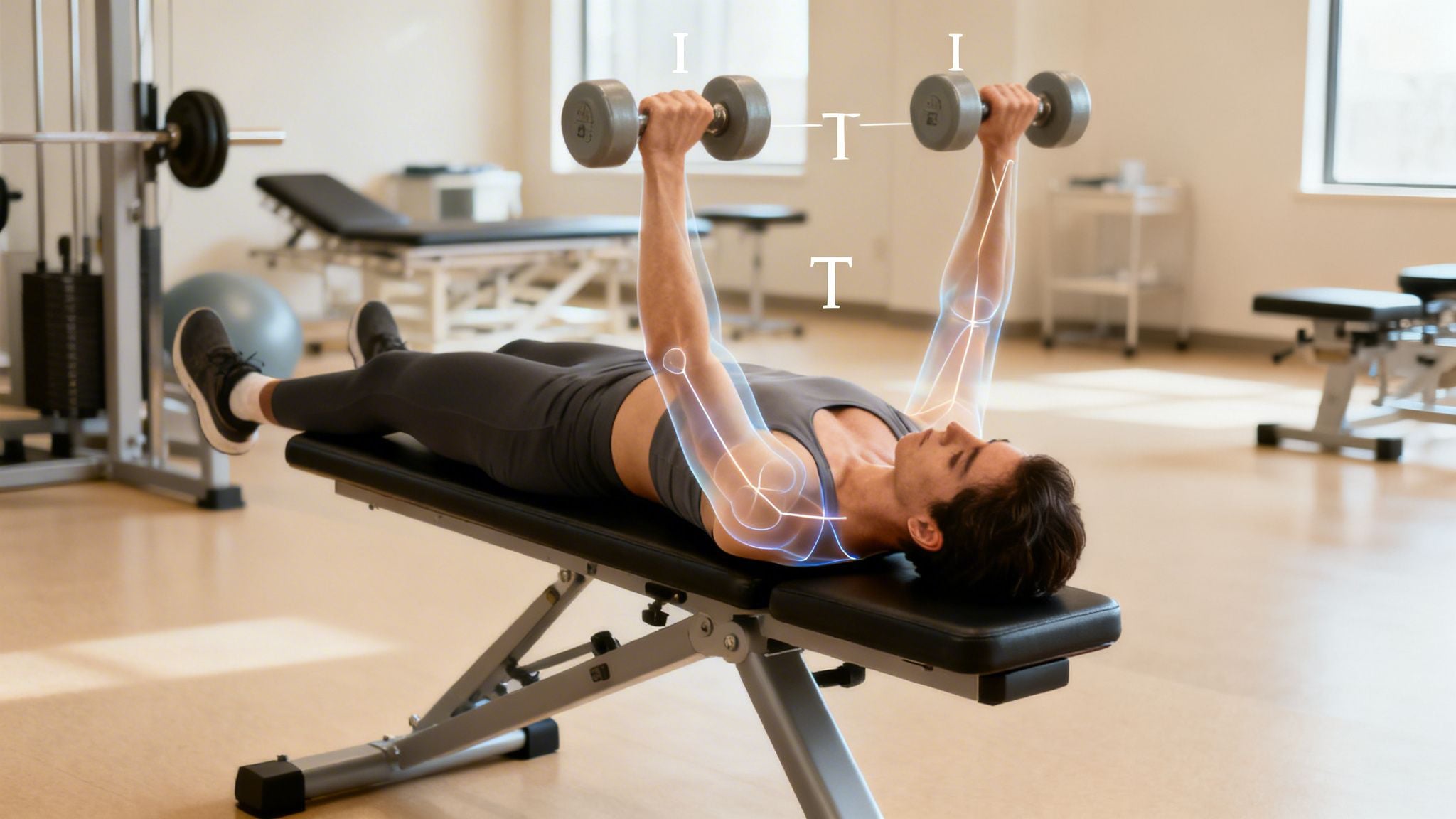
By moving the arms through three distinct patterns- an "I" (overhead), a "Y" (45-degree angle), and a "T" (90-degree angle)- you train the muscles to fire in a coordinated way. This coordination is fundamental for overhead athletes and anyone struggling with poor posture, making it one of the best exercises for rotator cuff strengthening and overall shoulder stability. Popularized by figures like Dr. John Kibler for its role in correcting scapular dysfunction, it's a staple in modern physical therapy and athletic training.
How to Perform It
Follow these steps for proper execution:
- Setup: Lie face down on a stability ball or an incline bench set at a 45-degree angle. Let your arms hang straight down towards the floor, holding very light dumbbells (2-5 lbs) or no weight at all.
- Position: Maintain a neutral spine by keeping your head in line with your back; don't crane your neck up. Before starting, gently squeeze your shoulder blades together and down, away from your ears.
- Execution: Raise your arms in a controlled motion to form one of the three letters. For the "I," lift your arms straight overhead with thumbs pointing up. For the "Y," lift them out at a 45-degree angle. For the "T," lift them directly out to your sides.
- Hold & Return: Pause for 1-2 seconds at the top of each raise, focusing on the squeeze between your shoulder blades. Slowly and with control, lower the arms back to the starting position before beginning the next repetition or pattern.
When to Use This Exercise
This exercise is exceptionally effective for correcting the rounded shoulders and forward head posture common in desk workers. It’s also a key component of training programs for swimmers, volleyball players, and other overhead athletes to build endurance and prevent injuries. In a rehabilitation setting, it's introduced once foundational strength is established to help reintegrate proper movement patterns and build the muscular support needed for more demanding activities.
Clinical Insight: At Highbar Physical Therapy, we use Prone I-Y-Ts to retrain the brain-muscle connection that governs posture and shoulder movement. Many people are surprised by how challenging this is with just bodyweight, which highlights underlying weakness. We typically prescribe 2-3 sets of 10-12 repetitions for each letter, emphasizing slow, controlled movements to help patients get better and reclaim an active, fuller life.
4. Half-Kneeling Pallof Press
While direct rotation exercises are crucial, true shoulder health requires integrating the rotator cuff with the core and scapula. The Half-Kneeling Pallof Press is a superior anti-rotation exercise that accomplishes just that. It indirectly challenges the rotator cuff to act as a dynamic stabilizer while the core resists rotational forces, bridging the gap between isolated strengthening and real-world functional movement. This integrated approach makes it one of the best exercises for rotator cuff strengthening for long-term resilience.
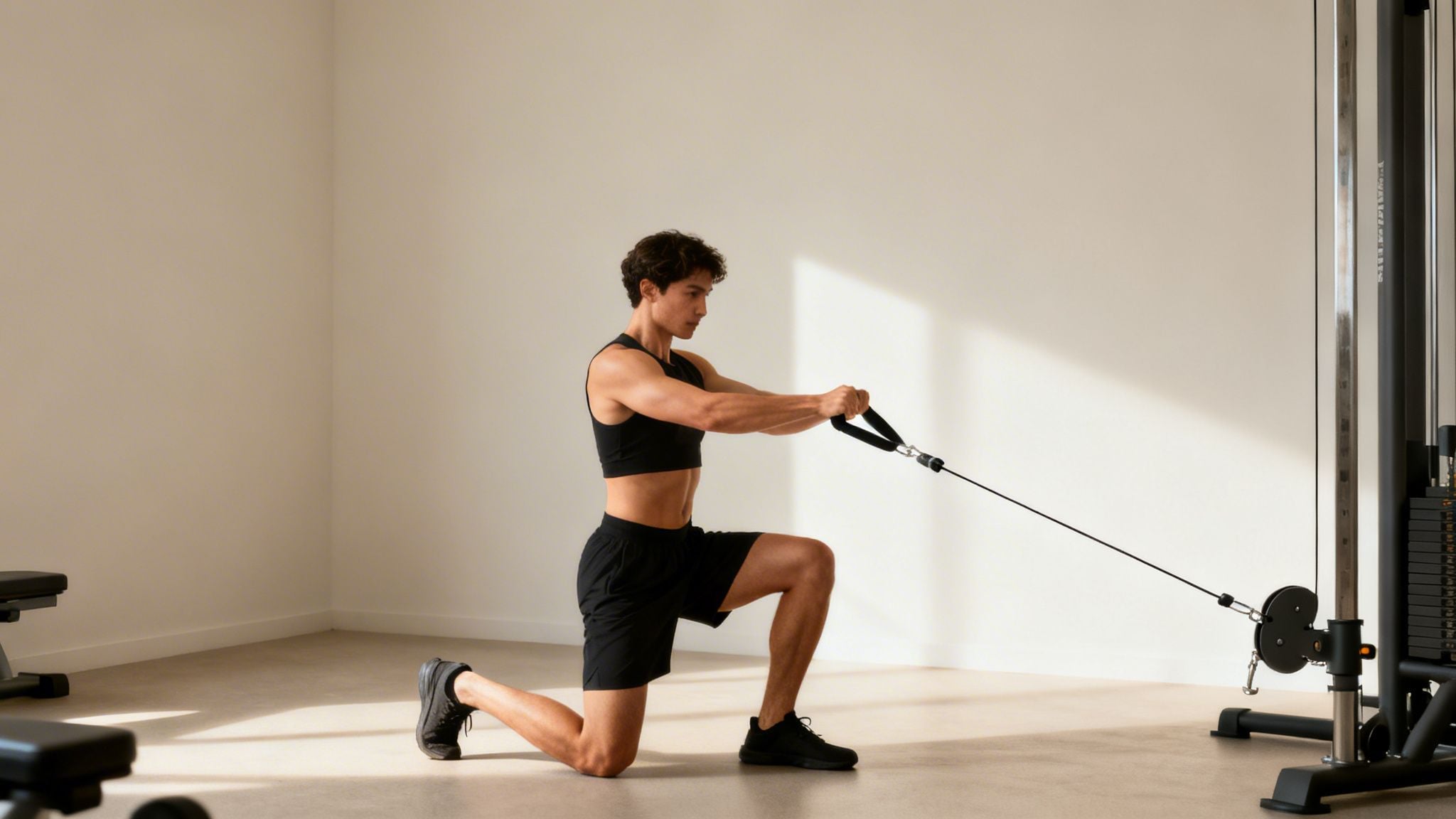
Popularized by functional movement specialists, this exercise trains the shoulder to remain stable while the arms move away from the body. This is a critical skill for manual laborers lifting objects, athletes transferring force, and anyone reaching overhead. By resisting the pull of the band or cable, you teach your rotator cuff, scapular muscles, and core to work in unison, preventing unwanted shoulder joint motion and protecting it from injury.
How to Perform It
Follow these steps for proper execution:
- Setup: Anchor a resistance band or set a cable machine handle at chest height. Position yourself in a half-kneeling stance perpendicular to the anchor point, with your inside knee down on a pad and your outside foot forward.
- Position: Grasp the handle with both hands and bring it to the center of your chest. Engage your core to maintain a tall, upright posture, ensuring your hips and shoulders are square.
- Execution: Slowly press the handle straight out in front of your chest until your arms are fully extended. The resistance will try to pull you into rotation; your job is to fight that pull and remain perfectly still.
- Hold & Return: Hold the fully extended position for 2-3 seconds, focusing on keeping your shoulders down and your torso stable. Slowly and with control, bring the handle back to your chest to complete one repetition.
When to Use This Exercise
The Pallof Press is an excellent choice for intermediate stages of rehabilitation and for performance training. It's highly effective in return-to-work programs for manual laborers with a history of shoulder pain and is a staple in strength programs for overhead athletes. It's also beneficial for addressing postural imbalances, as poor core control can sometimes contribute to neck and shoulder issues. If you experience such discomfort, you might find it useful to explore effective exercises for neck pain relief.
Clinical Insight: At Highbar Physical Therapy, we value exercises that connect different parts of the body. The Pallof Press is a perfect example of teaching the shoulder how to co-contract with the core. This integrated strength is what helps people get back to lifting their kids, playing their sport, and living fuller lives without fear of re-injury. We often program 2-3 sets of 12-15 repetitions per side, emphasizing a controlled tempo over heavy resistance.
5. Quadruped Shoulder Taps (Bird Dogs with Shoulder Focus)
This exercise is a foundational movement for integrating core stability with shoulder control, making it a critical component for comprehensive rotator cuff health. The Quadruped Shoulder Tap, often called a Bird Dog with a shoulder focus, challenges the rotator cuff to act as a dynamic stabilizer for the shoulder joint while the body is in motion. It targets the entire cuff, particularly the subscapularis and supraspinatus, which work to keep the head of the humerus centered in the socket.
By coordinating the movement of the opposite arm and leg, this exercise develops proprioception (your sense of body position) and neuromuscular control. This connection between the brain and the shoulder muscles is essential for both rehabilitation and injury prevention, establishing it as one of the best exercises for rotator cuff strengthening by teaching the shoulder how to remain stable during functional activities.
How to Perform It
Follow these steps for proper execution:
- Setup: Begin on your hands and knees on a comfortable mat. Position your hands directly under your shoulders and your knees directly under your hips, creating a "tabletop" position.
- Position: Engage your core by drawing your belly button towards your spine to create a flat, neutral back. Keep your gaze directed down at the floor to maintain a neutral neck.
- Execution: Slowly lift one arm straight out in front of you while simultaneously extending the opposite leg straight back. The key is to lift without arching your back or allowing your hips to rotate. Focus on keeping the shoulder of your supporting arm stable and strong.
- Hold & Return: Pause for 1-2 seconds at the peak of the extension, focusing on maintaining a level torso. Slowly and with complete control, return your hand and knee to the starting position on the mat. Repeat on the other side.
When to Use This Exercise
The Quadruped Shoulder Tap is highly effective in early to mid-stage rehabilitation, where re-establishing neuromuscular control is a primary goal. It’s also an excellent baseline exercise prescribed during initial physical therapy assessments to gauge a patient's core and scapular stability. Furthermore, its low-impact nature makes it a perfect addition to a daily morning mobility routine or as part of a warm-up to activate the core and shoulder stabilizers before a workout.
Clinical Insight: At Highbar Physical Therapy, we value this exercise for its ability to rebuild the connection between the core and the shoulder. True shoulder strength isn't just about the cuff; it's about how the cuff functions as part of a larger system. This movement helps you understand that stability, allowing you to get back to your activities safely and live better lives. We often start with 2-3 sets of 10-12 repetitions per side, prioritizing perfect form and slow, deliberate movements.
6. Standing Cable External Rotation
For those ready to progress beyond basic bands, the standing cable external rotation is an outstanding next step. This advanced exercise swaps the variable tension of a band for the consistent, smooth resistance of a cable machine. By doing so, it challenges the infraspinatus and teres minor through their entire range of motion, a key factor in building functional strength and making this one of the best exercises for rotator cuff strengthening.
The constant tension provided by the cable is superior for promoting muscle hypertrophy and endurance. This makes it a staple in intermediate to advanced rehabilitation and athletic conditioning, particularly for overhead athletes who require robust and resilient shoulders.
How to Perform It
Follow these steps for proper execution:
- Setup: Adjust a cable pulley to elbow height and attach a D-handle. Stand sideways to the machine, about 12-18 inches away, with your working arm furthest from the anchor point.
- Position: Grasp the handle with your palm facing inward. Bend your elbow to 90 degrees and keep it tucked near your side. Stand with an upright posture, engaging your core to prevent leaning.
- Execution: Keeping your elbow fixed at your side, slowly rotate your forearm outward, pulling the cable across your body. Focus on using your shoulder muscles to initiate the movement, not momentum.
- Hold & Return: Pause for 1-2 seconds at the peak of the rotation, squeezing the muscles in the back of your shoulder. Slowly and with control, return to the starting position, resisting the pull of the cable.
When to Use This Exercise
This movement is typically introduced in later stages of rehabilitation once a solid foundation of strength and motor control has been established. It's a go-to for return-to-sport programs for athletes in baseball, volleyball, and tennis, where powerful deceleration is crucial. It’s also frequently integrated into the strength and conditioning protocols of professional and Olympic-level athletic programs to maintain peak shoulder health and performance. We recommend performing it 2-3 times per week with rest days in between sessions.
Clinical Insight: At Highbar Physical Therapy, we progress patients to cable exercises to prepare them for the demands of sport and daily life. The ability to precisely increase the weight allows us to apply progressive overload systematically, which is essential for getting people stronger and back to living fuller lives. We start with a low weight for 2-3 sets of 12-15 repetitions, ensuring flawless form before adding resistance.
7. Prone Horizontal Abduction with External Rotation
As we move into more advanced movements, the prone horizontal abduction with external rotation stands out as a highly effective posterior shoulder strengthener. This compound exercise targets the infraspinatus, teres minor, and posterior deltoid, along with crucial scapular stabilizers like the rhomboids and middle trapezius. By combining horizontal abduction (lifting the arms out to the side) with external rotation (thumbs up), it creates a powerful stimulus for the entire posterior rotator cuff complex.
This movement is one of the best exercises for rotator cuff strengthening because it directly challenges the muscles responsible for decelerating the arm, a critical function for overhead athletes like throwers and swimmers. Performing it in a prone (face-down) position on an incline bench provides trunk support, allowing for better isolation of the target muscles and minimizing the tendency to use momentum or improper body mechanics.
How to Perform It
Follow these steps for proper execution:
- Setup: Set an incline bench to a 30-45 degree angle. Grab a pair of light dumbbells (2-5 lbs is a great starting point) and lie face down on the bench with your chest supported. Let your arms hang straight down toward the floor, palms facing each other.
- Position: Maintain a neutral neck by looking down at the floor, not up. Squeeze your shoulder blades together slightly to set your scapula in a stable position.
- Execution: Keeping your elbows straight, raise your arms out to your sides in a wide arc, simultaneously rotating your hands so that your thumbs point up towards the ceiling at the top of the movement. Raise the dumbbells until your arms are parallel to the floor. Focus on squeezing your shoulder blades together as you lift.
- Hold & Return: Pause for 1-2 seconds at the peak of the contraction, feeling the engagement in your upper back and the back of your shoulders. Slowly and with complete control, lower the weights back to the starting position.
When to Use This Exercise
This exercise is ideal for the later stages of rehabilitation once a solid foundation of strength and control has been established. It is a staple in conditioning programs for throwing and overhead athletes, helping to build the robust posterior chain strength needed to prevent injury and enhance performance. It's also excellent for anyone looking to correct rounded shoulders and improve overall posture by strengthening the often-neglected muscles of the upper back.
Clinical Insight: At Highbar Physical Therapy, we progress patients to this exercise to build functional strength that translates directly to demanding daily activities and sports. It’s about more than just muscle; it's about developing the control and endurance that allows people to return to their passions and live fuller lives. We typically prescribe 2-3 sets of 12-15 repetitions, emphasizing perfect form and control over heavy weight.
8. Sleeper Stretch with Posterior Capsule Mobilization and Isometric Hold
While primarily known as a stretch, this movement is a hybrid that integrates mobility with gentle strengthening, making it a unique and effective tool for shoulder health. It specifically targets posterior capsule tightness, a common issue in rotator cuff dysfunction that can restrict internal rotation and alter shoulder mechanics. By adding an isometric hold, it also strengthens the internal rotators (like the subscapularis) in an end-range position.
This dual-action approach is what makes this one of the best exercises for rotator cuff strengthening. It addresses both flexibility deficits and strength needs simultaneously, creating a more balanced and functional shoulder joint. It is a vital complement to the external rotation exercises that often dominate rotator cuff programs.
How to Perform It
Follow these steps for proper execution:
- Setup: Lie on the floor on the side of your affected shoulder. Your body should be rolled slightly backward (about 20-30 degrees) to position the shoulder blade correctly and avoid direct impingement.
- Position: Bend the bottom arm so your shoulder and elbow are at 90-degree angles, with your forearm pointing toward the ceiling. Use your top hand to gently press your bottom forearm down toward the floor.
- Execution: Gently push down until you feel a mild to moderate stretch in the back of your shoulder. Do not push into pain. This is the posterior capsule mobilization phase. Hold this gentle stretch for 30-60 seconds, breathing deeply.
- Hold & Return: After the stretch, actively resist your top hand by trying to rotate your bottom forearm back toward the ceiling, creating an isometric contraction. Hold this gentle contraction for 5-10 seconds. Relax and repeat the sequence.
When to Use This Exercise
This exercise is exceptionally useful for individuals experiencing a "pinching" sensation or loss of motion, particularly overhead athletes like pitchers or swimmers who develop tight posterior capsules. It's a standard component in many home exercise programs for rotator cuff rehabilitation, often prescribed to be done daily to improve mobility before performing strengthening work. It also serves as an excellent warm-up for anyone before engaging in overhead lifting or sports.
Clinical Insight: At Highbar Physical Therapy, we find this exercise essential for patients who have hit a plateau in their recovery due to restricted mobility. Restoring internal rotation is key to normal shoulder function. We guide our patients to focus on the sensation of the stretch in the back of the shoulder, not the front. We typically advise 3-5 repetitions of a 30-second stretch followed by a 5-second isometric hold, emphasizing that it should always be pain-free.
Rotator Cuff: 8-Exercise Comparison
| Exercise | Implementation complexity | Resource requirements | Expected outcomes | Ideal use cases | Key advantages | Limitations |
|---|---|---|---|---|---|---|
| Band External Rotation at 0° Abduction | Low — simple single-plane movement | Resistance band, small space | Improved external rotation endurance/early strength, reduced impingement symptoms | Early-phase rehab, home programs, prevention | Low risk, highly accessible, easy to progress | Limited maximal strength gains, less precise loading |
| Side-Lying External Rotation with Dumbbell | Low–Medium — gravity-assisted isolation | Light dumbbells, mat | Measurable external rotation strength with progressive overload | Intermediate rehab, athletes returning to sport | Precise load progression, stable position, isolates rotators | Requires weights, less suitable very early post-op, may cause discomfort with instability |
| Prone I‑Y‑T Raises | Medium — multi‑plane, coordinated patterns | Incline bench or stability ball, light weights or bodyweight | Improved scapular stability, posterior shoulder strength, posture correction | Postural programs, swimmer/overhead athlete training, mid‑phase rehab | Comprehensive stabilizer activation, scalable, improves proprioception | Requires equipment and coordination, neck strain risk, not for acute tears |
| Half‑Kneeling Pallof Press | Medium–High — anti‑rotation, integrated pattern | Cable machine or heavy band, kneeling pad | Enhanced core anti‑rotation and integrated shoulder stability, functional transfer | Return‑to‑sport/work, advanced rehab, functional conditioning | Functional carryover, prevents compensations, core integration | Needs equipment and coaching, complex for early rehab or limited mobility |
| Quadruped Shoulder Taps | Low — foundational motor control drill | Mat or padded floor | Improved scapular control, neuromuscular endurance and proprioception | Early‑phase rehab, foundational stability, home routines | No equipment, low joint stress, excellent for neuromuscular retraining | Limited strength development, wrist load, may be too basic for advanced athletes |
| Standing Cable External Rotation | Medium–High — controlled, variable resistance | Cable machine, clinic/gym access | Precise strength gains and measurable progress, advanced conditioning | Advanced rehab, return‑to‑sport, elite athletic conditioning | Consistent resistance, precise loading, multi‑angle options | Requires gym equipment, not suitable for acute phases, less accessible for home use |
| Prone Horizontal Abduction with External Rotation | Medium–High — compound posterior pattern | Incline bench or stability ball, dumbbells or cable | Robust posterior shoulder and rotator cuff strength, improved scapulohumeral rhythm | Throwing athletes, advanced rehab, sport‑specific conditioning | Comprehensive posterior chain strengthening, high sport transfer | Equipment and coordination required, higher technical demand and mobility needs |
| Sleeper Stretch with Posterior Capsule Mobilization & Isometric Hold | Low — mobility with gentle isometrics | None (mat/bed), optional manual assistance | Improved posterior capsule mobility, reduced impingement, end‑range internal rotator activation | All rehab phases, warm‑up mobility, daily home programs | Addresses capsule tightness, no equipment, suitable early stages | Can be uncomfortable if very tight, needs proper coaching, not a primary strength exercise |
Your Next Move: Partnering with an Expert for Lasting Results
You now have a detailed blueprint of some of the best exercises for rotator cuff strengthening. We've explored foundational movements like the Band External Rotation and Side-Lying Dumbbell External Rotation, which isolate key muscles. We’ve also examined more complex, integrated exercises such as the Half-Kneeling Pallof Press and Prone I-Y-T Raises, which challenge shoulder stability within a full-body context.
The goal of this guide was to empower you with knowledge, demonstrating not just the what but the why and how behind each movement. Understanding correct form, common mistakes, and appropriate progressions is the first critical step toward building strong, resilient shoulders. However, knowledge alone is not the endgame; proper application is where true progress is made.
From Information to Actionable Insight
The most significant takeaway is that rotator cuff health is a dynamic process, not a one-time fix. Your body is constantly adapting, and your strengthening program must adapt with it. Simply performing a static list of exercises indefinitely will eventually lead to a plateau or, worse, new imbalances.
This is where the principles of progressive overload and individualized programming become paramount. A few key points to carry forward include:
- Pain is a signal, not a challenge. Sharp, pinching, or radiating pain during an exercise is your body's way of saying something is wrong. Do not push through it. This is a clear indicator that you need a professional assessment to identify the underlying cause, which could range from improper form to a more significant structural issue.
- Quality over quantity, always. Executing five perfect repetitions of a Prone Horizontal Abduction is far more beneficial than twenty sloppy ones. Poor form ingrains faulty movement patterns and can put undue stress on the very tissues you're trying to heal.
- The rotator cuff doesn't work in a vacuum. As we discussed, a strong rotator cuff relies on a stable and mobile scapula (shoulder blade). The two are intrinsically linked. Alongside this strengthening, incorporating dedicated scapular mobility exercises for injury prevention is crucial for overall shoulder health and longevity.
The Value of an Expert Guide
Think of this article as an exceptionally detailed map. While a map is incredibly useful, it can't tell you about an unexpected road closure or help you navigate a detour. A physical therapist is your expert local guide, capable of interpreting the map in the context of your unique body and goals.
A licensed physical therapist provides a level of care that no article or video can replicate. They perform a detailed assessment to diagnose the root cause of your shoulder pain or weakness. They don't just give you exercises; they craft a personalized, evolving plan that changes as you get stronger.
Key Insight: A physical therapist is a movement expert. They are trained to identify the subtle compensations your body makes to avoid pain or weakness, patterns that you might not even notice. Correcting these compensations is often the key to unlocking lasting relief and peak performance.
At Highbar Physical Therapy, our clinical team embodies this principle. We are passionate about helping people get better and live fuller lives. We don't just treat symptoms; we empower you with the tools and understanding to take control of your health. If you're ready to move beyond guessing and start a structured, expert-led journey to a stronger shoulder, we are here to help.
Don't let shoulder pain dictate your life's activities. The team at Highbar Physical Therapy specializes in diagnosing the root cause of shoulder issues and creating personalized recovery plans. Take the first step toward living a fuller, pain-free life by scheduling your evaluation today.