Pickleball is the fastest-growing sport in New England, and courts across Rhode Island and Massachusetts are packed. It’s social, affordable, and easy to pick up. But at Highbar, we’re seeing the flip side of the boom: a steady rise in pickleball injuries and most of them preventable.
Why pickleball catches so many players off guard
The game looks gentle, but it demands quick lateral movement, sudden stops, reaching, twisting, and backpedaling. Many players are also active adults returning to sport after years away, so enthusiasm outpaces conditioning. That “too much, too soon” gap is where most injuries start.
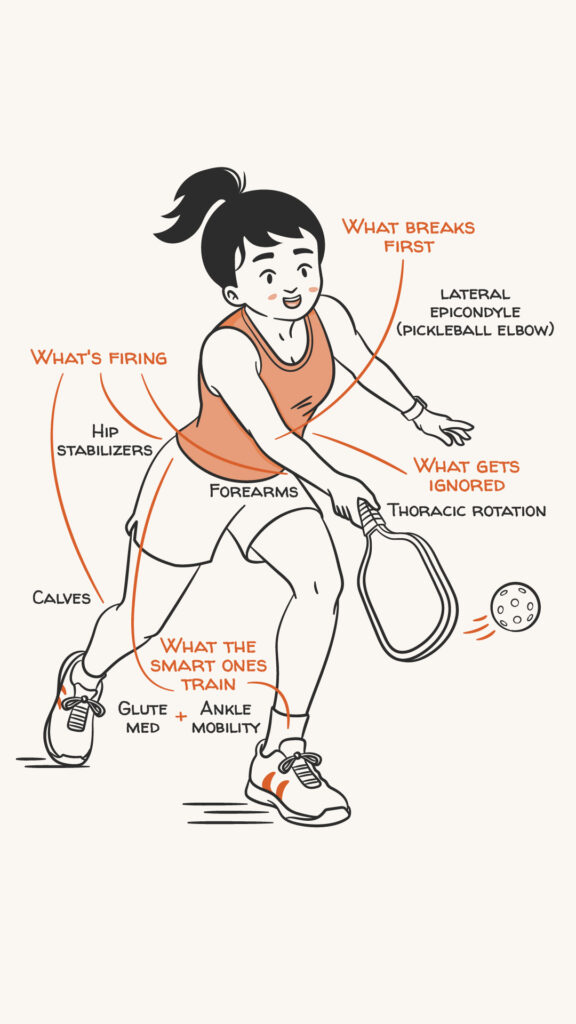
The pickleball injuries we treat most
Ankle sprains and falls top the list. Quick direction changes and backpedaling toward the kitchen line are a classic recipe. For example, players often plant their foot to change direction and roll the ankle outward, leading to swelling and instability that lingers if untreated.
Pickleball elbow (similar to tennis elbow) builds gradually from repetitive gripping and off-center paddle contact, especially with off-speed dinks and volleys. It usually shows up as soreness on the outside of the elbow that gets worse when gripping a coffee cup or turning a doorknob.
Achilles tendon irritation shows up as morning heel stiffness that eases as you warm up, then returns after a few games, often in players who ramped up their court time quickly after a long break from activity.
We also see knee pain from pivoting, especially in players with pre-existing meniscus wear who make sharp lateral cuts chasing a wide shot. Rotator cuff strain from overhead serves and smashes is common in players who serve frequently without much shoulder conditioning. And lower back pain from all that twisting shows up most in players who rotate through the lower back instead of the hips when reaching for a shot.
How to prevent them
Warm up dynamically with leg swings, hip circles, and a few minutes of light lateral shuffling, instead of static stretching, which doesn’t prepare tendons for quick, reactive movements. Build your playing volume gradually. For instance, if you’re new to the sport or coming back after time off, cap yourself at two or three games in a session for the first couple of weeks rather than playing for hours on day one. Wear real court shoes, not running shoes, since running shoes are built for forward motion and don’t offer the lateral support pickleball’s side-to-side movement demands. Strengthen your hips, glutes, core, and shoulders off the court with simple exercises like side-lying leg raises, planks, and resistance-band rotator cuff work. And respect early warning signs: a lingering ache that shows up game after game is your body asking for attention before it becomes a bigger problem.
When to see a physical therapist
If you have a nagging ache that won’t settle or pain that’s getting worse, a PT evaluation is a smart first step. We’ll do a thorough movement assessment to find what’s actually driving the problem, not just where it hurts. And here’s what many players don’t realize: in both Rhode Island and Massachusetts, you don’t need a referral to start physical therapy.
With Highbar clinics across the region, including Tiverton, Westerly, Cranston and Providence, RI, and Attleboro, Boylston, Sudbury and Dartmouth, MA. There’s a local team near your favorite court.
Find your nearest Highbar location and book online →
Frequently Asked Questions
What is the most common pickleball injury?
Ankle sprains are the most common acute injury; pickleball elbow and Achilles irritation are the most common overuse injuries.
Do I need a referral to see a PT for pickleball in RI or MA?
No. Both states allow direct access, so you can book an evaluation without a physician referral.
How do I prevent pickleball injuries?
Warm up dynamically, wear court shoes, ramp up gradually, and strengthen your hips, core, and shoulders.
When should I see a PT for pickleball pain?
If pain lingers past a few days of rest, worsens, or limits your play.