Ankle and Foot Physical Therapy
Every step you take starts with your feet — and when something goes wrong down there, you feel it everywhere. Physical therapy restores the stability and strength your ankles and feet need to keep you moving.
Schedule Your Evaluation
25+ Clinics Across New England • No Referral Needed • Most Insurance Accepted
Understanding Ankle & Foot Pain
Your foot and ankle complex contains 26 bones, 33 joints, and over 100 muscles, tendons, and ligaments — all working together in a space smaller than a shoebox. It’s an engineering marvel until something breaks down.
Ankle sprains are the single most common athletic injury in the world, plantar fasciitis affects roughly 2 million Americans each year, and Achilles tendon problems sideline everyone from elite runners to people who just increased their walking routine.
Physical therapy is the frontline treatment for nearly all of these conditions, and early intervention makes a measurable difference in recovery time.
Video Gallery


What Your Body Is Telling You
That ankle you rolled six months ago still matters. If your ankle feels loose, gives way on uneven ground, or just doesn’t feel trustworthy — you likely have residual instability from a sprain that never got properly rehabbed. Research shows that roughly 40% of ankle sprains lead to chronic instability when left to heal on their own.
Morning heel pain that eases as you walk is the hallmark of plantar fasciitis. It’s your body’s way of saying the tissue is overloaded and inflamed. The good news: this condition has excellent outcomes with the right PT approach, and most people avoid injections or surgery entirely.
A thickened or tender Achilles tendon signals that the tendon is struggling to keep up with the demands you’re placing on it. Achilles issues are stubborn when treated with rest alone but respond remarkably well to structured eccentric loading programs guided by a physical therapist.
How Physical Therapy Helps
Ankle and foot rehab at Highbar Health is built around restoring the stability, strength, and confidence your lower extremity needs to perform — whether you’re an athlete or just want to walk without pain.
- Balance and proprioception training to rebuild the neuromuscular control that prevents future sprains and falls
- Specific tendon-loading protocols backed by strong evidence for Achilles tendonitis and plantar fasciitis recovery
- Manual therapy and joint mobilization to restore normal ankle range of motion after injury or surgery
- Footwear guidance and custom recommendations based on your foot mechanics, activity level, and the surfaces you spend your time on
Common Ankle & Foot Conditions We Treat
Ankle Sprains & Chronic Instability
- Acute sprains and recurring instability from incomplete rehab — treated with balance training, strengthening, and proprioceptive retraining to prevent re-injury.
Plantar Fasciitis
- Heel pain from overloaded plantar tissue — managed with targeted loading protocols, manual therapy, and footwear guidance for lasting relief.
Achilles Tendonitis
- Tendon pain and thickening from overuse — resolved with structured eccentric loading programs, the gold standard backed by decades of research.
Post-Surgical & Fracture Rehab
- Recovery after ankle surgery or fractures — guided with evidence-based protocols to restore range of motion, strength, and return to full activity.
When to See a Physical Therapist
These are all conditions where early PT prevents small problems from becoming chronic ones. Don’t wait for it to get worse.
- An ankle that's been sprained more than once
- Heel pain lasting longer than two weeks
- A tender or thickened Achilles tendon
- Foot or ankle pain changing your shoes, route, or plans
Your Feet Carry You Through Life
Make sure they're up to the job. Schedule your ankle and foot evaluation at Highbar Health. No referral needed, most insurance accepted, 25+ clinics across New England.
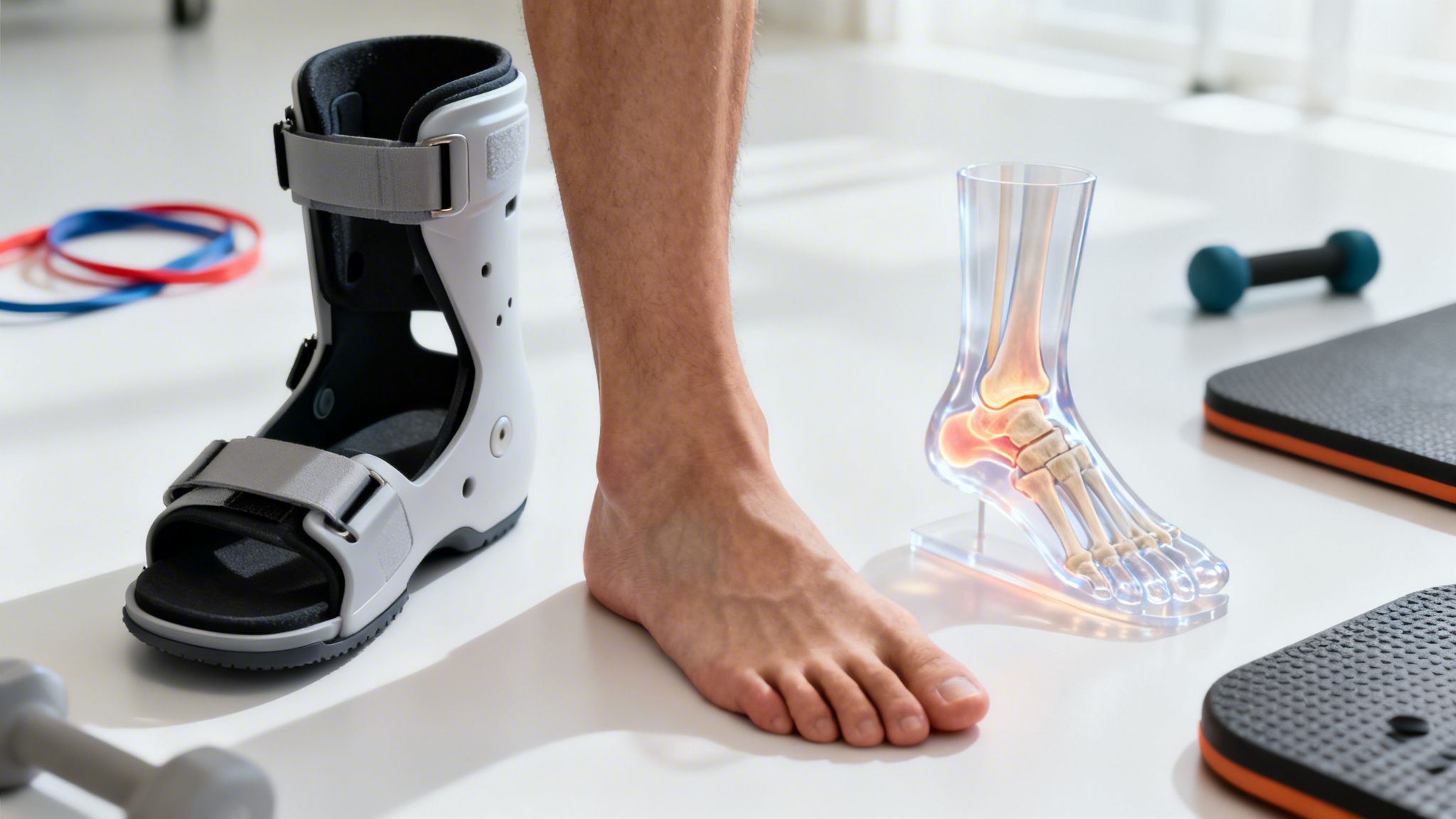
Common reasons ankles hurt
Ankle pain is usually caused by a mix of load, strength, mobility, and how your body moves. Common examples include:
- Ankle sprain (often after rolling it on a curb, stairs, or in sport)
- An ankle that keeps giving way or feels unstable (often after old sprains that never fully healed)
- Achilles pain at the back of the ankle (often hurts with running, jumping, or first steps in the morning)
- Heel or arch pain that travels up into the ankle (often plantar-related)
- Stiffness after a fracture, surgery, or long time in a boot
- Arthritis or joint changes
Want a plan that fits your ankle and your goals? Find a PT →
Quick answers about ankle pain
FAQS
When should I see a PT for ankle pain?
If pain has lasted more than a week, is limiting walking or sport, or keeps coming back, it’s time. Untreated ankle issues are the biggest reason people sprain the same ankle again.
Should I rest or exercise with ankle pain?
A brief rest period after a fresh injury is fine, but full rest usually backfires. Guided movement and loading is what builds an ankle that can trust itself again.
Do I need an MRI before I start PT?
Usually no. Most ankle problems are figured out by how they move and feel. Imaging is reserved for specific situations, and your PT will tell you when it’s needed.
I sprain the same ankle over and over. Why?
Once an ankle has been sprained, the muscles and balance reflexes around it often don’t fully recover on their own. PT rebuilds that strength and control so it stops happening.
My Achilles hurts every morning. What does that mean?
That stiffness-first-thing pattern is classic Achilles irritation. It responds well to slow, heavy calf loading and a smart return-to-activity plan — not stretching alone.
I just got out of a boot or cast. Do I really need PT?
Almost always, yes. Time in a boot leaves the ankle stiff and the muscles around it weaker than you’d think. PT restores motion, rebuilds strength, and gets you back to normal walking faster.
How long does an ankle sprain take to heal?
Most mild to moderate sprains feel a lot better within 2–4 weeks, but full strength and balance can take longer. Coming back too soon is the biggest reason ankles re-sprain — guided return matters.